
Bringing a Legend Back to Life (5124 Z)
Members of the active MG Linth club are taking on a special project during the 2019–2020 winter season: They are building a replica of Graupner’s legendary Cirrus glider model—but not in the conventional way; instead, they are using the latest materials and optimized aerodynamics.
Where Tuggen’s students attend shop class during the day, evenings are spent tinkering, building, and talking shop: Under the guidance of Sepp Mächler and Kurt Bamert, the “construction coordinator” for the Linth Model Aircraft Club, about 12 enthusiastic model aircraft pilots meet every two weeks. Each of them is building a model of the Cirrus glider. Over the course of ten evenings, they learn the next steps in the construction project, discuss the best building techniques, and exchange tips and tricks.
The model airplane, released by Graupner in 1969 with a wingspan of about three meters, is a classic and is modeled after the production aircraft flown by world champion Harro Wödl. However, Christoph Mächler, the project’s main initiator, didn’t want to simply replicate the legendary aircraft; he wanted to create something entirely new: “Our hybrid construction method, in which CFRP—that is, carbon-fiber-reinforced plastic—is clad with balsa wood, has never been seen before.” The idea came to the entrepreneur and airline pilot virtually “out of the blue”: “I was drawn to building a model that looks like the original on the outside but is in no way inferior to a modern aircraft.” Flying should be fun—with even better flight characteristics than the original and with materials that won’t sustain damage even during extreme flight maneuvers, pilot error, or strong winds. “ “The wings of the original Cirrus would sometimes come apart if you took a turn a little too aggressively,” recalls Christoph, who has already designed and built over 50 different models himself.
First, a lot of thought went into the design: How could the individual components be reinforced with carbon fiber in a way that wasn’t visible from the outside? How much thinner could the wing profile be as a result? This design, which combines traditional model-building techniques with the latest materials, improves the aerodynamic properties and makes the plane even lighter than the original. The entire structure has been optimized,
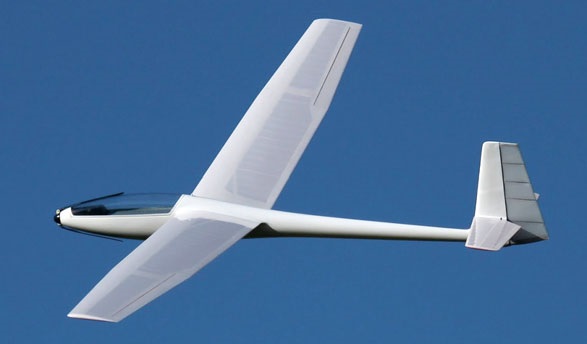
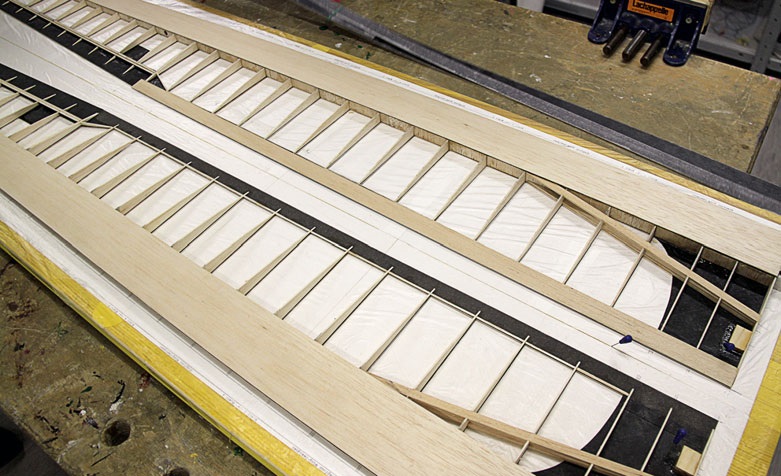
Designed for high speeds and all-weather conditions. The spars are made of carbon fiber-reinforced plastic (CFRP) and are tapered according to the forces acting on them, being slightly thicker on the inside and thinner toward the outside. The wing features open rib surfaces and is planked only at the leading edge. The ailerons—which were optional at the time—increase agility.
Although Walti Gerber CNC-milled all the components and Sepp had already coated many of them with CFRP beforehand, building a Cirrus using this newly developed construction method takes about 100 hours. One of the participants smiles: “I can really relax, especially during monotonous tasks like building the more than 30 ribs per wing.” It’s important to the model airplane pilots that the plane looks like the original—there’s no cutting corners here! For example, the original struts are indispensable, even if they no longer serve any structural purpose due to the use of better materials. The ribs aren’t simply drilled through and stabilized with a CFRP tube; instead, they’re built onto the original structure of two rib stringers so that they visually match the original. The materials aren’t cheap, but thanks to their strength, they’ll certainly mean less repair work for the pilots than planes made entirely of balsa wood—“a plane like this is easy on the nerves,” laughs one participant. The electric motor’s battery is located at the plane’s center of gravity; in strong winds, a larger—and thus heavier—battery can be used—clever!
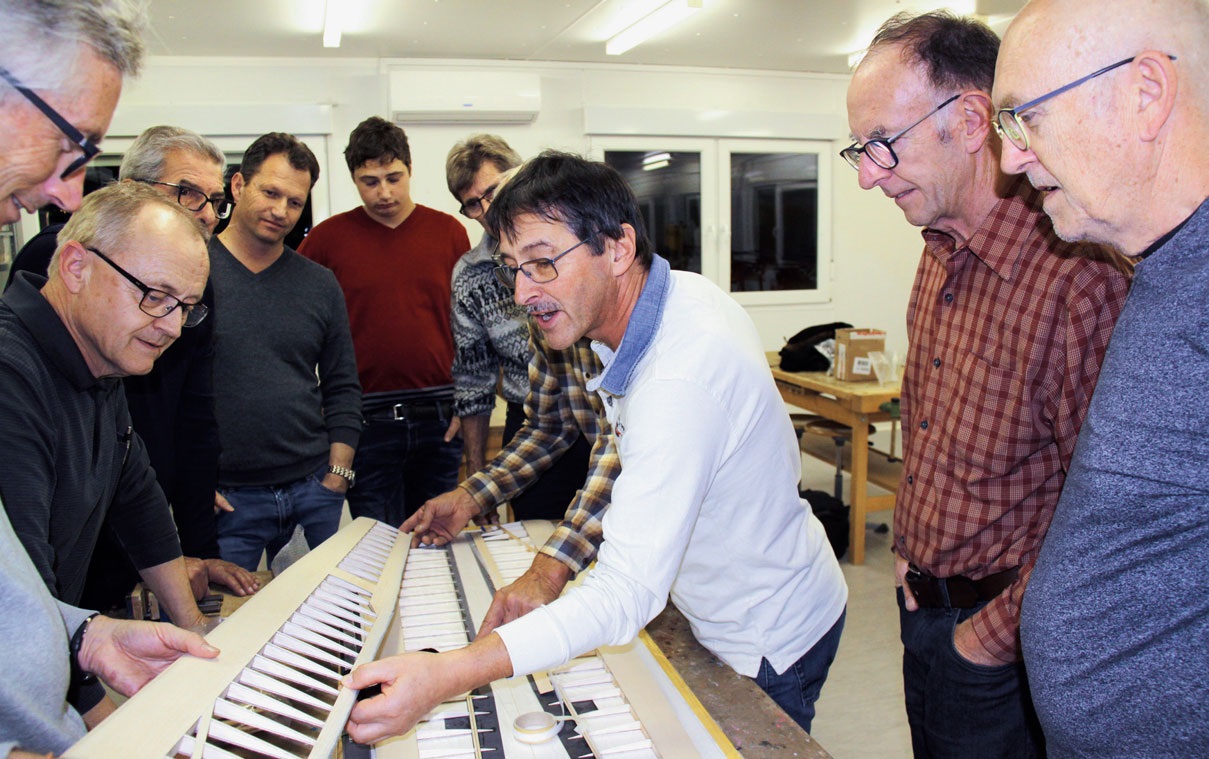
Although some course participants bring their materials with them—since they’re currently stuck or have something they want to “save”—most of the work is done at home. However, these tinkerers aren’t left to fend for themselves: Thanks to the Slack app, which works similarly to WhatsApp, the most important steps are
captured and documented through photography. Little by little, this is creating an archive of valuable tips and tricks. “At first, we wanted to shoot videos, but that turned out to be impractical,” says Christoph, a former multiple Swiss champion in the F3J category and a key co-developer of the GPS Triangle category. He found that watching the footage briefly proved tedious, and the details weren’t clearly visible enough in the videos. Now, if anyone has a question, they simply post a picture of their problem on Slack and immediately receive tips from their fellow pilots. Focused, the model builders get back to work: Will their efforts pay off? The upcoming flying season will tell, and the anticipation is already palpable. A project like this brings people together—the participants all agree on that. A joint flight day, where the newly certified Cirrus pilots will put their skills to the test, is already planned, and there’s sure to be plenty of socializing as well. ■
*Photos by Rahel Meister, Sprachwerk GmbH, Reto Diethelm, and Christoph Mächler*


News from HEBU

TEAM MANAGER "THIS" BOSSHARD
 Rodito Nussbaumer

YOU KNOW WHAT I MEAN? 125 YEARS OF THE SWISS AERO CLUB
 Emil Giezendanner

PRIDE AND GOOD IDEAS
 Markus Nussbaumer

ATOM, THE NEW DOUBLE-DECKER FROM CPLR
 Matthias Bosshard

SUMMER FUN 2026 AT MG USTER
Martin Wunderli
F3A EUROPEAN CHAMPIONSHIPS IN ST-MACAIRE, FRANCE
Matthias Bosshard
52. 2026 ALPS CUP
Emil Giezendanner
HORIZON HOBBY/LEMACO NEWS: MICRO OV-10 BRONCO 645 MM BY E-FLITE

TWIN TOWN PARTNERSHIP
Wolfgang Voeller
CORSAIR F4U – A WARBIRD WITH A MEMORABLE LOOK
Jürgen Rosenberger, Jürgen Prinz
TRY-OUT DAY AT MFV WETTINGEN
Urs Keller
WELCOME, NEW MEMBER!
Andrea Bolliger
EURO CONTEST GLIDER ACRO TOUR AUSTRIA 2026

BY YOUTH, FOR YOUTH
Lorena Betschen
INSIGHTS INTO THE HISTORY OF SEAPLANES

SMALL, MODEL-LIKE SAILBOATS
Res Dauwalder
What's New at Leomotion.com

COUPE DES ALPES – OBSERVE AND LEARN
Rodito Nussbaumer
34th HAHNENMOOS ALPINE MODEL AIRPLANE CAMP
Res Dauwalder
FREE FLIGHT IN THE MIDDLE OF SUMMER
Urs Muntwyler
THE PC-21 STORY
Emil Giezendanner
NEWS FROM HEBU
 Julia Bucher

FROM 0 TO 100
Markus Nussbaumer
MEMORIES
Wolfgang Völler
NOS REGION – A HUB FOR ELECTRIC AVIATION
Emil Giezendanner
Have you almost forgotten about aircraft that take off and land vertically?
Emil Giezendanner
DO YOU KNOW WHAT I MEAN IN THE LAND OF SMILES?
Emil Giezendanner