
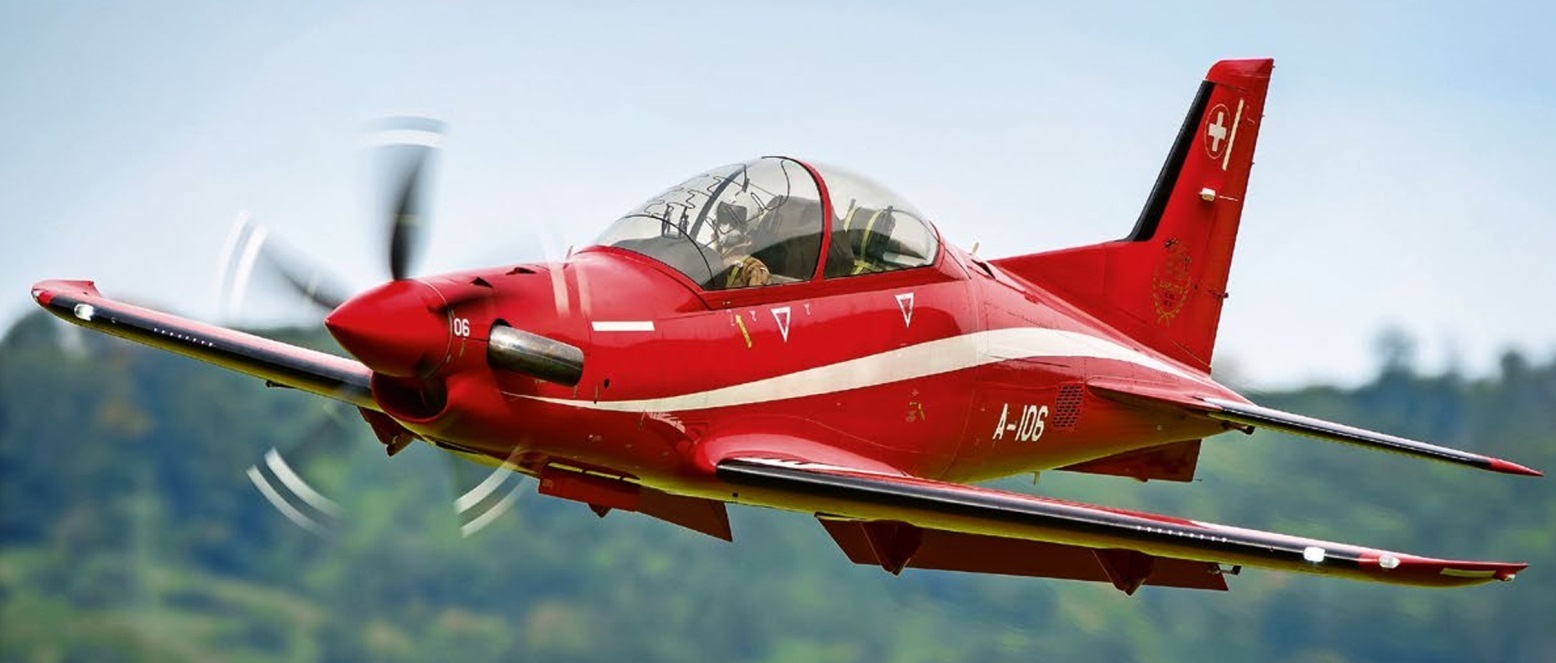
THE PC-21 STORY
THE PC-21 STORY
PC-21 models are popular and widespread in Switzerland. It would be downright cruel not to give these beautiful and elegant RC models a little more attention here at MFS. PC-21 models are available in various sizes and versions—from the perfect all-FRP model to a wooden kit. They are based on Pilatus Aircraft’s successful pilot training program.
Swiss aircraft manufacturers have always had a tough time. Nevertheless, since 1939, Pilatus Aircraft has, against all odds, achieved an international breakthrough as a successful aircraft manufacturer. The story began on December 16, 1939, with the founding meeting in the conference room of the Nidwalden Cantonal Bank; Emil Georg Bührle served as president. Construction of the factory in Stans began as early as the spring of 1940. The dedication ceremony took place on February 5, 1942, and was attended by General Henri Guisan. In addition to various maintenance and modification contracts—
the Air Force, Swissair’s DC-3s, Eidgenössische Flugzeugwerke Emmen, and licensed productions—a great deal of energy and creativity was poured into the development and construction of new aircraft. This has led, not least, to a success that is unique worldwide. The fact that Swiss politics has always had a peculiar relationship with aircraft manufacturing in Switzerland (P-16 & Co.) was not to leave Pilatus unscathed. As early as 1982, left-wing extremists carried out an arson attack on Pilatus, which is said to have destroyed four aircraft. In 2018, the Group for a Switzerland without an Army (GSoA) and other peace advocates accused Pilatus of violating the War Material Act. After various relaxations of the law in Parliament, they threatened to launch a referendum. Current reports from the front lines should demonstrate that any aircraft can be modified for military use (during the Vietnam War, even bicycles were used as combat vehicles, etc.). The wide range of aircraft—the PC-24, PC-12 PRO, PC-21, and PC-7 MKX—as well as the truly phenomenal production and sales figures amaze more than just laypeople and must, without a doubt, be described as a major Swiss pioneering achievement. Pilatus has a strong international network. The subsidiary, founded in 1998, is headquartered in Adelaide (South Australia). It coordinates sales, marketing, and support for civilian and military customers in the region. A plant opened in Broomfield, Colorado, in 2024. It is used for the final assembly of the PC-12 and PC-24.

A common thread running through the company’s 80-year history is its uncompromising focus on the future: The development and production of training aircraft for aspiring pilots—the subject of this report—began with the P-1 project, which never progressed beyond the drawing board. As early as 1945, the P-2, a two-seat trainer, made its maiden flight. The P-2 was Pilatus’s first mass-produced aircraft; 54 units are said to have been built. This was followed by a long series of training aircraft—including three WLM-1 gliders for military training purposes. As early as 1958, no fewer than 78 P-3s were delivered to the Air Force. As early as 1962, the first aircraft were sold abroad, and in 1976, series production of the PC-7 began. In 1981, the Swiss Air Force ordered 40 PC-7 Turbo Trainers. Development of the state-of-the-art PC-21 turboprop trainer began as early as 1998, with the rollout taking place in 2002. To date, Pilatus has sold between 500 and 600 PC-7s (excluding licenses) and 312 PC-21s. Pilatus is committed to the future, not only in pilot training but also in fostering the next generation of talent. In 2017, Pilatus was awarded the National Education Prize for its commitment to vocational training. Vocational apprenticeships are available in more than ten different trades.
With the PC-21, the amazing Pilatus Aircraft success story is set to come to an end here—or rather, to transition into model aircraft. Perhaps you’ll start by ordering a Pilatus model kit?
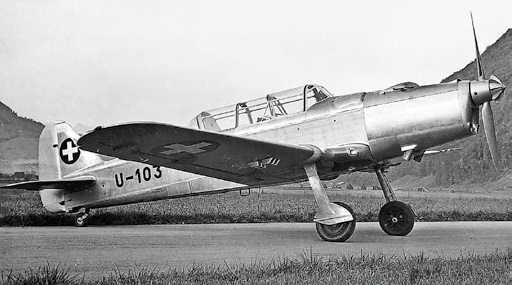
The PC-21 models available on the market cater to a variety of preferences and expectations. While some simply want to own and fly a racy motorized RC model, others want to perform a few aerobatic maneuvers or own a semi-scale model that can even be used in competitions. The aerobatics scene is completely standardized in the F3A class to biplanes with counter-rotating propellers, and serious aerobatic pilots are more or less limited to the “EXTRA” or similar models. The PC-21 offers a change of pace with little competition and also serves as a bridge between propeller models and jets. The fact that larger models can also be equipped with gas turbines—turbo-props—greatly expands their range of applications.
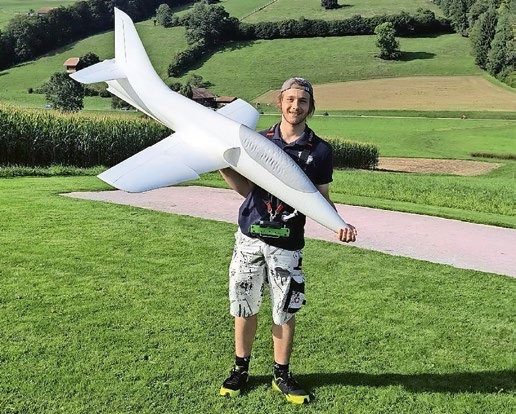
With larger models (2 m and up), covering them with film often causes problems. It turns out that film, when applied over large areas, is more prone to wrinkling. It’s therefore worth carefully considering whether to choose fiberglass or wood/film. If you want to keep costs down, you’ll have to avoid plastic models. With fiberglass models, I would also pay very close attention to the weights and, where possible, compare them: there are significant differences. This is because lightweight plastic models must be manufactured much more carefully—usually using a vacuum process—and are accordingly more expensive. For smaller models, covering them with film is not a problem. (State-of-the-art films are much more expensive, but they hold up well in sun and rain. Unfortunately, I’m not aware of any models available for purchase.) New production methods are on the rise: 3D printing!
The smaller PC-21 50e is probably the most common model. With a speed of 5 to 6 S and a weight of about 3 kg, this elegant plane is easy to handle and fits right in with many of Sebart’s other models. The construction—wood reinforced with carbon fiber—is nearly identical across all models. Minor improvements, such as reinforcements, are made almost continuously to models that sell well. The PC-21 50e is a high-speed semi-scale model with a three-legged retractable landing gear that stands out pleasantly from the familiar motorized models.
Much of what is described above also applies to the PC-21 XL, including its construction and elegant appearance. Compared to its smaller counterpart, however, it requires a much greater amount of effort. This includes the design for both combustion and electric motors. Over the years, Sebart has made several modifications. These are undoubtedly beneficial but require some extra effort on the part of the user. For example, the new retractable landing gear is of good quality but requires adjustments to the covers. The recommended Hacker Q80 M motor does not fit either the specified spacer bolts (11 mm too long) or the marked placement on the motor bulkhead. Whether the three-piece wing is an advantage or a disadvantage is a matter of debate. In any case, it’s impractical that the wing is bolted to the fuselage from below, requiring the rather bulky model to be laboriously turned over and placed on its landing gear. Securing the very attractive canopy with four M3 screws is quite a crude process. At 9.5 kg, the model is light for its size and offers experienced pilots very good flight characteristics and limited aerobatic capabilities.
Phoenix Model (Vietnam) offers three ARF PC-21 models. The quality is decent. In some cases, details—such as the wing and tail assembly—have been handled in very creative ways. The wood-and-foil constructions are moderately lightweight and sturdy. The Phoenix PC-21, with a wingspan of 1.772 m and a weight of 7.5 kg, is roughly the same size as an F3A model—but is significantly heavier. It’s easy to handle and fits in a mid-size car. The fuselage is supplied in two parts.
The instruction manuals are clearer and more detailed than those from Sebart. The fiberglass model weighs 16 kg with a turboprop engine. Equipping models of this class with electric motors is not practical or is far too time-consuming.
The choice isn’t easy. In my view, models that require a lot of flight preparation and/or are large and cumbersome to handle aren’t suitable for daily use. For frequent flyers, the effort involved in transport and assembly shouldn’t be any more time-consuming than for an F3A model.
*Source: Pilatus Aircraft*
*Photos: M. Waldmeier and O. Jacob*
Read the full article
Sign up or log in to read the full article.

News from HEBU

TEAM MANAGER "THIS" BOSSHARD
 Rodito Nussbaumer

YOU KNOW WHAT I MEAN? 125 YEARS OF THE SWISS AERO CLUB
 Emil Giezendanner

HORIZON HOBBY/LEMACO NEWS: MICRO OV-10 BRONCO 645 MM BY E-FLITE

PRIDE AND GOOD IDEAS
 Markus Nussbaumer

34th HAHNENMOOS ALPINE MODEL AIRPLANE CAMP
Res Dauwalder
TRY-OUT DAY AT MFV WETTINGEN
Urs Keller
F3A EUROPEAN CHAMPIONSHIPS IN ST-MACAIRE, FRANCE
 Matthias Bosshard

52. 2026 ALPS CUP
Emil Giezendanner
ATOM, THE NEW DOUBLE-DECKER FROM CPLR
Matthias Bosshard
SUMMER FUN 2026 AT MG USTER
Martin Wunderli
What's New at Leomotion.com

COUPE DES ALPES – OBSERVE AND LEARN
Rodito Nussbaumer
TWIN TOWN PARTNERSHIP
Wolfgang Voeller
BY YOUTH, FOR YOUTH
Lorena Betschen
CORSAIR F4U – A WARBIRD WITH A MEMORABLE LOOK
Jürgen Rosenberger, Jürgen Prinz
SMALL, MODEL-LIKE SAILBOATS
Res Dauwalder
WELCOME, NEW MEMBER!
Andrea Bolliger
FREE FLIGHT IN THE MIDDLE OF SUMMER
Urs Muntwyler
EURO CONTEST GLIDER ACRO TOUR AUSTRIA 2026

INSIGHTS INTO THE HISTORY OF SEAPLANES
THE PC-21 STORY
Emil Giezendanner
NEWS FROM HEBU
 Julia Bucher

FROM 0 TO 100
Markus Nussbaumer
MEMORIES
Wolfgang Völler
NOS REGION – A HUB FOR ELECTRIC AVIATION
Emil Giezendanner
DO YOU KNOW WHAT I MEAN IN THE LAND OF SMILES?
Emil Giezendanner
Have you almost forgotten about aircraft that take off and land vertically?
Emil Giezendanner