
WELCOME, NEW MEMBER!

The SMV brings together about 8,000 members—but that number is steadily declining—by more than 100 each year. So model aviation could use some new blood. But how do you attract them, and what exactly does “a welcoming culture” mean?
People join a club because they want to deepen their interest in a particular activity and to pursue that activity with like-minded people. The club, in turn, is typically interested in new members who participate in club activities, remain active in the club, and—depending on their skills and availability—may later take on a role on the board or within the association. Thus, the welcoming culture must extend far beyond the initial introductory phase.
The SMV expects clubs to take an active role in recruiting young talent, for example by organizing “Ferienpass” events and youth days. Public relations efforts and good relationships with schools would also be desirable. “The club must also have a plan for what it wants to and can continue to offer young people after the vacation programs. It needs members in the role of a ‘junior or youth development coordinator’ who will take charge of the young athletes. Ideally, they should be integrated into the club’s board so that information flows freely and the young people feel valued and fully included,” says Martin Schneebeli on behalf of the SMV board. How difficult it is to implement youth projects successfully and sustainably becomes clear in practice.
It’s mostly teenagers who sign up for the model-building course offered by the Staffelbach Model Flying Club. During the winter months, they spend 10 to 12 evenings building a model under the expert guidance of Adrian Hunziker and other club volunteers. You might think this means plenty of new blood for the group, but Hunziker, who also serves as the group’s youth representative, puts things into perspective: “Most participants still come for their first flight, but after that, you don’t hear from many of them anymore—despite offers like guided flying.” Not even the prospect of participating in the club’s internal gliding competition brings them back to the airfield. For Hunziker, this is all the more surprising because the model and accessories cost around 500 francs and so many evenings were invested. Similar experiences have been reported over the past few years at the Young Silent Wings workshop (see article in the last issue).
Parental support plays a major role in whether young people continue with such projects. “The airfields aren’t right around the corner, and transporting all the equipment also requires some logistics with parents or other helpers,” says Schneebeli. Added to this is the fact that young people or their parents have other commitments whose schedules conflict with training sessions. It’s nothing new that young people’s interests shift quickly and they end up giving up model flying. Nevertheless, the association is committed to youth when it comes to promoting the next generation. “It makes a lot of sense to engage young people early on and ‘infect’ them with a passion for model flying.” Many end up moving to a different location later on or pursue a career in another branch of aviation. At this stage of life, work, family, or other hobbies take priority. Later, when you have more time again, you remember model aviation and pick it up where you left off,” says Martin Schneebeli.
N.P. (name known to the editors) discovered model aircraft flying as a child through a family of friends who took him to the airfield with their son. When it came time to join the local club, the club turned him down because N.P. lived in a different canton. “It was a long time ago, but the issue existed even back then. Here’s a young person, and they won’t accept him.” This gives the man—now an adult—pause for thought. “It wasn’t as if they had reached their capacity limits, either.” Other children and teenagers might have given up on their dream of taking up model flying at that point. But his father looked around for other clubs. Eventually, they were accepted into another group—also outside their home canton. He recalls that even there, some members resisted their admission. N. P. is now a member of several clubs. When it comes to being accepted and integrated into a club, there are differences, says N. P. “When I was younger, some members were dismissive and aloof toward me.” Questions like “What’s he doing there? Can he do that?” made him feel uncomfortable. “Then there’s the opposite—when the other members approach you, talk to you, and ask questions. That makes you feel at ease right from the start!” For N.P., a welcoming culture means members approaching a newcomer without prejudice and accepting him without requiring him to prove himself first. That’s all it takes. Social interaction is important to him. This can also include having a meal or a drink together after flying.
Many people foster a welcoming atmosphere without even realizing it, because it happens naturally. When Adrian Hunziker was watching a boy fly a model plane, he asked him if he had anything “remote-controlled” at home. “Cars,” the boy replied. Hunziker asked if he was interested in model airplanes. The boy said yes and added that he didn’t have the money for one. Hunziker offered to bring a dual-control model to the airfield one day and let him try it out. “I gave him my email address. No sooner had I gotten home than I already had a message from him in my inbox. He could hardly wait to meet me at the airfield each time, and was one of those who could fly on their own by the end of the year,” says Hunziker. “He took the aircraft-building course and was active in the club for a long time. He’s now friends with my son. For the time being, he’s given up flying. The boys are now in school and have other interests.”
Hunziker is drawing conclusions from the feedback on the model-building course: “We’re turning the system on its head and organizing a casual flying event this fall where everyone can try flying a dual-control model. The idea is to draw the attention of those who discover an interest and talent for model flying to the model-building course in the winter. Until the course begins, they can fly with us four to five times. That should be an incentive to keep flying the model they built themselves.” Hunziker has other ideas on how to get young people excited about model flying and club life. “We could take a gasoline engine apart and put it back together with the kids, then install it in a model and tune it. Soldering is almost part of everyday life in model building. We could show the kids that, too. It would also be valuable to cover topics related to electronics and battery voltage.” Field trips, such as to the model-building fair in Friedrichshafen, would also be an option. The MFV Wettingen demonstrated just how easy it can be to organize an open house. They distributed flyers in the surrounding area, which resulted in about 20 sign-ups. And even if only a fraction of these trial participants discover model flying as a new hobby, the club has still provided a positive experience for some neighbors. A welcoming culture is therefore neither complicated nor a science, but simply the opposite of rejection: being open to those who are interested, willing to explain your hobby, and eager to share your knowledge. ■
*Andrea Bolliger*
Read the full article
Sign up or log in to read the full article.

News from HEBU

TEAM MANAGER "THIS" BOSSHARD
 Rodito Nussbaumer

YOU KNOW WHAT I MEAN? 125 YEARS OF THE SWISS AERO CLUB
 Emil Giezendanner

PRIDE AND GOOD IDEAS
 Markus Nussbaumer

ATOM, THE NEW DOUBLE-DECKER FROM CPLR
 Matthias Bosshard

SUMMER FUN 2026 AT MG USTER
Martin Wunderli
F3A EUROPEAN CHAMPIONSHIPS IN ST-MACAIRE, FRANCE
Matthias Bosshard
52. 2026 ALPS CUP
Emil Giezendanner
HORIZON HOBBY/LEMACO NEWS: MICRO OV-10 BRONCO 645 MM BY E-FLITE

TWIN TOWN PARTNERSHIP
Wolfgang Voeller
CORSAIR F4U – A WARBIRD WITH A MEMORABLE LOOK
Jürgen Rosenberger, Jürgen Prinz
TRY-OUT DAY AT MFV WETTINGEN
Urs Keller
EURO CONTEST GLIDER ACRO TOUR AUSTRIA 2026

BY YOUTH, FOR YOUTH
Lorena Betschen
INSIGHTS INTO THE HISTORY OF SEAPLANES

SMALL, MODEL-LIKE SAILBOATS
Res Dauwalder
What's New at Leomotion.com

COUPE DES ALPES – OBSERVE AND LEARN
Rodito Nussbaumer
34th HAHNENMOOS ALPINE MODEL AIRPLANE CAMP
Res DauwalderWELCOME, NEW MEMBER!
Andrea Bolliger
FREE FLIGHT IN THE MIDDLE OF SUMMER
Urs Muntwyler
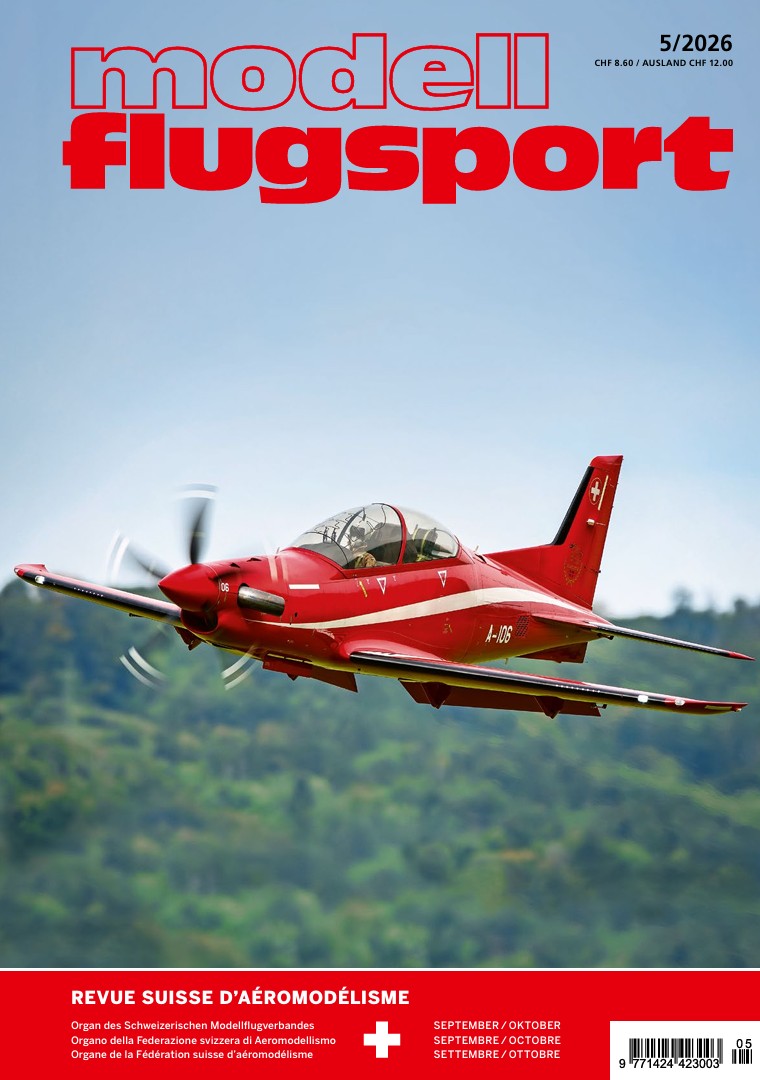
THE PC-21 STORY
Emil Giezendanner
NEWS FROM HEBU
 Julia Bucher

FROM 0 TO 100
Markus Nussbaumer
MEMORIES
Wolfgang Völler
NOS REGION – A HUB FOR ELECTRIC AVIATION
Emil Giezendanner
Have you almost forgotten about aircraft that take off and land vertically?
Emil Giezendanner
DO YOU KNOW WHAT I MEAN IN THE LAND OF SMILES?
Emil Giezendanner