
EURO CONTEST GLIDER ACRO TOUR AUSTRIA 2026

On the occasion of the Euro Tour Glider Acro Competition in Austria, we’d like to introduce you to three pilots (one Swiss, one German, and one Austrian). They’ve agreed to answer a few questions for us and share their passion for glider aerobatics.
Oliver Rentsch (SUI): My name is Oliver Rentsch. I’ve been flying model airplanes since fifth grade. Then, at our model airfield, I saw the aerobatic glider pilots training. And I thought, if they can do that, so can I. So I bought a model. With my budget, that was (only) enough for a Lo-100 with a 3.5-meter wingspan. And that’s when I got hooked.
Armin Kölblin (GER): I’m Armin, 31 years old, and I’ve been competing in aerobatic gliding since 2011. I’ve been flying in the Unlimited class for 13 years.
Martin Knasmillner (AUT): Martin Knasmillner, National Technical Advisor for glider aerobatics in Austria. I’ve been overseeing the class throughout Austria since 1999 and have been flying in it myself since then as well. I’ve been flying in the Unlimited class ever since it was established.
OR: What really fascinates me about sailplane aerobatics is that there’s simply one attempt. You start at a certain altitude, and you have to complete all the maneuvers before you reach the ground. And you can’t just give it a quick burst of throttle like in other categories. Everything simply has to be just right, and achieving that level of precision really fascinates me.
AK: In general, compared to powered flight, I find it very interesting that you basically have to do everything with speed and momentum. That’s also part of the appeal of the whole thing: that it’s classic, silent, and precise. I also find the camaraderie with the other pilots very interesting and wonderful. I also like the structure of the programs: that we always fly a known compulsory routine, an unknown one, and then the freestyle routine.
MK: The beauty of the glider aerobatics scene is that it’s a very friendly class. It’s not really a competitive class, so to speak, but rather a gathering place for friends who practice the sport together. For me, that’s actually the most important thing, and it’s also the most fun. On top of that, there’s the silent aerobatics. That adds another special thrill to the experience.
OR: Right now I’m flying a really old Swift S1 with a 4.5-meter wingspan and a Rosenthal fuselage. And someone built the wings themselves at some point. This plane has had something like four previous owners.
AK: I fly a Bruckmann Swift with a 5.80-meter wingspan, on a 1:2.2 scale, powered by an FES motor. Before that, I had the smaller Swift from Bruckmann Modellbau with a 4.70-meter wingspan. Two years ago, I switched to the larger Swift. In general, they fly similarly in terms of handling. But because of its size, it’s a whole different mass that you’re pushing through the air and that moves through the air. That’s a ton of fun.
MK: I fly a Foka 4 with a 6.30-meter wingspan. I also fly a Foka with a 5-meter wingspan. The model with a 6.30-meter wingspan weighs 17.5 kg, and the one with a 5-meter wingspan weighs 11 kg. These models aren’t run-of-the-mill, which is why I enjoy flying them so much. They might not be the ideal aircraft for aerobatics, but they just look great and fly beautifully.
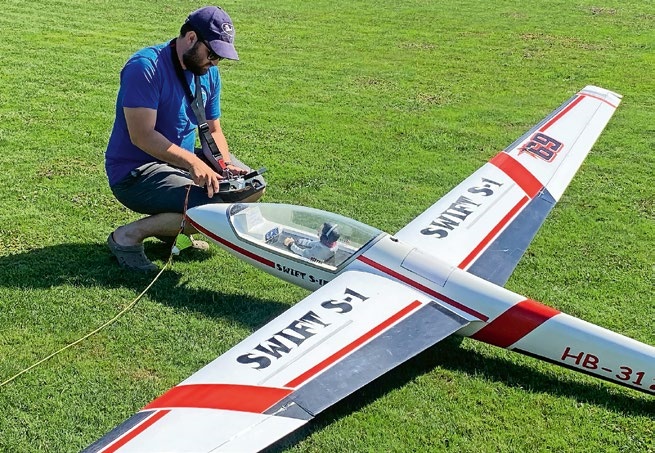
OR: The Swiss Acro Connection offers two open house days each year. I signed up for one of them. They gave me a lot of help with setting up the model. And then I was practically already signed up for my first competition. It’s actually a great way to get started: you jump right in, and they help you, support you, and that’s where you learn the most. Skill comes with experience.
AK: It’s definitely very important not to be afraid. We may all be pilots competing against each other, but we’re still one big family.
We support each other whenever we can. If you know someone, you can just talk to them. Or you can go to a competition, talk to someone there, and say you’re interested.
MK: For a beginner, I’d first recommend a glider aerobatics model—which you can always get for a reasonable price—with a wingspan of about four meters to get started. In any case, they should get in touch with a pilot who’s already active in the scene. The most important thing in glider aerobatics is that the model is set up correctly, so you’re not struggling with the model’s quirks but can focus on the maneuvers.
Read the full article
Sign up or log in to read the full article.

News from HEBU

TEAM MANAGER "THIS" BOSSHARD
 Rodito Nussbaumer

YOU KNOW WHAT I MEAN? 125 YEARS OF THE SWISS AERO CLUB
 Emil Giezendanner

ATOM, THE NEW DOUBLE-DECKER FROM CPLR
 Matthias Bosshard

SUMMER FUN 2026 AT MG USTER
Martin Wunderli
F3A EUROPEAN CHAMPIONSHIPS IN ST-MACAIRE, FRANCE
Matthias Bosshard
52. 2026 ALPS CUP
Emil Giezendanner
PRIDE AND GOOD IDEAS
 Markus Nussbaumer

CORSAIR F4U – A WARBIRD WITH A MEMORABLE LOOK
Jürgen Rosenberger, Jürgen Prinz
TRY-OUT DAY AT MFV WETTINGEN
Urs Keller
TWIN TOWN PARTNERSHIP
Wolfgang Voeller
BY YOUTH, FOR YOUTH
Lorena Betschen
INSIGHTS INTO THE HISTORY OF SEAPLANES

SMALL, MODEL-LIKE SAILBOATS
Res Dauwalder
What's New at Leomotion.com

HORIZON HOBBY/LEMACO NEWS: MICRO OV-10 BRONCO 645 MM BY E-FLITE

COUPE DES ALPES – OBSERVE AND LEARN
Rodito NussbaumerEURO CONTEST GLIDER ACRO TOUR AUSTRIA 2026

34th HAHNENMOOS ALPINE MODEL AIRPLANE CAMP
Res Dauwalder
WELCOME, NEW MEMBER!
Andrea Bolliger
FREE FLIGHT IN THE MIDDLE OF SUMMER
Urs Muntwyler
THE PC-21 STORY
Emil Giezendanner
NEWS FROM HEBU
 Julia Bucher

FROM 0 TO 100
Markus Nussbaumer
MEMORIES
Wolfgang Völler
NOS REGION – A HUB FOR ELECTRIC AVIATION
Emil Giezendanner
Have you almost forgotten about aircraft that take off and land vertically?
Emil Giezendanner
DO YOU KNOW WHAT I MEAN IN THE LAND OF SMILES?
Emil Giezendanner