
...and all the way up to the stratosphere
Twenty centimeters of fresh snow fell overnight—the best powder. The sky is cloudless, the skis are waxed, but once-passionate skiers are ignoring them—what happened? The sky is steel-blue with excellent visibility—the most beautiful flying weather! Anyone stuck in the lowlands, shrouded in high fog, can hardly imagine that somewhere in the mountains, above the fog line, half a dozen large model gliders are circling the peaks...
We can’t really do that in the middle of winter—but we can fly along slopes and in thermal currents, starting from the valley floor! Stable weather conditions (Bise, Föhn) bring us high-altitude winds in which we could fly “along the slope”—that is, at a safe distance from the mountain—sometimes all the way up to the stratosphere, with the climb rate increasing continuously with altitude. A vario is helpful here. Thanks to the excellent visibility, this is also possible without one, though I recommend using “wing depth × 4,000” as a guideline for the altitude, which is still clearly visible. Visibility depends more on the depth of the glide than on the wingspan. From Lake Davos, reaching 1,500 m above the launch site is easily possible.
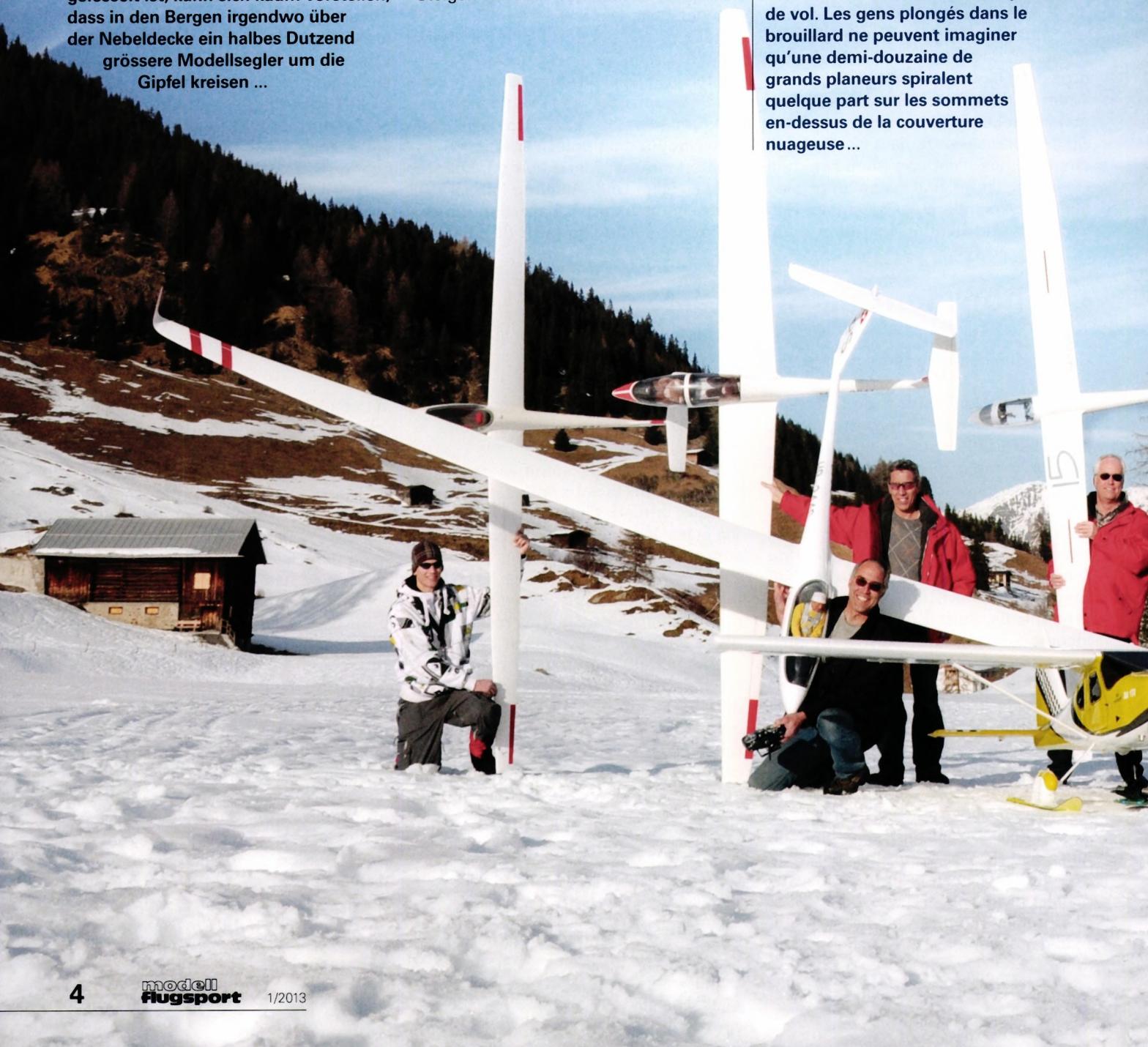
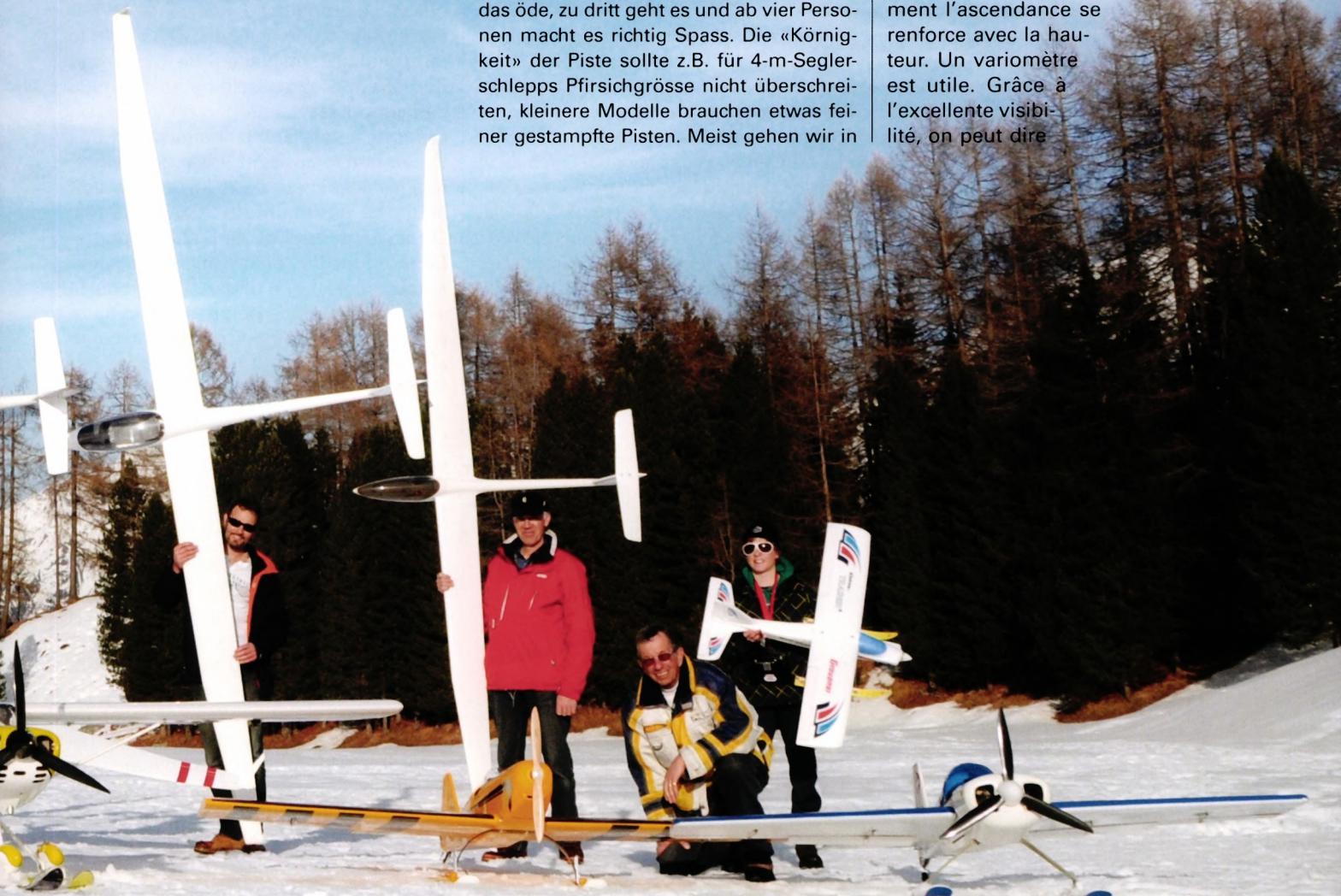
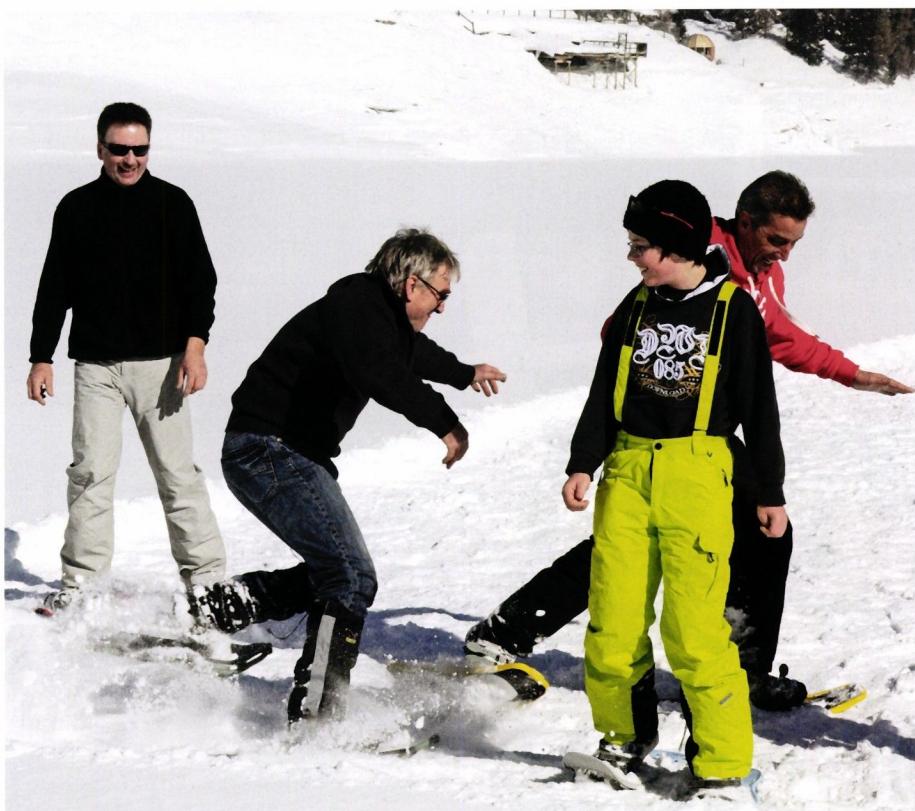
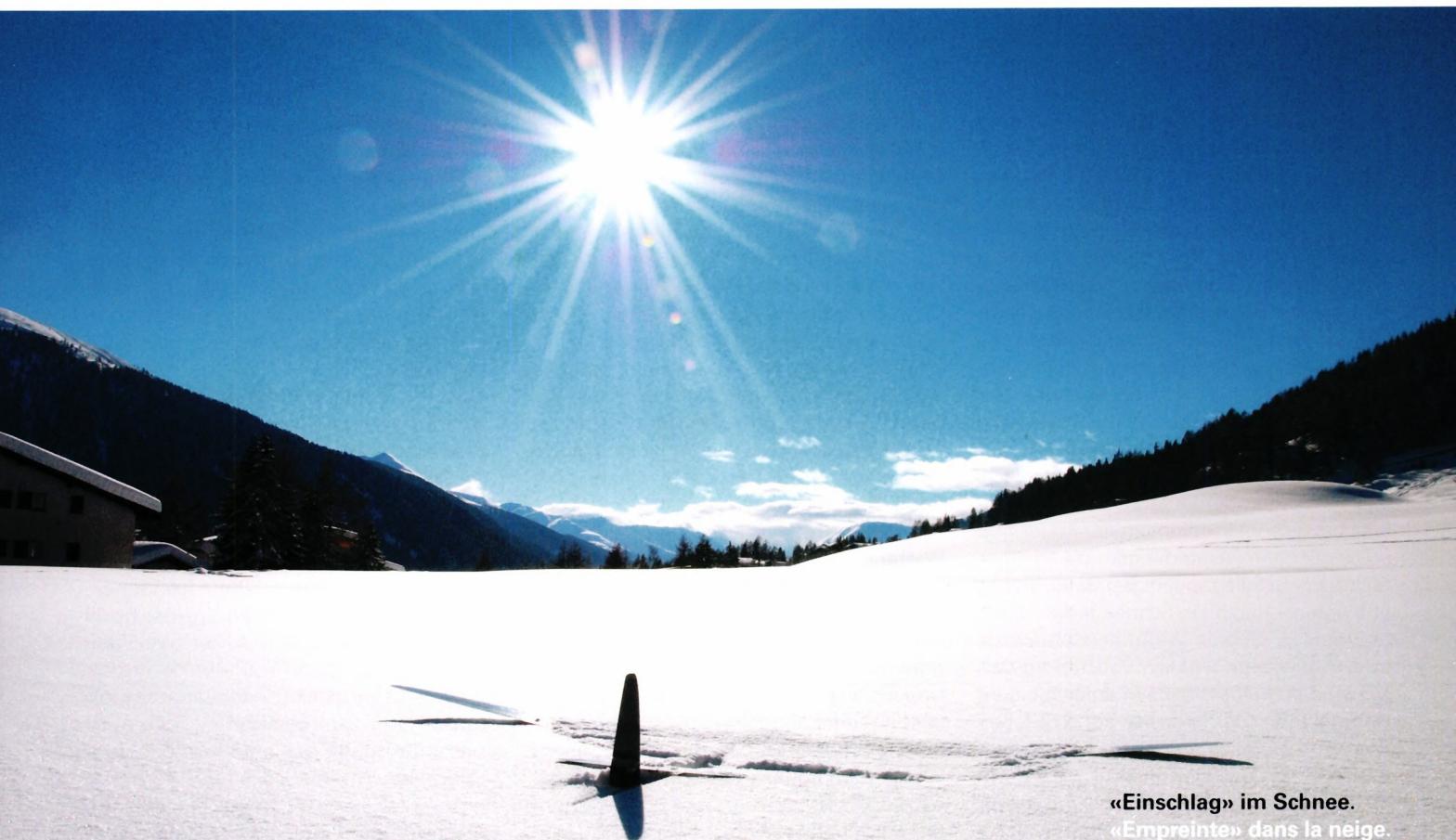
From black-frozen ice to deep snow: Flying is always possible, as is towing. We’ve only had one instance where there was so little snow on the hard ice that we could have flown on wheels instead of skis. In such cases, you have to expect the glider to slide an incredibly long distance during a belly landing. Normally, however, we have to pack down a runway with snowshoes: it’s tedious with just two people, manageable with three, and really fun with four or more. The “grain size” of the trail shouldn’t exceed peach-sized grains, for example, for 4-meter glider tows; smaller models require slightly finer-packed trails. We usually make four passes over the snow in clearly overlapping tracks. For 20-kg towing combinations, a 10 × 60 m area should be sufficient. We slope the front edge of the trail (in the direction of flight). In the launch area, the apron next to the runway is packed. Around it, the gliders lie in the snow—on a mat if the snow is deep, or in a small packed parking bay.
All of the following guidelines apply exclusively to our Lake Davos! Every lake can be different, but deep lakes with little current are likely to have similar conditions. The situation is quite different, however, on frozen flowing bodies of water. When the lake is frozen, the “safety officer” —known as the “Ice Saint”—carefully steps onto the ice, secured with a mountaineering rope, and drills through the ice every few meters using a cordless drill with a 10 × 500-mm twist drill bit. If the effective ice thickness is less than 15 cm, the ice is not deemed safe, and there’s no point in venturing away from the shore. Here, the ice usually gets thicker than 40 cm in winter, so we hardly have to worry. Surprisingly, the ice is almost always the same thickness: so if it’s 32 cm near the shore, our other drill holes—all the way out to the middle of the lake—are usually 31 to 33 cm as well. The ice builds up differently depending on frost conditions and snowfall amounts. It’s important to know that fallen snow can push the ice below the water’s surface! Then we end up with a slush layer—for example, 10 cm of ice, topped by 15 cm of water-soaked snow, and then 30 cm of normal snow. When walking across the ice, you’re in for a nasty surprise! However, compacting the snow with snowshoes ensures that the insulating layer of snow—which acts like Styrofoam (!)—disappears, and the slush freezes solid overnight: this has already saved a major flying day for us. Nowadays, though, we avoid flying on the lake immediately after heavy snowfalls and wait 14 days.
Even thick layers of frozen ice have holes in them! You can spot them by the bird tracks that converge on them in a star shape. In Lake Davos, they occur about every 100 meters, are about 10 to 20 cm in diameter, but have almost perfectly vertical ice walls, like a stovepipe. You can safely walk right up to the edge, and every few years one of us actually stumbles with a foot into one of these snow-covered holes and gets a wet foot—but you can’t fall through. River and Stream Mouths: No rivers flow into Lake Davos, but several streams come down from the surrounding slopes. At their mouths, open patches form in the ice, which, surprisingly, regains full thickness just 1 to 2 meters from the open water.
Even without a Föhn or Bise, gliding through the blue sky is simply beautiful. You can glide gently through the “gained” meters or tackle them with the more experienced gliders in an aesthetically pleasing way. Weather conditions that cause fog in the Mittelland are generally stable, so there is hardly any vertical air movement. Strong air currents only occur above a certain altitude. In the Davos area, this is usually around 400 m above the lake (approx. 2,000 m above sea level), which is the altitude to which you must tow the glider. For this reason, a minimum wingspan of about 4 m for normally stretched gliders (based on a 15-meter prototype) has become the standard here for meaningful flights. It’s possible for there to be complete calm over the lake, yet for snow plumes to be blowing up on the summit ridges. Since winter winds are usually steady and not turbulent, such snow plumes aren’t a deterrent—on the contrary, you just have to get there... When the Bise blows, the high-altitude wind accumulates at the Seehorn; when the Föhn blows, it accumulates at the Parsenn—both are flying areas where we regularly fly one-hour or thousand-meter flights. Thermals usually set in over the closed snow cover starting in March. They often break up over the first snow-free patches of forest and grow stronger as they rise. There is one major, truly serious weather hazard: cirrus clouds. These can form locally at astonishing speeds. Anyone flying a pure white glider at an altitude of 800 m above the Parsenn will suddenly have visibility problems. For this reason, it’s advisable to leave the best thermal when high clouds begin to form and reposition yourself a few hundred meters lower. The color scheme of the undersides also helps with this problem. As a rule, it’s newcomers to winter flying who fall into this visibility trap: When illuminated from below—through the snow cover—a white glider can truly disappear completely into thin altocirrus or altostratus clouds. When flying against a dark blue sky, the pilot must be prepared for a surprise: dark blue models become invisible. The color scheme that works well under a whitish summer sky is completely useless—the glider disappears entirely. Over snow, there’s only one color for the underside: white. This is the perfect opportunity to fly and spot large scale gliders—which sometimes pose a challenge due to their coloring in the summer—over the greatest distances. The reason is the sunlight reflected by the snow cover. However, visibility is also the only objective hazard when flying in winter. The advantages far outweigh the disadvantages: First and foremost is the soft snow cover, which has already saved countless models. It lies across the entire landscape like a single carpet of foam, and if you’re lucky, it even absorbs vertical impacts so effectively that there is little or no damage.
What many people can’t imagine is how little it actually feels like it’s cold sometimes. Body heat isn’t carried away by the air, but only by the humidity. In our high valley, we once had a relative humidity of just 4% at 16 °C in the winter—which corresponds to a water vapor content of 0.02% relative humidity (!) at +25 °C. Air this low in moisture is virtually impossible to reproduce artificially. On that day, we flew without gloves. Even otherwise, as long as only light winds are blowing (which is often the case in the valleys in winter), it’s surprisingly warm because the snow-covered slopes around us reflect the sun’s rays. In March, we’ll surely spend a few days flying in just a T-shirt, so to speak. It’s only the wind that picks up in the afternoon that forces us to put on a jacket. Hand and transmitter protection: Pilots using console transmitters like to fly with a transmitter windscreen, while those using handheld transmitters wear gloves. Salewa makes some great fold-up mittens with cut-off individual fingers underneath: highly recommended. We Davos locals are pretty weather-hardened by now. Newcomers to the lake may get horribly sunburned. The neck, ears, and the undersides of the forearms are particularly at risk when you roll up your sleeves in the heat. For our eyes, we now wear sunglasses with wide side shields or leather frames to protect against glare. Spending a day in the snow means cold feet. The fairly inexpensive, huge brown lace-up boots with white “fur lining”—which, like so many things, come from China—have proven to be very reliable... In any case, the boots must be waterproof. The fact that model flying provides enough sun and serotonin to combat the winter blues even in winter just tops it all off.
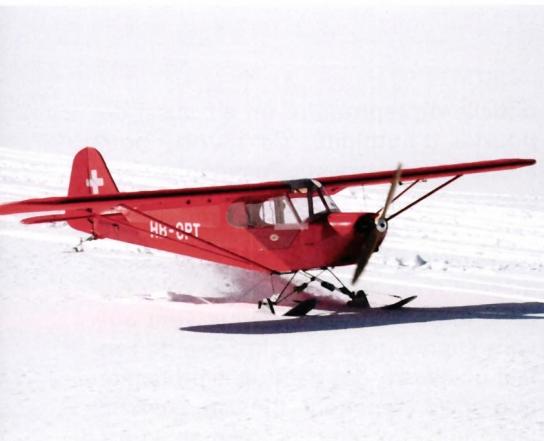
In deep powder snow, you can take off and land very well with floats. On packed snow or even ice, however, you must use floats with a hard surface: Balsa covered with foil gets mercilessly scraped away, and EPP suffers as well. The following types of skis are available:
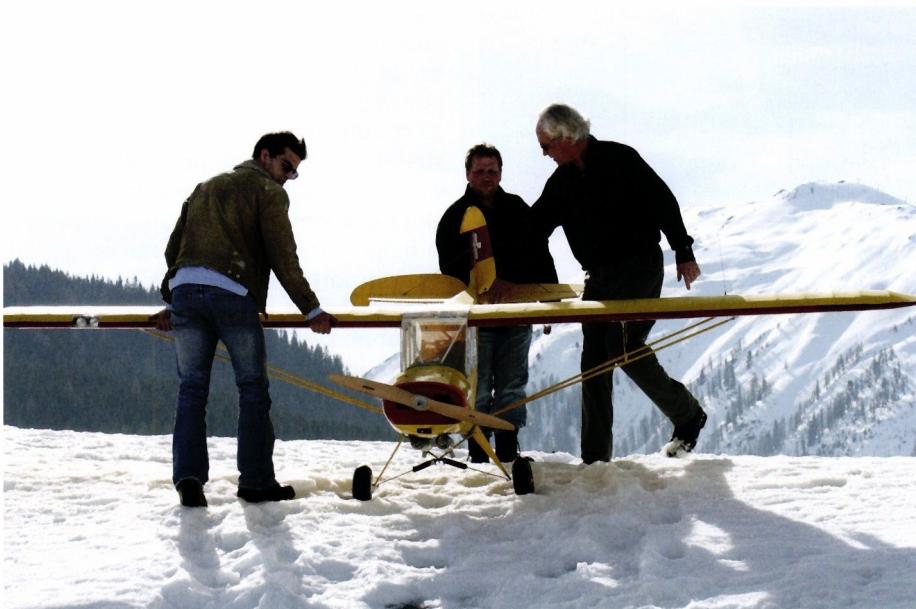
- Short, prototypical “barrel staves” for scale models, such as those on the TC-Piper in our club. They don’t track as well as long, narrow skis and are therefore somewhat more difficult to handle in crosswinds or on slopes that slope to one side.
- Long, narrow skis—most simply, the tips of cross-country or alpine skis. The “floating beam” with a 200 cm³ engine displacement, which is often seen on our lake, and similar junk even fly with full-length alpine skis.
- Mini skis—We still use the rubber duck-like Wingo skis and similar models on our fun planes: Acromaster, Sebart Su-29, etc. However, they require neatly packed runways.
Taildragger models can be equipped with either three skis (three-legged) or two skis (four-legged). For tow planes and larger models, the version with a tail ski is preferable because it allows for better control during the takeoff run. Important: The tiny tail ski is also equipped with a vertical “keel”—this greatly improves steering effectiveness! Towing in snow is like towing in water. It’s unbelievable how snow can get inside the fuselage through even the tiniest cracks. For this reason, moisture-sensitive components such as receivers or controllers should not be mounted at the bottom of the glider’s fuselage keel, as a puddle can easily form inside the fuselage. The glider’s retractable landing gear is completely sealed with fabric tape. Fixed landing gear (as on the Salto) is removed, and the holes are sealed with tape. On gliders, the tail wheels are left in place but sealed tightly—otherwise, they act like small excavators, stuffing the tail tube full of snow. The air intakes on electric models are also sealed. We do not use additional sealants such as liquid rubber for controllers and receivers, etc. Strict flying discipline during landing is also essential: the gliders’ spoilers must be retracted before the glider plunges into the snow! Only at temperatures below –15 °C does the snow remain “powdery” enough that you might be able to blow it completely out of the spoilers’ housings. Especially at temperatures just above zero on the ground and just below zero in the air, the flaps tend to freeze solid due to snow in the compartments.
The topic of “batteries” can be covered quickly: NiMH batteries are the least tolerant of cold. NiCd batteries are no longer available commercially, and the high resistance of older batteries is exacerbated by the cold. LiPo: We’re increasingly using them even in colder conditions. Charge only to 4.1 V! We store the flight batteries in a simple insulated box until just before use: A camping cooler is filled with one or two hot water bottles (filled with boiling water)—this keeps them warm throughout the entire flying day. LiFePo batteries are best suited for cold conditions. Most of our winter gliders are now equipped with 2S 1230 Ah batteries plus a linear regulator as the receiver power supply—we’ve had no problems since then. Fast 2.4 GHz systems and power-hungry digital servos have generally led to a rethinking of power supply strategies. But electronics also have their pitfalls: Some motor controllers from China refused to work below –15 °C. The servos all work—but we don’t use cheap servos. There’s a simple way to determine whether a model aircraft is cold-weather-ready: let it freeze overnight on a really cold night (everything except the batteries) and test it the next morning before sunrise to see if everything works.
We usually meet at 11. It’s often still too cold any earlier. Every pilot brings snowshoes, and one or two also have the thermal cooler mentioned earlier, where the LiPo batteries are stored. If the ice isn’t yet 40 cm thick, we usually bring a bag with a 45-meter rope in case a rescue becomes necessary, though we’ve never had to use it. After transporting the aircraft and equipment to the launch site, we first pack down a runway. Since we often have guests, this is followed by a brief pilot briefing—flying over Lake Davos is a bit of a delicate matter because, just like in an amphitheater, we’re being closely watched from all sides. Once or twice a winter, we invite friends from the lowlands who’ve been eagerly waiting. On these occasions, the pilots’ wives come along and treat us to hot soup, coffee, and punch, which everyone greatly appreciates. The atmosphere is fantastic.
Once you’ve found two or three people willing to go on a winter flying trip, it’s really simple: Snowshoes, a tow plane (e.g., Mentor), two smaller gliders, one or two “China firecrackers” (small Funtanas or Extras or something like that), and off you go in the car—drive as far into the Alps as you can until you see the sun. In winter, practically the entire Alps are one big airfield; you just need to find a somewhat open valley and a parking spot from which you can pack down the runway in the snow. Anyone who tows snow-white gliders into the dark ultramarine-blue sky for the first time is hooked.
For us model aviators in Davos, flying in winter has become almost more important than slope flying, even though we have an excellent slope-flying area right on our doorstep in Brämabüel. Our model-building season has also shifted: We often build in the fall so we can test-fly the models in the first snow and later fly them on the lake. We’d like to encourage all model aviators to fly in winter over a dazzling white blanket of snow and under a steel-blue sky!
You can find more photos and reports on the club’s blog at mfgdavos.ch.
Contact: bertram@radelow.ch


News from HEBU

TEAM MANAGER "THIS" BOSSHARD
 Rodito Nussbaumer

YOU KNOW WHAT I MEAN? 125 YEARS OF THE SWISS AERO CLUB
 Emil Giezendanner

F3A EUROPEAN CHAMPIONSHIPS IN ST-MACAIRE, FRANCE
 Matthias Bosshard

HORIZON HOBBY/LEMACO NEWS: MICRO OV-10 BRONCO 645 MM BY E-FLITE

PRIDE AND GOOD IDEAS
 Markus Nussbaumer

34th HAHNENMOOS ALPINE MODEL AIRPLANE CAMP
Res Dauwalder
TRY-OUT DAY AT MFV WETTINGEN
Urs Keller
52. 2026 ALPS CUP
Emil Giezendanner
EURO CONTEST GLIDER ACRO TOUR AUSTRIA 2026

ATOM, THE NEW DOUBLE-DECKER FROM CPLR
Matthias Bosshard
CORSAIR F4U – A WARBIRD WITH A MEMORABLE LOOK
Jürgen Rosenberger, Jürgen Prinz
SUMMER FUN 2026 AT MG USTER
Martin Wunderli
What's New at Leomotion.com

THE PC-21 STORY
Emil Giezendanner
COUPE DES ALPES – OBSERVE AND LEARN
Rodito Nussbaumer
TWIN TOWN PARTNERSHIP
Wolfgang Voeller
BY YOUTH, FOR YOUTH
Lorena Betschen
SMALL, MODEL-LIKE SAILBOATS
Res Dauwalder
WELCOME, NEW MEMBER!
Andrea Bolliger
FREE FLIGHT IN THE MIDDLE OF SUMMER
Urs Muntwyler
INSIGHTS INTO THE HISTORY OF SEAPLANES

NEWS FROM HEBU
 Julia Bucher

FROM 0 TO 100
Markus Nussbaumer
MEMORIES
Wolfgang Völler
NOS REGION – A HUB FOR ELECTRIC AVIATION
Emil Giezendanner
DO YOU KNOW WHAT I MEAN IN THE LAND OF SMILES?
Emil Giezendanner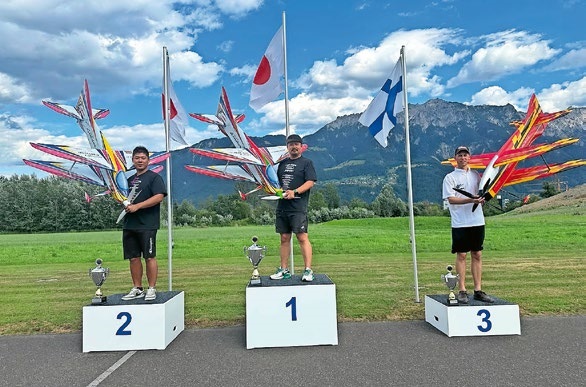
A SPECTACULAR F3A WORLD CUP IN THE PRINCIPALITY OF LIECHTENSTEIN
Emil Giezendanner