
Magnetic Control for Luckystar
To build the magnetic head, you must purchase a Mamo II controller, which is available from specialty retailers. The head can also be mounted on other models using the appropriate fuselage connector. It works best on F1A-scale models.
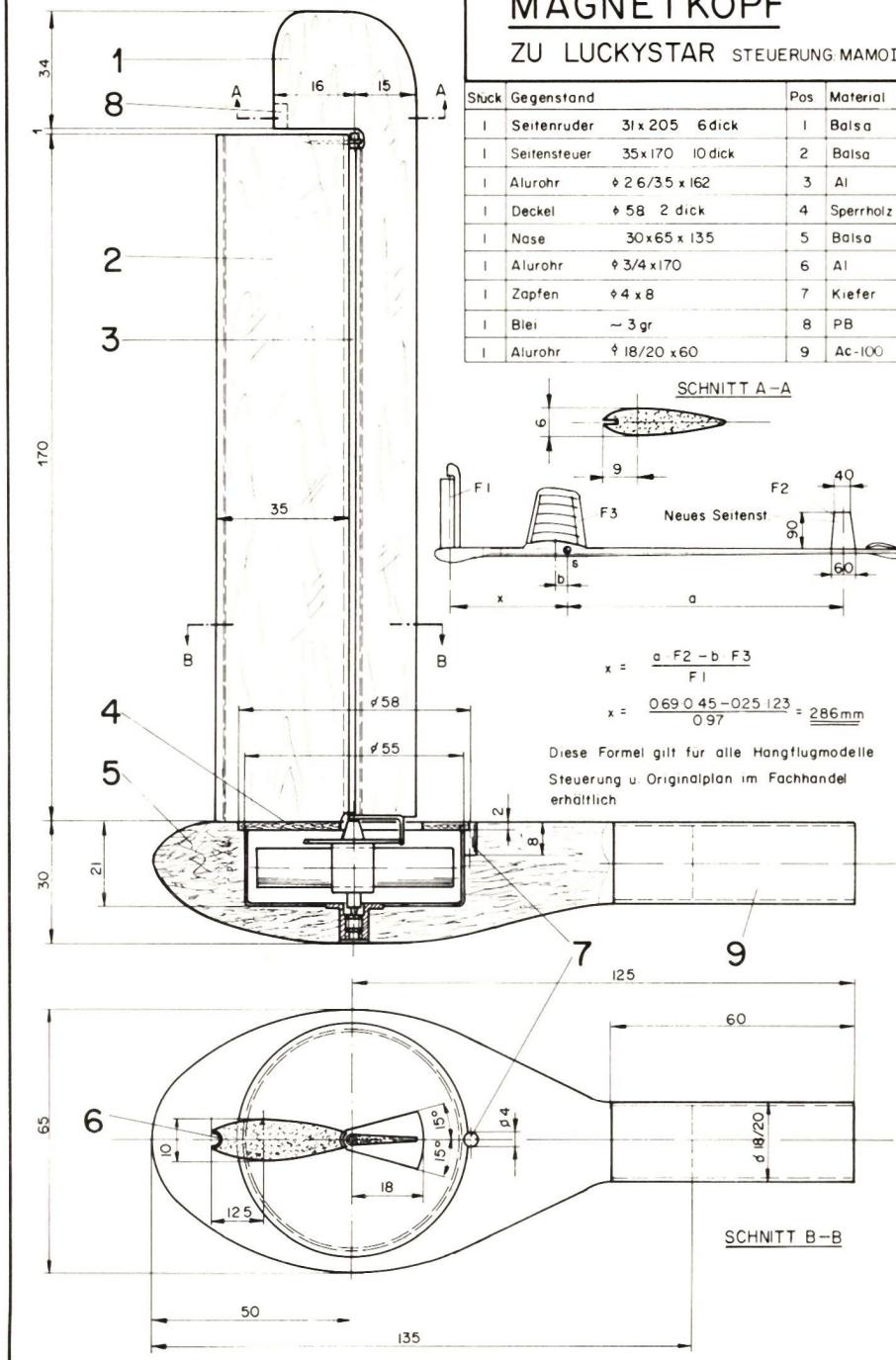
From a block of balsa wood (Item 5), we shape the nose after gluing Item 9 in place (using Araldit). Using a tenon saw drill bit ( $∎ 55$ ), we drill the hole ( $∎ 55$ ) to a depth of 23 mm. If you don’t have one, the fuselage nose can also be glued together from several layers of balsa strips, after first cutting out holes ( $∎ 55$ ) with a fretsaw. For the cover (Item 4), cut a recess ( $∎ 58$ ). A pine cone ( $∎ 4 × 8$ ) (Item 7. The templates for items 1 and 2 (side rudder and rudder) must be made exactly according to the plan. The aluminum tube ( $∎ 3/4$ ) (item 6) is glued in place with Araldite (make the slot with a round file). Then carefully file it down to half its diameter using a flat file. The two resulting edges must be sharp. Glue the side control to the lid using white glue. The side control must be exactly at a right angle so that the magnet’s axis can rotate freely. Tube ( $∎ 2.6 / 3.5$ ) Item 3 should also be glued in place with Araldit. Cover all balsa parts with thin tracing paper.
Next, we need a new rudder at the rear. Dimensions are shown on the plan; use 3 mm thick balsa.
This is necessary because the areas in front of and behind the center of gravity S must be equal. (Crosswind).
Use a pin to lock the rudder (Pos. 1) to the aileron (Pos. 2). Adjust the rear aileron until the model flies on a straight course. If we now release rudder position 1, we can set the appropriate course using the gear on the magnet, depending on the slope’s angle. Move the model left and right by hand, so that rudder position 1 reaches the 15° stop. Also try this on a slope. If everything is in order, you can try your first takeoff from the slope—and don’t forget the thermal safety device!
| Piece | Item | Item | Material |
|---|---|---|---|
| 1 | Rudder 31 x 205, 6 thick | 1 | Balsa |
| 1 | Aileron 35 x 170, 10 thick | 2 | Balsa |
| 1 | Aluminum tube $∎ 2.6 / 3.5$ x 162 | 3 | Al |
| 1 | Lid $∎ 58$ 2 thick | 4 | Plywood |
| 1 | Nose 30 x 65 x 135 | 5 | Balsa |
| 1 | Aluminum tube $∎ 3/4$ x 170 | 6 | Al |
| 1 | Pin $∎ 4$ x 8 | 7 | Pine |
| 1 | Lead ~ 3 g | 8 | PB |
| 1 | Aluminum tube $∎ 18/20$ x 60 | 9 | Ac-100 |


News from HEBU

TEAM MANAGER "THIS" BOSSHARD
 Rodito Nussbaumer

YOU KNOW WHAT I MEAN? 125 YEARS OF THE SWISS AERO CLUB
 Emil Giezendanner

PRIDE AND GOOD IDEAS
 Markus Nussbaumer

ATOM, THE NEW DOUBLE-DECKER FROM CPLR
 Matthias Bosshard

SUMMER FUN 2026 AT MG USTER
Martin Wunderli
F3A EUROPEAN CHAMPIONSHIPS IN ST-MACAIRE, FRANCE
Matthias Bosshard
52. 2026 ALPS CUP
Emil Giezendanner
HORIZON HOBBY/LEMACO NEWS: MICRO OV-10 BRONCO 645 MM BY E-FLITE

TWIN TOWN PARTNERSHIP
Wolfgang Voeller
CORSAIR F4U – A WARBIRD WITH A MEMORABLE LOOK
Jürgen Rosenberger, Jürgen Prinz
TRY-OUT DAY AT MFV WETTINGEN
Urs Keller
EURO CONTEST GLIDER ACRO TOUR AUSTRIA 2026

BY YOUTH, FOR YOUTH
Lorena Betschen
INSIGHTS INTO THE HISTORY OF SEAPLANES

SMALL, MODEL-LIKE SAILBOATS
Res Dauwalder
What's New at Leomotion.com

COUPE DES ALPES – OBSERVE AND LEARN
Rodito Nussbaumer
34th HAHNENMOOS ALPINE MODEL AIRPLANE CAMP
Res Dauwalder
WELCOME, NEW MEMBER!
Andrea Bolliger
FREE FLIGHT IN THE MIDDLE OF SUMMER
Urs Muntwyler
THE PC-21 STORY
Emil Giezendanner
NEWS FROM HEBU
 Julia Bucher

FROM 0 TO 100
Markus Nussbaumer
MEMORIES
Wolfgang Völler
NOS REGION – A HUB FOR ELECTRIC AVIATION
Emil Giezendanner
Have you almost forgotten about aircraft that take off and land vertically?
Emil Giezendanner
DO YOU KNOW WHAT I MEAN IN THE LAND OF SMILES?
Emil Giezendanner