
Starfire – with adjustable air outlet
The Starfire is actually a typical impeller jet with an elegant design and no specific real-world counterpart. This means that model builders aren’t bound by the specifications of any existing original and thus enjoy complete freedom when making modifications. The following report showcases an unusual modification designed to improve flight characteristics.
The Impellerjet kit is distributed by the American company Yellow Aircraft. It is reported that several thousand units have already been sold.
The jet was originally designed by Tom Cook, who has a reputation for designing fast models with excellent aerodynamic properties. Hans-Peter Hofer has already built the “Firebird” turbine jet, which he developed himself. In actual flight operations, however, he soon realized that even the large dimensions of the Dübendorf airfield were barely sufficient to reach speeds exceeding 500 km/h.
The Starfire is a medium-sized impeller jet. Given
its electric propulsion. An early version of it flew rather unspectacularly over the Dübendorf airfield. But at some point, the idea arose to rebuild this e-jet as a significantly more powerful second version. The parts supplied by the manufacturer—a fiberglass fuselage and balsa wings with numerous plywood ribs—allow plenty of room for modifications. And thanks to his many years of model-building experience, Hans-Peter possesses a very broad knowledge of strength, aerodynamics, and the construction of high-strength aircraft.
Just as with a sports car that’s already quite powerful and is tuned to offer even more driving pleasure, the goal with this model was to use modifications to further improve its already impressive flight characteristics. To push the existing physical limits a bit further, the goal was to reduce drag slightly, increase structural strength, and boost propulsion. This led to the following adjustments:
Reduction in drag:
RDS linkage for all control surfaces. Landing gear bays that can be completely sealed in both the retracted and extended positions. Reinforcement of the landing gear cylinders to increase the clamping pressure of the covers. An absolutely smooth-sanded fuselage, as well as finely polished wings and control surfaces, minimize turbulence. Reinforcement of all leading edges with a finely polished aluminum layer.
Structural reinforcement:
All surfaces and control surfaces made of balsa
surfaces and control surfaces with a high-strength carbon fiber fabric. Use of high-performance digital servos to increase control surface forces.
Increased propulsion power:
Installation of a very powerful motor (just under 10 kW) with a fan precisely matched to it. Use of a 200-A ESC specially adapted for this application. Batteries with 6600 mAh, 65 C, and 13 cells, distributed throughout the fuselage. For a jet weighing approximately 8 kg, this is a rather powerful powerplant.
Control is handled by a Weatronic micro-receiver with 3-D gyro stabilization. It also includes a powerful telemetry system with a GPS sensor for measuring speed and altitude. The model also transmits 3-D position data to the transmitter at very short intervals, which can later be used with Google Earth to display the flight path.
One truly extraordinary feature is the “variable nozzle”—developed by Hans-Peter Hofer himself—which is an air outlet behind the propulsion unit whose cross-sectional area can be adjusted. A smaller cross-sectional area allows for a higher jet velocity during high-speed flight, resulting in a significant increase in flight speed. This
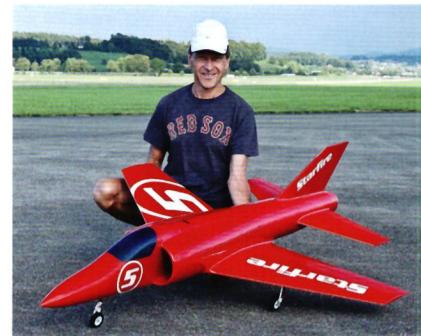
This effect can also be observed with a garden hose when you use your thumb to reduce the cross-sectional area at the end of the hose. In this case, the water's exit velocity also increases, and the resulting water jet sprays considerably farther.
Maiden flights always lift the spirits of the spectators a little and even make the pilot feel a bit nervous. But with a production model built carefully according to plan, this excitement quickly subsides, and the pilot then limits himself to adjusting the fine trim for optimal controllability. But how will this tuned model perform? As long as the aircraft stays within the usual limits, probably quite unspectacularly. Much like an extreme mountaineer climbing the Matterhorn on a tourist route in ideal weather.
The maiden flight at the “Jets over Dübendorf” event is now giving people plenty to think about. Will the model’s owner dare to push the jet to its limits in front of the assembled audience of experts? Will the thrust tube constriction—a design feature unique to this model so far—even function at such high airflow speeds? What speeds and accelerations can this jet’s structure actually withstand? When an extreme mountaineer climbs the Eiger North Face in a shorter time, it’s usually not without risk. But it does generate a certain amount of publicity. For the Starfire, something similar would be possible in a much more modest setting. Due to the lack of a certified test track, no official speed measurement can be taken. However, numerous owners of this aircraft in the U.S. would certainly be interested in the maximum speed achieved. And the two record-chasers—one on the mountain and one in the air—have one more thing in common: if they fall during their record attempt, their mission will have failed once and for all.
The day had finally arrived, and that morning a storm was raging over the airfield. After noon, the wind died down considerably, making the planned maiden flight at “Jets over Dübendorf 2012” possible after all. The Starfire took off as if it had already done so a hun-
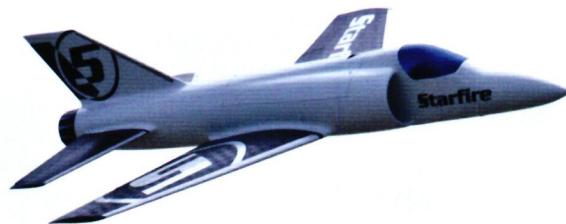
This time he did it that way—against the wind. He reached a safe altitude fairly quickly. Thanks to gyroscopic stabilization, the jet was hardly affected even by strong gusts of wind. It traced its path across the sky as if guided by invisible rails. It mastered rolls and loops with flying colors. And after a perfect three-point landing, it stood safely once again in the hangar next to the runway.
Thanks to the relatively moderate flight speed, the photographer was able to capture a few more
sharp aerial photos of this event. Even if it may not have been the fastest Impellerjet on the airfield, it is certainly a very fast Starfire with surprisingly quiet flight noise. And it is precisely these characteristics that make it so popular even near the Dübendorf airfield. After all, the neighbors really appreciate any jet they don’t have to hear roaring overhead. If only the Swiss Army could operate such whisper-quiet jets, the issue of military aircraft noise would likely disappear from the political agenda in no time.
Hermann Mettler


News from HEBU

PRIDE AND GOOD IDEAS
 Markus Nussbaumer

TEAM MANAGER "THIS" BOSSHARD
 Rodito Nussbaumer

YOU KNOW WHAT I MEAN? 125 YEARS OF THE SWISS AERO CLUB
 Emil Giezendanner

F3A EUROPEAN CHAMPIONSHIPS IN ST-MACAIRE, FRANCE
 Matthias Bosshard

HORIZON HOBBY/LEMACO NEWS: MICRO OV-10 BRONCO 645 MM BY E-FLITE

ATOM, THE NEW DOUBLE-DECKER FROM CPLR
Matthias Bosshard
SUMMER FUN 2026 AT MG USTER
Martin Wunderli
What's New at Leomotion.com

52. 2026 ALPS CUP
Emil Giezendanner
TWIN TOWN PARTNERSHIP
Wolfgang Voeller
CORSAIR F4U – A WARBIRD WITH A MEMORABLE LOOK
Jürgen Rosenberger, Jürgen Prinz
SMALL, MODEL-LIKE SAILBOATS
Res Dauwalder
TRY-OUT DAY AT MFV WETTINGEN
Urs Keller
WELCOME, NEW MEMBER!
Andrea Bolliger
COUPE DES ALPES – OBSERVE AND LEARN
Rodito Nussbaumer
EURO CONTEST GLIDER ACRO TOUR AUSTRIA 2026

BY YOUTH, FOR YOUTH
Lorena Betschen
INSIGHTS INTO THE HISTORY OF SEAPLANES

34th HAHNENMOOS ALPINE MODEL AIRPLANE CAMP
Res Dauwalder
THE PC-21 STORY
Emil Giezendanner
FREE FLIGHT IN THE MIDDLE OF SUMMER
Urs Muntwyler
NEWS FROM HEBU
 Julia Bucher

FROM 0 TO 100
Markus Nussbaumer
MEMORIES
Wolfgang Völler
NOS REGION – A HUB FOR ELECTRIC AVIATION
Emil Giezendanner
DO YOU KNOW WHAT I MEAN IN THE LAND OF SMILES?
Emil Giezendanner
Have you almost forgotten about aircraft that take off and land vertically?
Emil Giezendanner