
Review of the Sebart Sukhoi 29S 2.2-meter
Electric model airplanes have become much more popular in recent years. There has been a real boom, especially among aircraft with a wingspan of up to about 1.6 meters. But the 2-meter class—that is, aircraft with a wingspan of two meters and 10-S propulsion systems—is also becoming increasingly common.
For several years now, I have been flying aerobatic models in the 2-meter class as well as those with a 1.6-meter wingspan. The 1.6-meter models can be powered by a 5-S power system, while the 2-meter models use a 10-S power system. I use the same batteries for both model classes; for the 2-meter model, I simply connect the 5-S packs in series. Now I’ve had the idea of powering a 2.2-meter model with 10 S as well, but with double the capacity—that is, 10 S, 2 P. This way, the same batteries can be used for the entire hangar. This reduces the cost of the batteries. The batteries are also flown regularly. “Battery care” and maintenance are also simpler.
Model: In 2010, I flew the 2-meter Sebart Sukhoi 29S 140. At the end of 2010, I purchased a Sebart Sukhoi 29S with a 2.2-meter wingspan. As expected, the 2.2-meter version handles just as well in the air. During dynamic aerobatics, both aircraft can be flown with precision and exhibit neutral flight characteristics. Both models are also easy to control in 3D flight.
Motor and ESC: The Plettenberger Terminator 30-8 (mounted in the spinner), Rasa 24 × 12 (folding propeller), and the Jeti Spin 200 A ESC work together perfectly.
In my opinion, it has a very good power-to-weight ratio. With the 10S, 2P setup, it has plenty of power, both for dynamic flight and in 3D maneuvers. Additionally, the noise level is very pleasant and quiet. The measured current draw while stationary on the ground is about 145 A.
Power battery: Currently, I’m using the ePower ECO 30C 4500 mAh. I connect them in parallel, so I have a 10S 2P setup with a total of 9000 mAh on board. The motor runtime (pure motor runtime) is a good 7 minutes. After 7 minutes, 6,750 mAh of the 9,000 mAh have been used, which corresponds to 75% of the capacity. This results in flight times of about 10 minutes.
Motor Mounting: I think the Terminator can certainly be operated without any problems with a strong propeller and tail-mount configuration. The ideal cooling provided by mounting it in the spinner, as well as the mechanically advantageous direct attachment of the folding propellers to the motor housing, speaks in favor of the variant I chose. In addition, mounting the motor in the spinner will be the lighter option overall. In terms of center of gravity, the arrangement—with the motor at the very front of the spinner—is also advantageous. The difficulty with mounting the motor in the spinner lies in the fact that there is usually a long distance to cover from the existing motor dome to the motor flange. Thus, the challenge remains to design a lightweight yet stable mounting bracket.
RC System: To control the control surfaces, I chose the Futaba BLS 155 servo. It is very fast and also has sufficient travel and holding force.
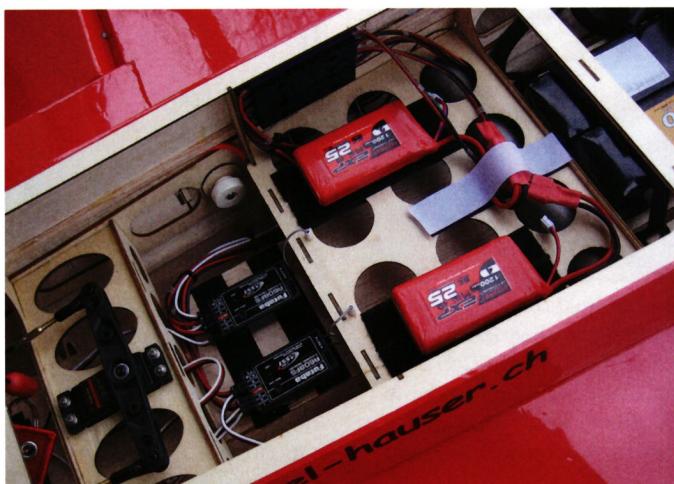
With a model of this size, it is essential to take measures to ensure operational safety. The five servos in total must not simply be connected to a single receiver. There is a high risk that the receiver board will fail over time due to the high currents. To address this issue, there are essentially two options to choose from: First, the classic “power switch.” The power current for the servos flows exclusively and directly through the switch. The receiver is used only as a signal transmitter.
In the variant I chose, two receivers are installed. The servos are distributed accordingly between the two receivers. I have provided a separate RC power supply for each receiver. This gives me two completely separate, redundant systems on board. The advantage of this approach lies in the “simplicity of the system,” the lower cost, and the light weight. For even larger models, I see no reason not to use a third receiver for an even better distribution of the load.
Protective bags for the model: I’d already had protective bags custom-made at www.rc-taschen.at for the 2-meter Sebart Sukhoi 29S 140. The bags fit perfectly and are of high quality. The new 2.2-meter Sukhoi should also be fitted with some. At www.rc-taschen.at, custom bags are made for a wide variety of models. The bags can be customized with individual accessories.
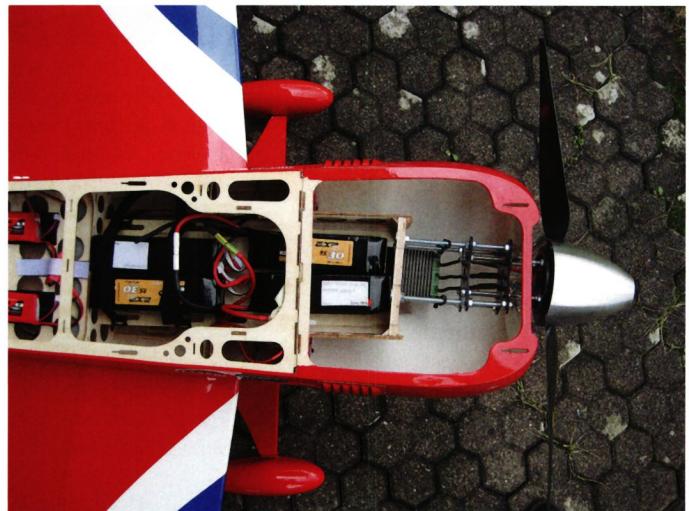
The electrically powered 2.2-meter Sukhoi is a versatile aerobatic model. Electric propulsion has been well-established and suitable for everyday use in this class for some time now. I would like to take this opportunity to thank www.eflight.ch for their expert support. ■
Best regards
, Michel Hauser
www.michel-hauser.ch
| Wingspan | 2180 mm |
| Length | 2,210 mm |
| Takeoff weight | 9,213 g |
| Plettenberger Terminator | 30-8 |
| Rasa | 24×2 (folding propeller) |
| Jeti Spin | 200 Opto |
| 5 pcs. | Futaba BLS155 Servo |
| 2 pcs. | 2.4 GHz Futaba R608 |
| 2 pcs. | Emcotec DPSI SingleBat 5.9 V |
| 2 pcs. | 2 S receiver battery 1200 mAh |
| Power battery | 10S, 2P, 9,000 mAh (2 × 4,500 mAh) |


News from HEBU

TEAM MANAGER "THIS" BOSSHARD
 Rodito Nussbaumer

YOU KNOW WHAT I MEAN? 125 YEARS OF THE SWISS AERO CLUB
 Emil Giezendanner

F3A EUROPEAN CHAMPIONSHIPS IN ST-MACAIRE, FRANCE
 Matthias Bosshard

SUMMER FUN 2026 AT MG USTER
Martin Wunderli
TRY-OUT DAY AT MFV WETTINGEN
Urs Keller
52. 2026 ALPS CUP
Emil Giezendanner
BY YOUTH, FOR YOUTH
Lorena Betschen
ATOM, THE NEW DOUBLE-DECKER FROM CPLR
Matthias Bosshard
CORSAIR F4U – A WARBIRD WITH A MEMORABLE LOOK
Jürgen Rosenberger, Jürgen Prinz
SMALL, MODEL-LIKE SAILBOATS
Res Dauwalder
What's New at Leomotion.com

TWIN TOWN PARTNERSHIP
Wolfgang Voeller
EURO CONTEST GLIDER ACRO TOUR AUSTRIA 2026

INSIGHTS INTO THE HISTORY OF SEAPLANES

34th HAHNENMOOS ALPINE MODEL AIRPLANE CAMP
Res Dauwalder
WELCOME, NEW MEMBER!
Andrea Bolliger
HORIZON HOBBY/LEMACO NEWS: MICRO OV-10 BRONCO 645 MM BY E-FLITE

FREE FLIGHT IN THE MIDDLE OF SUMMER
Urs Muntwyler
COUPE DES ALPES – OBSERVE AND LEARN
Rodito Nussbaumer
PRIDE AND GOOD IDEAS
 Markus Nussbaumer

THE PC-21 STORY
Emil Giezendanner
NEWS FROM HEBU
 Julia Bucher

FROM 0 TO 100
Markus Nussbaumer
MEMORIES
Wolfgang Völler
NOS REGION – A HUB FOR ELECTRIC AVIATION
Emil Giezendanner
Have you almost forgotten about aircraft that take off and land vertically?
Emil Giezendanner
DO YOU KNOW WHAT I MEAN IN THE LAND OF SMILES?
Emil Giezendanner