
3rd FAI RC Glider World Championship, Category F3B, 1981
From July 12–17, 1981, 66 competitors from 22 nations gathered in Sacramento, California, USA, for the 3rd RC Gliding World Championship.
From the perspective of the team leader of the Swiss Aero Club delegation, the following conclusion can be drawn: Attending this World Championship was once again quite a demanding undertaking, both in terms of the time required for preparations and the financial burden borne by the national team members as well as the Swiss Aero Club, which in turn provided material support to the team. In contrast, the World Championships were extremely poorly organized by the AMA (Academy of Model Aeronautics), which was only able to stage at least four rounds over four days with great difficulty.
This resulted in a great physical strain on all competitors and volunteers. The daily schedule during the World Championships looked something like this: Wake-up call at 5:00 a.m. Flying sessions typically lasted until 7:00 p.m., with temperatures at times well above the 40°C mark. Return trip to the hotel, approx. 24 km. Maintenance of flight and infrastructure equipment. Showers and dinner at 9:00 p.m. Bedtime no earlier than 10:00 p.m.
It is deeply regrettable that, under such circumstances, meaningful social interaction among the participants was completely impossible. Even at the closing banquet—which featured an awards ceremony that, by even the most modest standards, was unworthy of a World Championship—such interaction could no longer take place due to a lack of time and extreme fatigue. With the exception of the top three places in the individual and team classifications, no other rankings were announced. The rankings were not available until five minutes before the participants’ departure, and even then, we were still missing the results for three rounds. In contrast, we encountered truly ideal flying conditions in Sacramento, with very good, consistent thermals throughout the day, which allowed for a fair competition. Due to the strong wind, the tight “therms”—especially those below 100 m above ground level—moved relatively quickly across the terrain, placing quite high demands on the pilots’ flying skills.
Once again, it must be noted that the arbitrary 12-lap limit in distance flying completely distorted the performance records, especially for the top pilots. As many as 48% of all distance flights flown reached the maximum limit of 12 laps! The time-consuming distance flight could easily have been omitted from the selection process without any loss of quality.
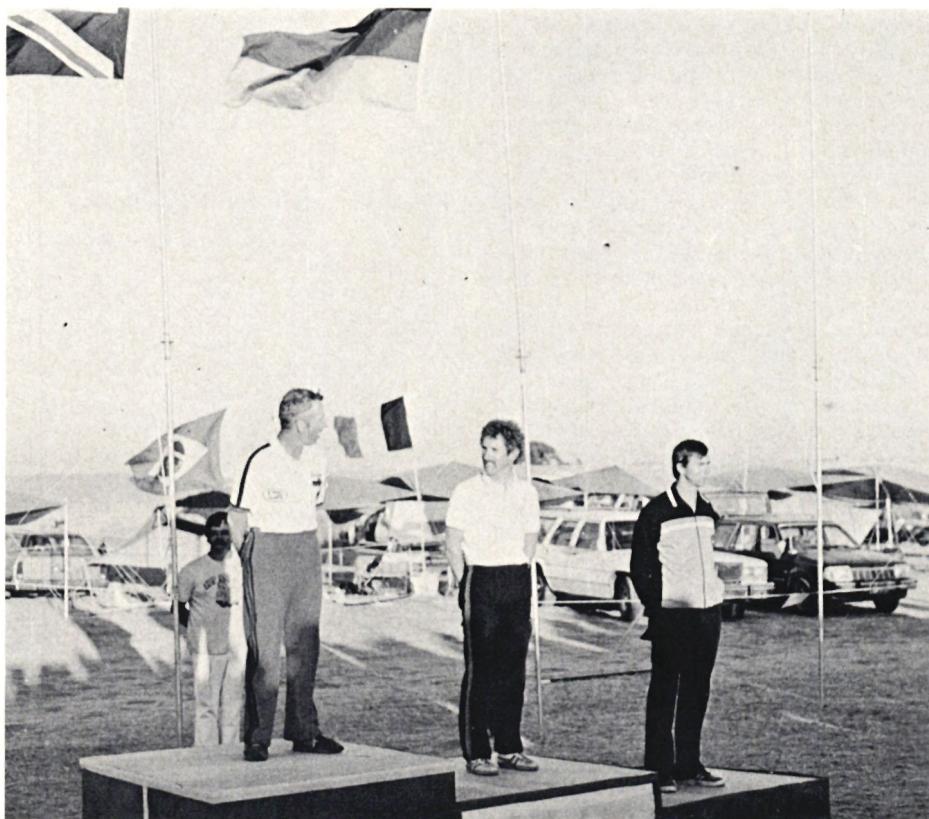
The top three finishers in the individual standings, from left to right:
1. Dwight Holley, USA
2. Sean Bannister, Great Britain
3. Wilhelm Schäffer, Germany
can be omitted. If RC gliding is to have any future as a competitive category, then the 12-round limit must be eliminated as soon as possible. Under these conditions, selection was based primarily on the results of the precision landing in the endurance flight and speed flight categories.
How does the team leader assess the Swiss pilots' performances?
I believe that the results of the World Championship need to be viewed in a somewhat nuanced way to do justice to the performances. If one considers only the rankings, the picture admittedly doesn’t look very favorable. However, it’s important to note that 19 pilots achieved a performance level of over 90% relative to the World Championship winner. The fact that two Swiss pilots were able to place within this range is certainly very encouraging. The fact that the third-place Swiss pilot—despite a self-inflicted zero score in the second speed flight and a third —after missing a turn by just a few centimeters—still managed to finish in 27th place with 21 seconds and 405 points, achieving a performance ratio of over 84% relative to the winner, clearly points to the very strong performance of the Swiss team. All of us—including the team leader and the pilots—know that we made mistakes and that we had to pay the price for them. Only the one who makes the fewest mistakes can win.
Neither the available aircraft nor the weather nor the organizer’s poor performance can in any way be held responsible for the Swiss team’s results.
For example, the fact that the team manager missed the end of the discipline time during the endurance flight—thereby preventing the pilot from securing the desperately needed landing points—or that during the distance flight he confused the running discipline time with the clock still running for the preparation time, are extremely frustrating mistakes and should really be just as rare as, for example, the aforementioned zero score in the speed flight due to overshooting the safety line or landings outside the 15-meter mark in the endurance flight. However, experience shows us time and again that even such unnecessary mistakes can happen.
In this regard, it seems important to me that we learn from such mishaps so that the same mistakes are not repeated.
The Swiss team can add another—certainly not insignificant—success to its record. Although many countries have made significant progress in the field of model aircraft construction in the two years since the last World Championship in Belgium, the Spartakus is regarded as a major advance in terms of construction technology, aerodynamic efficiency, and flight performance. In any case, our model sparked keen interest among many competitors and the interested specialist audience. I am convinced that the
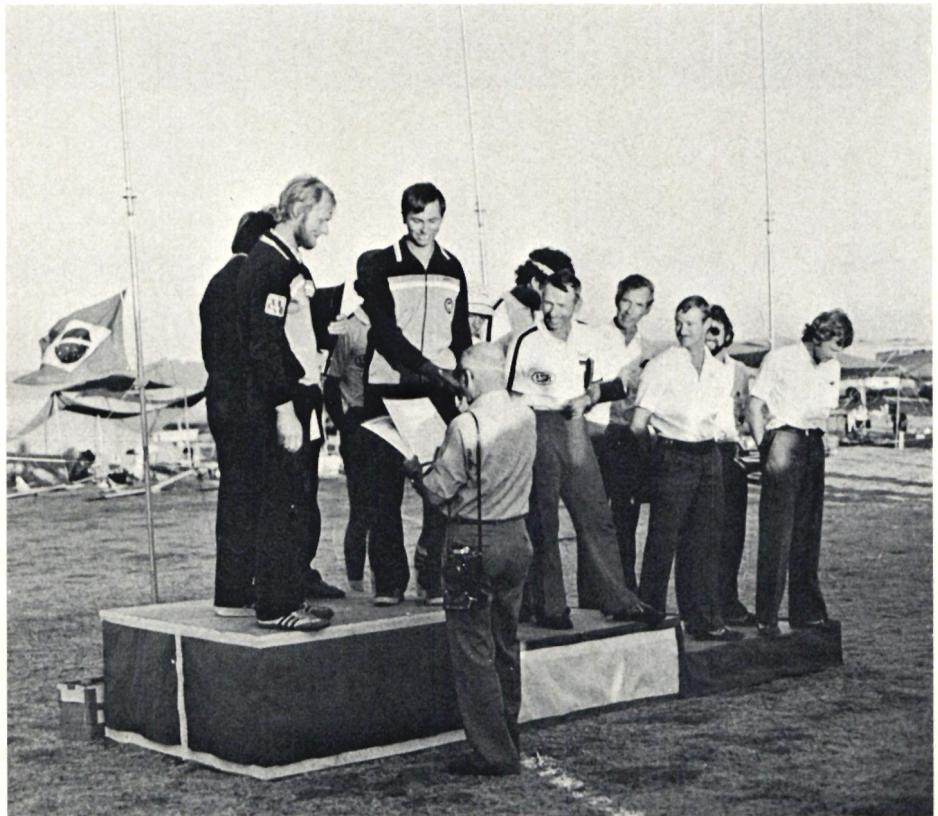
The winners of the team competition, from left to right:
1. Germany: R. Decker / W. Schäffer / W. Vauth and TM Quabeck
2. USA: Blake / Edberg / Holley and TM Pan Pruss
3. South Africa: N. Gerneke / Keil / Spavins and TM Jack Abbot
| Name | Enrollment | Duration | Distance | Speed | Total | |
|---|---|---|---|---|---|---|
| 1. Bannister | G | 974 | 1,000 | 8.8 | 1,000 | 2,974 |
| 2. Schaeffer | D | 1,000 | 1,000 | 9.2 | 957 | 2,957 |
| 3. Edberg | N | 994 | 1000 | 9.5 | 926 | 2920 |
| 4. Holley | N | 998 | 1000 | 9.6 | 917 | 2,915 |
| 5. Vauth | D | 983 | 1,000 | 10.1 | 871 | 2,854 |
| 6. Stoll | HB | 967 | 1,000 | 10.1 | 871 | 2,839 |
| 7. Blake | N | 987 | 1,000 | 10.6 | 830 | 2,817 |
| 8. Ten Holt | PH | 930 | 1,000 | 10.2 | 863 | 2793 |
| 9th Decker | D | 978 | 1,000 | 11.3 | 779 | 2,757 |
| 10. Läderach | HB | 887 | 1,000 | 10.3 | 854 | 2,741 |
| 11. Givone | I | 904 | 1,000 | 10.6 | 830 | 2,735 |
| 12. Schweinsberg | PH | 985 | 1,000 | 11.8 | 746 | 2,731 |
| 13. Gerneke | ZS | 983 | 917 | 10.6 | 830 | 2,730 |
| 14. De Santi | PP | 967 | 1,000 | 11.7 | 752 | 2,720 |
| 15th wedge | ZS | 987 | 1000 | 12.2 | 721 | 2708 |
| 16. Lyra | PP | 980 | 1,000 | 12.3 | 715 | 2696 |
| 17. Smith | VH | 967 | 1,000 | 12.2 | 721 | 2,689 |
| 18. Wasner Jr. | OE | 933 | 917 | 10.5 | 838 | 2,687 |
| 19. Frank | OY | 800 | 1,000 | 10.4 | 846 | 2,646 |
| 20. Hasegawa | YES | 987 | 1000 | 13.5 | 652 | 2,639 |
| also: | ||||||
| 26. Binkert | HB | 554 | 1,000 | 9.4 | 936 | 2,491 |


News from HEBU

TEAM MANAGER "THIS" BOSSHARD
 Rodito Nussbaumer

YOU KNOW WHAT I MEAN? 125 YEARS OF THE SWISS AERO CLUB
 Emil Giezendanner

F3A EUROPEAN CHAMPIONSHIPS IN ST-MACAIRE, FRANCE
 Matthias Bosshard

SUMMER FUN 2026 AT MG USTER
Martin Wunderli
TRY-OUT DAY AT MFV WETTINGEN
Urs Keller
52. 2026 ALPS CUP
Emil Giezendanner
BY YOUTH, FOR YOUTH
Lorena Betschen
ATOM, THE NEW DOUBLE-DECKER FROM CPLR
Matthias Bosshard
CORSAIR F4U – A WARBIRD WITH A MEMORABLE LOOK
Jürgen Rosenberger, Jürgen Prinz
SMALL, MODEL-LIKE SAILBOATS
Res Dauwalder
What's New at Leomotion.com

HORIZON HOBBY/LEMACO NEWS: MICRO OV-10 BRONCO 645 MM BY E-FLITE

TWIN TOWN PARTNERSHIP
Wolfgang Voeller
PRIDE AND GOOD IDEAS
 Markus Nussbaumer

EURO CONTEST GLIDER ACRO TOUR AUSTRIA 2026

INSIGHTS INTO THE HISTORY OF SEAPLANES

34th HAHNENMOOS ALPINE MODEL AIRPLANE CAMP
Res Dauwalder
WELCOME, NEW MEMBER!
Andrea Bolliger
FREE FLIGHT IN THE MIDDLE OF SUMMER
Urs Muntwyler
COUPE DES ALPES – OBSERVE AND LEARN
Rodito Nussbaumer
THE PC-21 STORY
Emil Giezendanner
NEWS FROM HEBU
 Julia Bucher

FROM 0 TO 100
Markus Nussbaumer
MEMORIES
Wolfgang Völler
NOS REGION – A HUB FOR ELECTRIC AVIATION
Emil Giezendanner
Have you almost forgotten about aircraft that take off and land vertically?
Emil Giezendanner
DO YOU KNOW WHAT I MEAN IN THE LAND OF SMILES?
Emil Giezendanner