
Marsh Harrier
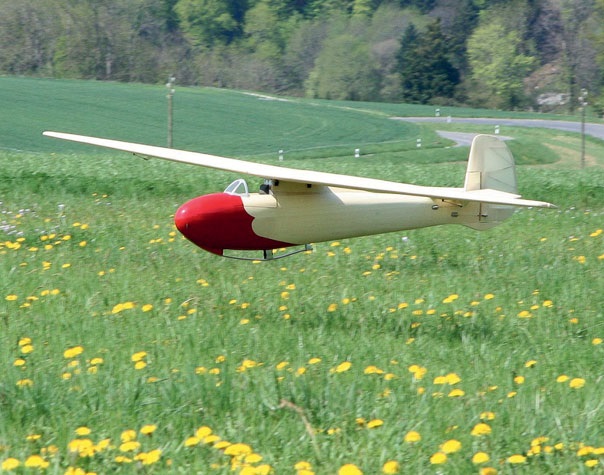
Construction of the Rohnbussard glider began two years ago, thanks to Stéphane from GAM Yverdon. Stéphane, a fan of “vintage” gliders, suggested that I try tow-in gliding and flying gliders. So I set up a 1.70-meter PC6 for towing, which I really enjoyed, and we had a lot of fun. One thing led to another, and we eventually decided to “think bigger.” The idea to build a Bussard came quickly; I placed the order at the end of 2017, and the kit arrived a bit late, at the end of January 2018. So, I stepped up the pace to be able to fly it this year.
Before starting construction, I did some research on the Rohnbussard to find photos and information about its specifications, since the plans for it are very basic. One of the major modifications was to replicate the original’s wing attachment system and then devise a way to secure it to the fuselage. Once that was done, I rolled up my sleeves and got to work.
The model doesn’t come with much explanation—in fact, there are no assembly instructions
(!) and, furthermore, the kit contained only fuselage spars and wing ribs: quite sparse. For a “short kit,” this was a very short kit indeed! I still need to mount the servos in the wings and fuselage. To make things easier, I installed aluminum control horns for the control surfaces. I had to rework some parts, build a wing assembly system, install the servos, and mount a circuit board in the fuselage. The onboard electronics are very simple: a voltage regulator, a 3S LiPo battery, three
servos, and a receiver. To adjust the CG, I needed 2 kg of lead just behind the first fuselage spar, and even so, the glider weighs 7 kg 800 in flight configuration with a wingspan of 4767 mm.
It took me about 400 hours of work to build this beautiful 1:3-scale model, the original of which made its first flight in 1933.
Jean-Luc Zogg


News from HEBU

HORIZON HOBBY/LEMACO NEWS: MICRO OV-10 BRONCO 645 MM BY E-FLITE

PRIDE AND GOOD IDEAS
 Markus Nussbaumer

TEAM MANAGER "THIS" BOSSHARD
 Rodito Nussbaumer

YOU KNOW WHAT I MEAN? 125 YEARS OF THE SWISS AERO CLUB
 Emil Giezendanner

F3A EUROPEAN CHAMPIONSHIPS IN ST-MACAIRE, FRANCE
 Matthias Bosshard

ATOM, THE NEW DOUBLE-DECKER FROM CPLR
Matthias Bosshard
SUMMER FUN 2026 AT MG USTER
Martin Wunderli
TRY-OUT DAY AT MFV WETTINGEN
Urs Keller
What's New at Leomotion.com

52. 2026 ALPS CUP
Emil Giezendanner
TWIN TOWN PARTNERSHIP
Wolfgang Voeller
34th HAHNENMOOS ALPINE MODEL AIRPLANE CAMP
Res Dauwalder
CORSAIR F4U – A WARBIRD WITH A MEMORABLE LOOK
Jürgen Rosenberger, Jürgen Prinz
SMALL, MODEL-LIKE SAILBOATS
Res Dauwalder
WELCOME, NEW MEMBER!
Andrea Bolliger
FREE FLIGHT IN THE MIDDLE OF SUMMER
Urs Muntwyler
COUPE DES ALPES – OBSERVE AND LEARN
Rodito Nussbaumer
EURO CONTEST GLIDER ACRO TOUR AUSTRIA 2026

BY YOUTH, FOR YOUTH
Lorena Betschen
INSIGHTS INTO THE HISTORY OF SEAPLANES

THE PC-21 STORY
Emil Giezendanner
NEWS FROM HEBU
 Julia Bucher

FROM 0 TO 100
Markus Nussbaumer
MEMORIES
Wolfgang Völler
NOS REGION – A HUB FOR ELECTRIC AVIATION
Emil Giezendanner
DO YOU KNOW WHAT I MEAN IN THE LAND OF SMILES?
Emil Giezendanner
Have you almost forgotten about aircraft that take off and land vertically?
Emil Giezendanner