
TELL RC Training Model 6.5–10 cc
The TELL RC high-wing aircraft stands out with its elegant lines.
Don’t worry, I’m not going to tell you the story of our national hero, Wilhelm Tell. On the other hand, I could at least imagine that, in the near future, this RC training model might achieve similar fame among model builders.
With a wingspan of 152 cm, this model is just right for those new to multi-channel systems. If you equip the Tell with a 6.5 ccm engine, you’ll get a docile model. Ground launches are no problem with the right runway—even grass. The Tell, controlled by the rudder, is even suitable for RC beginners. Even with just the rudder, the Tell flies with great poise and spirit. Simple aerobatics such as loops, turns, and inverted flight are easily achievable.
For experienced RC pilots, we recommend installing a 10 ccm engine. Equipped with this engine and ailerons, you’ll have a high-speed aerobatic model.
The Tell is an excellent training model for the National Aerobatics Program. The Tell handles exceptionally well during maneuvers. Thanks to its visually smooth lines, this model allows for detailed practice of maneuvers, especially during aerobatic training. Its flight characteristics during high-speed and low-speed flight are outstanding. For landings, the model can touch down with the controls fully extended.
The Tell is a shoulder-wing aircraft, designed and manufactured by MKT-Modellbau Gebr. Schaub & Co. It is a Swiss model not only in name but in every respect, a fact that is particularly evident in the design and quality of the kit. Incidentally, the Tell is a “super-quick” model kit that truly lives up to its name—it actually takes only a few hours to build and poses no problems even for inexperienced model builders.
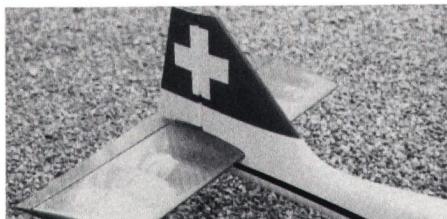
The fuselage is constructed using MKT’s famous and proven fiberglass construction method. The vertical stabilizer, including the rudder, is molded as a single piece.
The canopy, which also serves as the wing center section and wing attachment, is colored blue.
The wing attachment is ingeniously designed. Using a dowel that passes through the rear of the fuselage and an M6 Nylon screw at the front, you achieve a reliable and precise attachment.
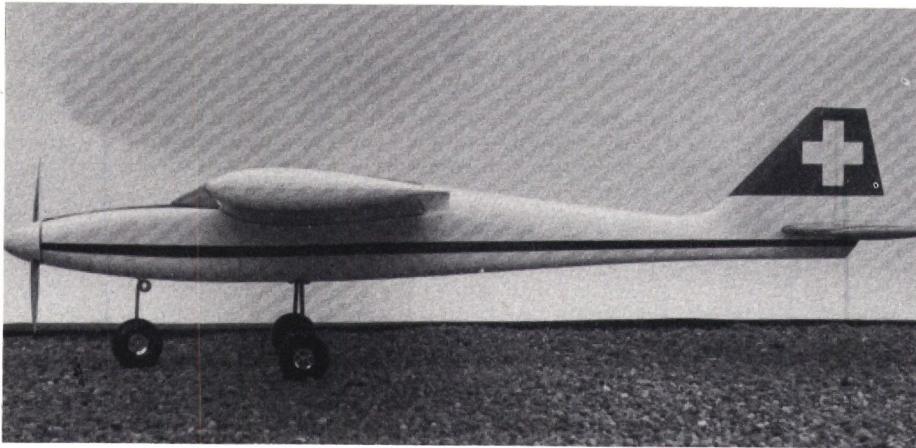
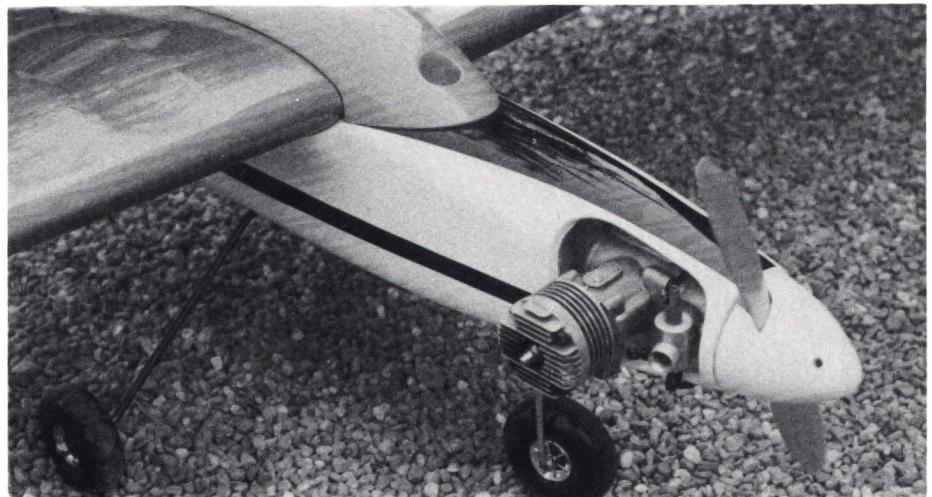
The horizontal stabilizer is glued into the preformed slot in the fuselage. The motor mount, including the frame member with the nose wheel bearing, is already installed. The motor recess is designed for 6.5 ccm motors. A larger type can also be easily fitted.
The anchor points for the main landing gear are also pre-cast into the fuselage.
The wing is constructed using the new MKT wood-foam construction method. The two-piece, hollow foam core, combined with the milled balsa main spar, results in a virtually indestructible airframe.
The molded leading-edge skin ensures excellent airfoil accuracy. Pre-milled aileron spars make it easier for beginners to install the ailerons.
Another innovation in model aircraft construction is the pre-finished white fiberglass edge strips, which not only save the builder a lot of sanding time but also ensure optimal durability at the wing tips. At the end of the wing assembly process, these edge strips are glued in place using two-component adhesive.
The horizontal stabilizer, built using the same rational design, is covered with film along with the wing. It is recommended to apply the film using a hair dryer.
Installing the control system poses no problems. There is sufficient space in the fuselage to ensure a neat and organized installation.
The Graupner 315 ml fuel tank is recommended. The OS40 FSR would be the ideal engine. When installing a 6.5 cc engine, 50–100 g of lead must be added beneath the engine, depending on how the control system is mounted.
For wheels, I recommend 55–60 mm in diameter for runway operation and approximately 65 mm in diameter for grass takeoffs.
Tips for the first flight:
The most important thing, as with all airplanes, is the position of the center of gravity. Ideally, with the Tell, the model tilts onto its tail when the rudder is tapped while the tank is empty; when fueled, the model always stands upright.
The steerable nose wheel should have only minimal travel. During takeoff, slowly apply full throttle from a standstill; once it has enough speed, the Tell will lift off the runway on its own.
Use subtle control inputs to fine-tune the model’s trim. For landing, a steady descent all the way to the runway is recommended.
I wish all Tell pilots much enjoyment with this truly successful model and say “happy landing.” Sch.
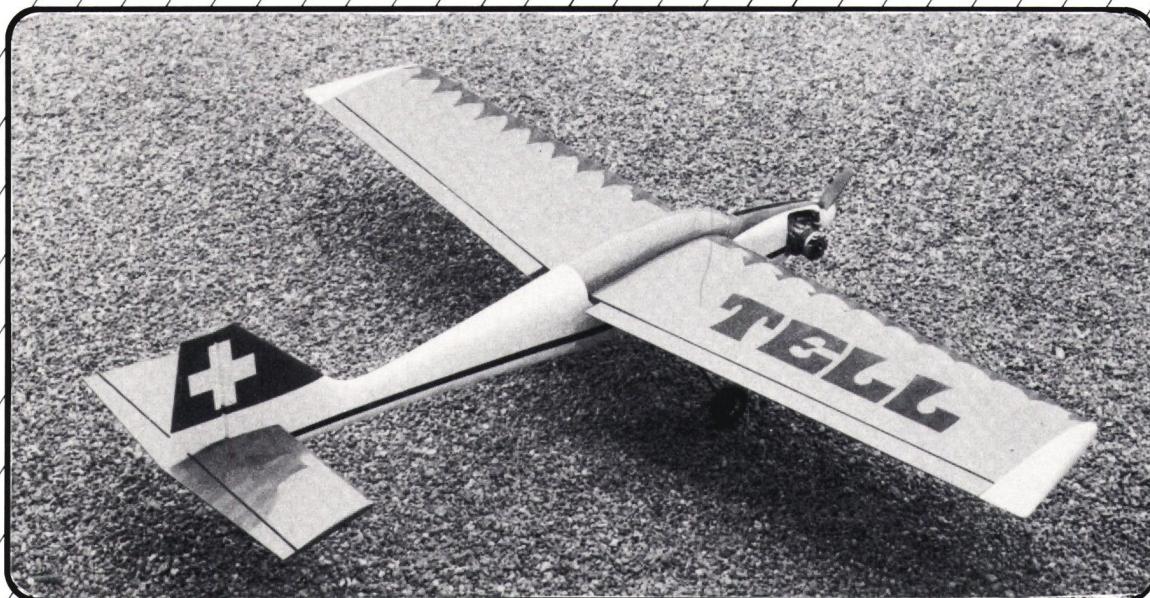
| Wingspan | 152 cm |
| Engine | 6.5–10 cc |
| Construction | MKT-HS wing construction and proven MKT fiberglass prefabricated elements |
| Where to Buy | Your local specialty store |


News from HEBU

TEAM MANAGER "THIS" BOSSHARD
 Rodito Nussbaumer

YOU KNOW WHAT I MEAN? 125 YEARS OF THE SWISS AERO CLUB
 Emil Giezendanner

PRIDE AND GOOD IDEAS
 Markus Nussbaumer

ATOM, THE NEW DOUBLE-DECKER FROM CPLR
 Matthias Bosshard

SUMMER FUN 2026 AT MG USTER
Martin Wunderli
F3A EUROPEAN CHAMPIONSHIPS IN ST-MACAIRE, FRANCE
Matthias Bosshard
52. 2026 ALPS CUP
Emil Giezendanner
HORIZON HOBBY/LEMACO NEWS: MICRO OV-10 BRONCO 645 MM BY E-FLITE

TWIN TOWN PARTNERSHIP
Wolfgang Voeller
CORSAIR F4U – A WARBIRD WITH A MEMORABLE LOOK
Jürgen Rosenberger, Jürgen Prinz
TRY-OUT DAY AT MFV WETTINGEN
Urs Keller
EURO CONTEST GLIDER ACRO TOUR AUSTRIA 2026

BY YOUTH, FOR YOUTH
Lorena Betschen
INSIGHTS INTO THE HISTORY OF SEAPLANES

SMALL, MODEL-LIKE SAILBOATS
Res Dauwalder
What's New at Leomotion.com

COUPE DES ALPES – OBSERVE AND LEARN
Rodito Nussbaumer
34th HAHNENMOOS ALPINE MODEL AIRPLANE CAMP
Res Dauwalder
WELCOME, NEW MEMBER!
Andrea Bolliger
FREE FLIGHT IN THE MIDDLE OF SUMMER
Urs Muntwyler
THE PC-21 STORY
Emil Giezendanner
NEWS FROM HEBU
 Julia Bucher

FROM 0 TO 100
Markus Nussbaumer
MEMORIES
Wolfgang Völler
NOS REGION – A HUB FOR ELECTRIC AVIATION
Emil Giezendanner
Have you almost forgotten about aircraft that take off and land vertically?
Emil Giezendanner
DO YOU KNOW WHAT I MEAN IN THE LAND OF SMILES?
Emil Giezendanner