
Original and Model: EC145 of the Civil Protection Agency
When building a full-scale model intended for use in scale model championships, there are many points and factors that must be carefully examined and evaluated before you can begin sourcing parts and starting the work. Many modelers make the mistake right at this stage of buying the model and deciding on the paint scheme before they have thoroughly verified the availability of reference materials for the prototype. What good is the most amazing replica or the most spectacular paint scheme if the prototype is in service tens of thousands of kilometers away and the necessary images simply cannot be obtained for proper construction documentation?
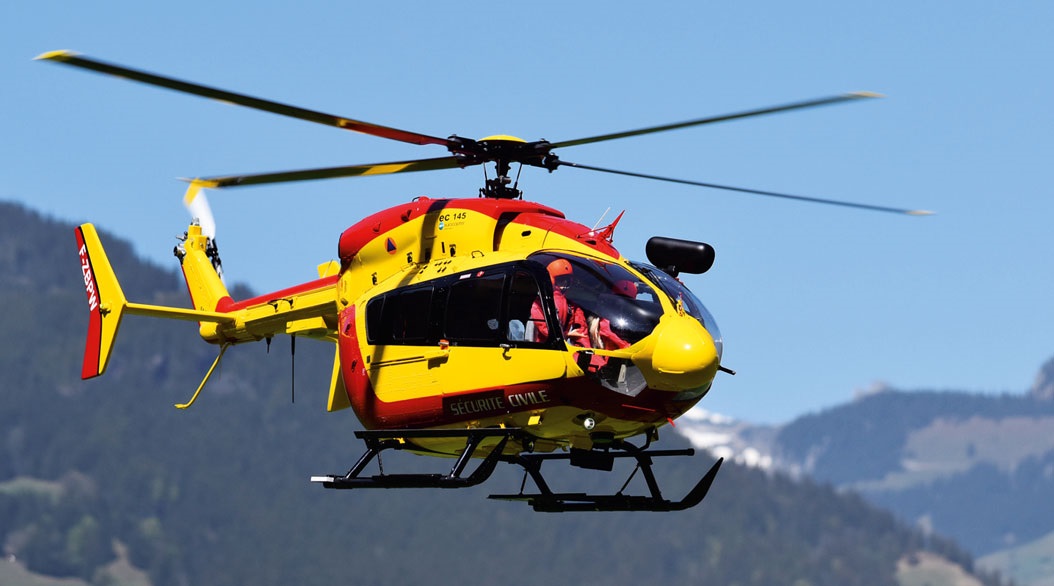
Michael Tschiemer from Matten, near Interlaken, wanted to address precisely these issues so that he could participate in national and international competitions in the future. He chose the EC 145 in the Sécurité civile livery as his model. This French organization has been operating this type of helicopter since April 2002. An initial batch of 32 helicopters was procured, followed later by six more, three of which were lost in accidents. In 2006, the EC 145s were equipped with IFR equipment so that they could also operate at night and in bad weather.
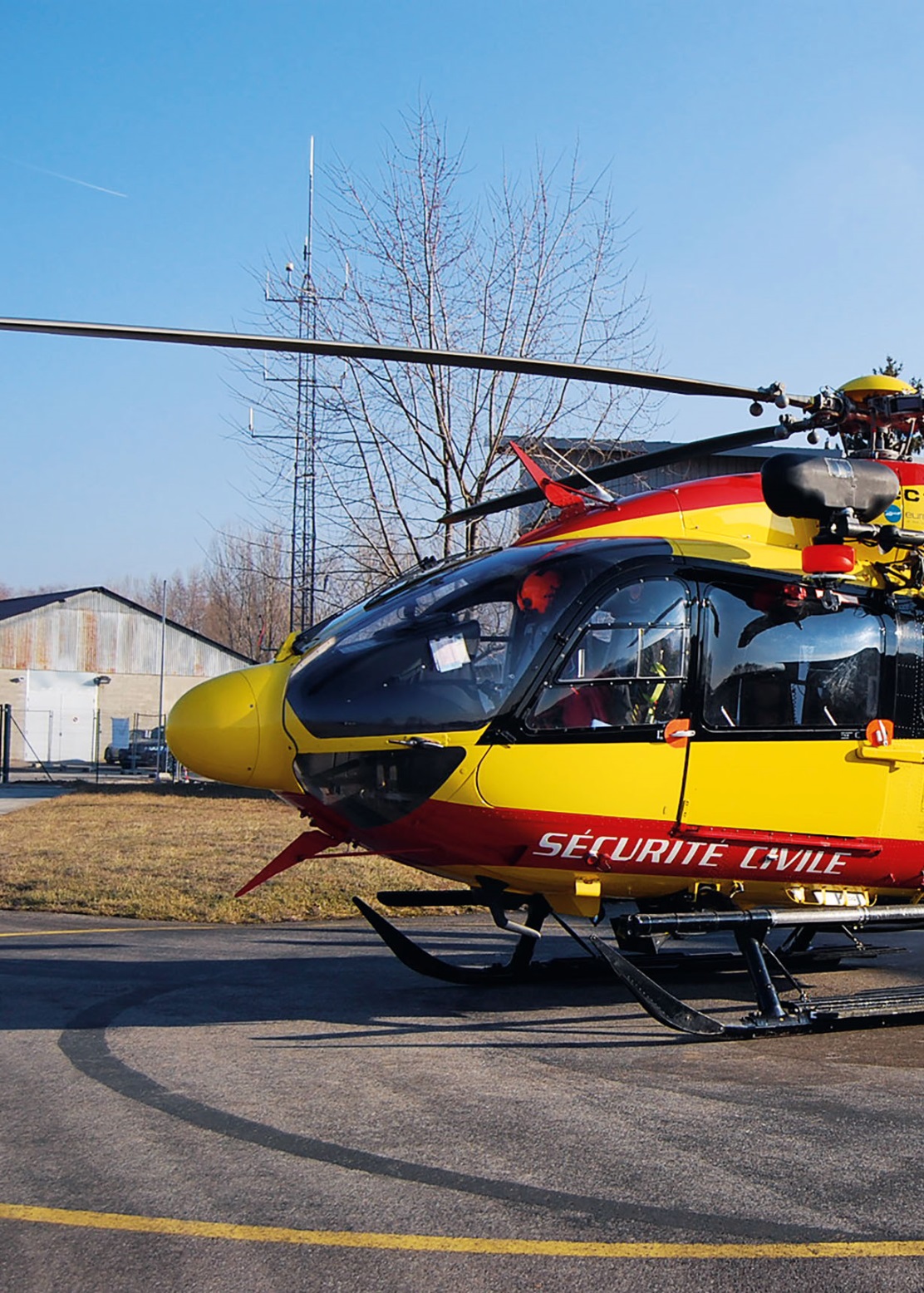
Michael Tschiemer from Matten, near Interlaken, wanted to address precisely these issues so that he could participate in national and international competitions in the future. He chose the EC 145 in the Sécurité civile livery as his model. This French organization has been operating this type of helicopter since April 2002. An initial batch of 32 helicopters was procured, followed later by six more, three of which were lost in accidents. In 2006, the EC 145s were equipped with IFR equipment so that they could also operate at night and in bad weather.
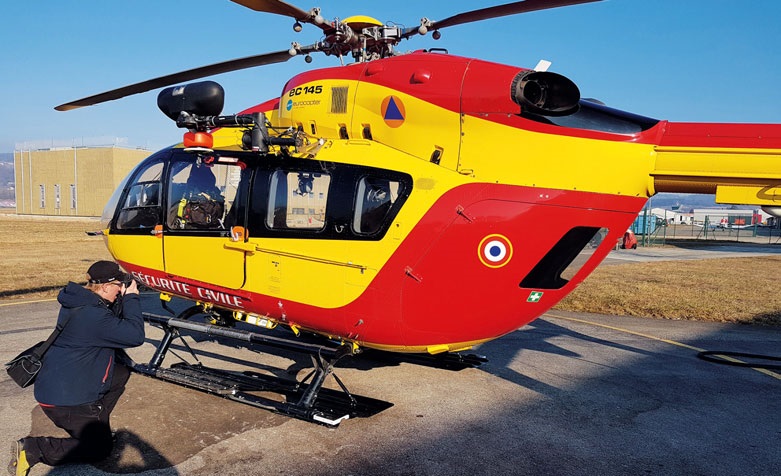
The Eurocopter EC 145 is a twin-engine light utility helicopter developed and manufactured by Eurocopter. Originally designated the BK117C2, the EC 145 is based on the MBB/Kawasaki BK 117 C1, which was incorporated into the Eurocopter program in 1992 following the merger of the helicopter division of Messerschmitt-Bölkow-Blohm (a subsidiary of Daimler-Benz) and the helicopter division of Aérospatiale-Matra to form Eurocopter. Depending on the customer configuration, the EC 145 can carry up to nine passengers and two crew members. It is used for passenger transport, emergency medical services (EMS), and search and rescue operations. In 2014, Airbus Helicopters renamed the EC 145 the H145. Military variants of the helicopter are also manufactured under various designations, such as the H145M or UH-72.
In France, the Sécurité civile brings together various resources—primarily public ones—to assist the population and respond quickly in the event of a major crisis or large-scale incident. This organization is divided into two levels:
- at the national level: the General Directorate for Civil Security and Crisis Management
- at the regional level: fire departments
The Civil Protection Air Resources Office reports to the national level. It consists of:
- a headquarters in Nîmes (with a command and logistics base, a training center for crews, and a maintenance center)
- 23 helicopter bases in France, Guadeloupe, and Martinique
Every year, these 35 EC 145 helicopters—affectionately known as “Dragons”—operated by 210 rescue pilots and mechanics, assist nearly 10,000 people. These helicopter missions are handled in order of priority:
- Deployment of personnel and equipment
- Police and technical assistance
- Forest firefighting
- Non-emergency assistance
- Emergency rescue and recovery
In all of these operations, the rescue and care of people always take priority.
In early 2016, Michael Tschiemer first began considering replacing his two models—the Super Puma and the Alouette III—with a new model for the Swiss Championship starting in 2018. With these two models—the Super Puma until 2013, followed by the Alouette III until 2016—he has consistently secured a podium finish since 2009, including two Swiss championship titles. He replaces his “workhorse” at regular intervals. Unfortunately, some participants in the Swiss Championship have been using the same model year after year. On the one hand, this makes the competition boring; on the other hand, when these are models that consistently rank at the top, new models have a hard time achieving a top placement.
Hansueli Tschiemer, Michael’s father, is a longtime judge in the Swiss scale modeling scene. As such, he was, so to speak, the expert on building the model perfectly right at home and was able to support his son with advice and practical help. This service—available before and during the construction of a scale model—is accessible to everyone through the Swiss Model Flying Association. There, you can be put in touch with a judge who will be happy to help ensure the creation of a successful scale model.
Do one thing without neglecting the other—that’s how one might describe Michael’s choice of model. By chance, he had learned that a colleague was offering an EC 145 with mechanical components for sale. After a few conversations with the seller, he was able to purchase these components. From the outset, however, it was clear that the old electromechanical system would have no place in the new model. It dated back to the early days of electric flight and did not allow for any modifications to the motor or gear ratio. The disassembly work began in late summer 2016. Parts that were no longer usable were discarded, while those that were usable were inspected, overhauled, and prepared for the new model.
At the same time, Michael researched and selected the real-world model on which the aircraft was to be based. The obvious choice, of course, would have been REGA, which is practically on his doorstep at the airfield in Wilderswil/Interlaken. But the fact that countless models already existed based on this prototype made him quickly dismiss that idea. While researching online, he stumbled upon the EC 145 operated by Sécurité civile rather by chance. As he continued his search, Michael discovered that the nearest base, DRAGON 74, is located in Annecy, just south of Geneva. He quickly wrote an email expressing his desire to visit the base and create a photo documentation of the real-life model, and sent it to the base management. A positive response came in less than 24 hours, so the appointment was set for January 7, 2017. On that day, two identical helicopters were stationed at the base, but only one of them was in service. This allowed Michael to spend the entire day photographing the EC 145 F-ZBPW. He took well over 1,000 photos from a wide variety of angles and capturing countless details. He was even able to take home a mechanic’s personal phone number that evening, just in case any details were missing.
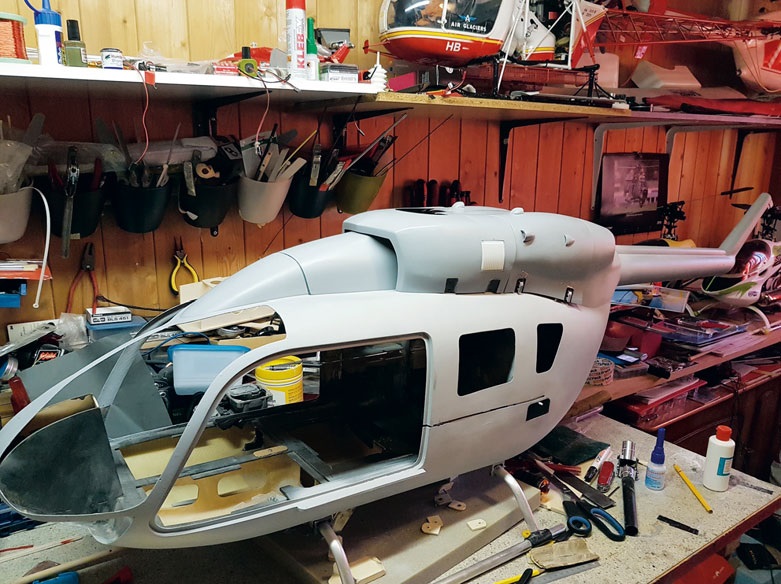
The old mechanical system was to be replaced with a new electromechanical system from Helikopter Baumann. To do this, some of the frames had to be cut out and replaced with new ones. It soon became clear, however, that the flexible shaft for the tail rotor drive could no longer be removed from the tail boom. As a result, Michael was able to cut off the old tail boom and later replace it with a new one. The radar nose gave Michael quite a headache. His attempt to make his own master model just wouldn’t fit. Rather by chance, however, he found a suitable one in an online store in England, which he ordered. After it was delivered quickly, it became clear that this radar nose fit the model 100%. After gluing it on and filling in the gaps, the result was more than impressive. In the next step, all the openings in the fuselage were laminated shut again, since most were in the wrong place or were too large. At the same time, the old paint was sanded off. Afterward, all the slots, cutouts, and windows were milled out again—but now in the right places and at the correct sizes. After bonding the new tail boom to the fuselage, the fixed-pitch propeller with the bevel gear could be repositioned. Fitting the doors also took a lot of work. On the purchased model, these were attached only with magnets. The two pilot doors were fitted with hinges so they could open. U-channels were installed in the fuselage for the two sliding doors. With corresponding guides in the U-channels, they now function as sliding doors.
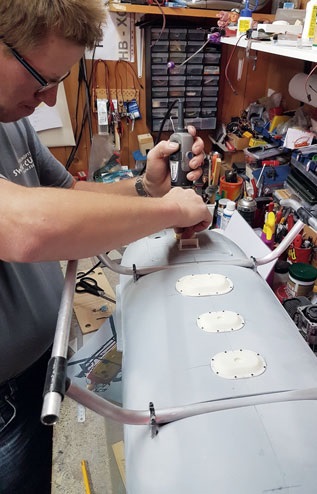
Michael Tschiemer had to invest a lot of time and patience in the scale modifications. The cable cutters were attached to the top and bottom of the cockpit. Ventilation openings were incorporated. The service panels were installed in their respective locations, some with hinged covers, just like on the original. The cutout for the retractable landing light was cut, and the correct air intakes, antennas, steps, and handrails were glued in place. The homemade rescue winch was mounted on the fuselage; it is removable. After priming the entire fuselage, Michael was able to apply the rivets. The landing gear was also modified and scaled down. Based on the photos he had taken in Annecy, he sketched the rivet lines onto the fuselage with a pencil. He applied the approximately 7,000 rivet dots using the tried-and-true technique of applying white glue with a syringe.
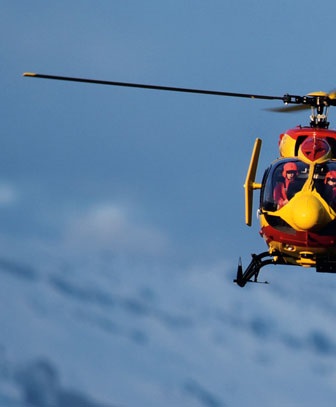
After the fuselage returned from the paint shop, Michael applied all the decals to the fuselage. The mechanical components—equipped with Futaba BLS 452 servos for the swashplate and a Kontronik Pyro 700-45 motor—were then installed in the fuselage. The Kontronik Jive 120 HV was used as the ESC. The tried-and-true bavarianDEMON 3X 3-axis stabilization system was used for attitude stabilization. After trimming the new set of discs to size, they were either glued in place or secured with screws. After installing the cockpit and placing the pilot dummies in their seats, work could begin on adjusting and programming the electronics. The more precisely this work is done on the workbench in the hobby room, the less needs to be adjusted and fine-tuned later at the airfield.
On September 15, 2017, just two weeks before the Scale Swiss Championship, the maiden flight took place. Right from the start, the model flew exactly as Michael Tschiemer had hoped. Only minor adjustments to the sensitivity and agility settings in the bavarianDEMON 3X were needed. Five flights were completed on the very first day, and the model became more fun to fly with each one. The fact that the right approach was taken in every respect with this model is demonstrated by Michael’s victory in the Semi-Scale category at the Swiss Championships just two weeks after the maiden flight.
During the winter months of 2017–2018, additional scale modifications were made to the model. Based on photos taken in Annecy, my own photos, and dimensional sketches, I built, painted, and installed the retractable gun myself. The winch, which had already been built and was part of the existing model, was further refined with cables and adhesives and adapted to closely match the original. Additional minor work on details such as the antenna guard, small lettering, and the addition of fasteners now complete the model’s appearance. Michael and his father spent about 1,300 hours building it.
| EC 145 | Prototype | Model |
| Crew | Two pilots, nine passengers | – |
| Max. takeoff weight | 1,340 kg | 11.8 kg |
| Engine | Two Arriel 1E2 engines, 720 PS each | Electric motor, controller |
| Fuel capacity | 879 liters | 2x 6S 5000 mA battery packs |
| Fuselage length | 11.69 m | 1.65 m |
| Length overall | 13.17 m (rotor spinning) | 2.01 m (rotor spinning) |
| Rotor diameter | 11.0 m | 1.82 m |
| Height | 4.00 m | 0.60 m |
| Max. cruising speed | 268 km/h | – |
| Range | 663 km (without reserve) | – |
| Max. rate of climb | 8.4 m/sec | – |
“I’ve had a very intense year building the EC 145. At times, under the pressure I put on myself to have the model ready for the 2017 Swiss Championship, I came very close to giving up on this project. At this point, however, I’d like to thank my father, who knew just how to motivate me to keep going, as well as for his help. I’d also like to extend a big thank you to the staff at Sécurité civile in Annecy. Without their unstinting support during the photo session and later with minor detail inquiries, it wouldn’t have been possible to complete the model so quickly. I’d also like to thank everyone else who contributed in any way to the success of the EC 145.
Not only have I devoted a great deal of time to building the model, but I’ve also been flying it as much as possible in the meantime. After 50 flights now, it’s still fun to fly it true to the prototype, and the great flight performance makes up for a lot.»
Photos: Hansueli Tschiemer, Anton Laube


News from HEBU

TEAM MANAGER "THIS" BOSSHARD
 Rodito Nussbaumer

YOU KNOW WHAT I MEAN? 125 YEARS OF THE SWISS AERO CLUB
 Emil Giezendanner

HORIZON HOBBY/LEMACO NEWS: MICRO OV-10 BRONCO 645 MM BY E-FLITE

PRIDE AND GOOD IDEAS
 Markus Nussbaumer

34th HAHNENMOOS ALPINE MODEL AIRPLANE CAMP
Res Dauwalder
TRY-OUT DAY AT MFV WETTINGEN
Urs Keller
F3A EUROPEAN CHAMPIONSHIPS IN ST-MACAIRE, FRANCE
 Matthias Bosshard

52. 2026 ALPS CUP
Emil Giezendanner
ATOM, THE NEW DOUBLE-DECKER FROM CPLR
Matthias Bosshard
SUMMER FUN 2026 AT MG USTER
Martin Wunderli
What's New at Leomotion.com

COUPE DES ALPES – OBSERVE AND LEARN
Rodito Nussbaumer
TWIN TOWN PARTNERSHIP
Wolfgang Voeller
BY YOUTH, FOR YOUTH
Lorena Betschen
CORSAIR F4U – A WARBIRD WITH A MEMORABLE LOOK
Jürgen Rosenberger, Jürgen Prinz
SMALL, MODEL-LIKE SAILBOATS
Res Dauwalder
WELCOME, NEW MEMBER!
Andrea Bolliger
FREE FLIGHT IN THE MIDDLE OF SUMMER
Urs Muntwyler
EURO CONTEST GLIDER ACRO TOUR AUSTRIA 2026

INSIGHTS INTO THE HISTORY OF SEAPLANES

THE PC-21 STORY
Emil Giezendanner
NEWS FROM HEBU
 Julia Bucher

FROM 0 TO 100
Markus Nussbaumer
MEMORIES
Wolfgang Völler
NOS REGION – A HUB FOR ELECTRIC AVIATION
Emil Giezendanner
DO YOU KNOW WHAT I MEAN IN THE LAND OF SMILES?
Emil Giezendanner
A SPECTACULAR F3A WORLD CUP IN THE PRINCIPALITY OF LIECHTENSTEIN
Emil Giezendanner