
The Neverending Story
The "Helicopter Model"—with a Twist
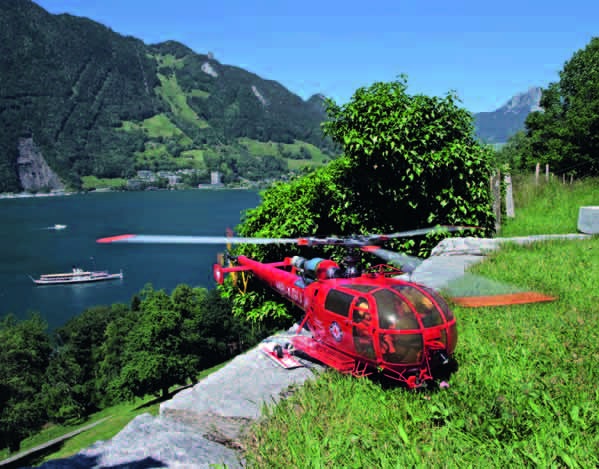
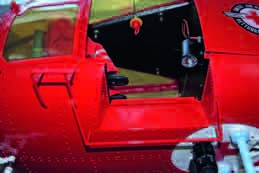
The project began about 30 years ago using a Vario fuselage kit—which was already available at the time—with a length of 1,300 mm. At that time, Martin was training as a model maker, so making modifications and adjustments to the model was, of course, no problem for him. Right at the start of work on the model, a significant modification was made to the fuselage: the installation of the floor hatch. In the original fuselage, this hatch folds down—for example, when the rescue winch was operated. On the model, however, instead of being hinged, it was constructed using a sheet metal panel that retracts into the floor. Many major and minor details on the fuselage and landing gear were added and faithfully reproduced
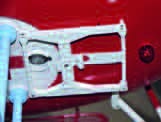
. The external mount for the searchlight and the frame for the load hook were custom-made based on photos of the real aircraft. The cargo basket, rescue winch, searchlight, and the landing gear retraction guards were purchased. Recreating the dummy turbine took a lot of time and effort, but the result makes all the hard work worthwhile.
The nitro version, which was distributed by Vario at the time, was used for the mechanical components. However, Martin’s goal had always been to create the quietest possible powertrain for his purposes, which eventually led him to remove all gear components and replace them with electric motors driving the main rotor and tail rotor directly
. As a result, the model operates virtually silently today, except for air noise, depending on the speed at which the main rotor is spinning. This now allows the model to operate continuously in a living area without disruptive background noise.
Of course, electronics were still at a different level of technology back then, which meant that the model was equipped with two “analog” strobe lights. Although these strobes worked well, they had the problem that powering them from a power supply unit located outside the model over a longer distance was problematic. Halogen bulbs were used as headlights, but they always posed a problem due to the significant heat
. The integrated searchlight could only be turned on for short periods at a time, as it was located very close to the fiberglass fuselage.
Although the external searchlight and the spotlights mounted on the model’s fuselage were less affected by this problem because they were “exposed,” the following still happened on several occasions: Occasionally, a fly would stray into the horizontally mounted headlights on the fuselage. If the spotlight was turned on and this went unnoticed, the fly would burn inside the spotlight, causing the black anodized coating to turn brown. Having these spotlights re-anodized black was an expensive undertaking. →
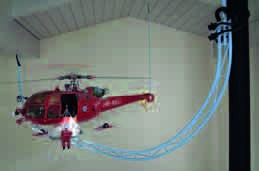
Martin Dällenbach took advantage of the COVID-19 crisis to bring the lighting up to the latest state of the art. The problematic analog strobe lights, as well as the headlights with halogen bulbs, were removed and replaced with products featuring the latest LED technology. As a special highlight, four LEDs were installed in the ceiling of the cabin to serve as interior lighting. This renovation has paid off in every respect—not least because of how the lighting looks when turned on—and, of course, these LEDs consume virtually no power compared to the old lighting. Power supply over long distances—since the model hangs at a great height in a specially constructed frame above the stairwell—is no longer a problem either.
I asked Martin Dällenbach a few questions about himself and this extraordinary project:
The internal combustion engines available at the time had never convinced me; turbines didn't exist yet, and operating the vehicle with an electric motor and battery would likely have been very difficult given its size. I also focused on the mechanics
I never really dared to try it because I didn't know enough about it. Furthermore, the idea of running such a model continuously in my living room appealed to me more and more than flying a model airplane myself
That’s no longer the case today either: I’m no longer a model builder, and I don’t fly myself either. What I do enjoy doing, however, is organizing helicopter flights with friends and taking photos of the helicopter in beautiful surroundings—as well as, of course, our wonderful natural scenery.
Yes, there have been repeated breaks lasting years during which I didn't do anything or, at times, didn't have time to work on the model. Today, my family is my top priority. That's also the reason why I put the lighting upgrade on hold during the COVID-19
I had caused a crisis. I was home for three weeks and had plenty of time for it.
Yes. Whenever I was able to set aside a significant amount of time for it. For example, a few years ago, I was able to make up for a lot of overtime, which allowed me to spend four weeks working on the model.
No, over the past 15 years or so, my passion in this area has shifted away from model helicopters and toward helicopter spotting.
can be requested and ordered.
No, I collected most of the photos for this project over the years. Many were provided to me by organizations such as Rega and other Swiss operators. But I also received many photos from private individuals whom I’ve gotten to know over the years. However, whenever the originals were still available, I took the photos myself. I compiled the descriptions through countless phone calls or on-site visits to former companies that operated the Alouette III.
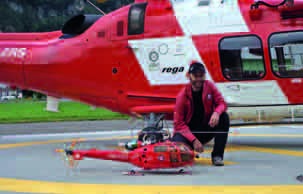
In the future, I might plan to set up a website in this area. My friend and I would like to sell products such as the books, stickers, and drawings mentioned—
as well as sell textiles. This website is also intended to be open to other aviation enthusiasts so they can post pictures, launch projects, etc.
I can't say yet. This project is still only in the early planning stages; when I do something, I do it right, which also takes the necessary time
It's needed. I'll have to discuss this with my family, too. I already have a rough concept for a site like this, but as I said, the whole thing needs to be thought through carefully.
**Thank you very much, Martin, for the great insights into your world of model building.**
*Photos: Martin Dällenbach*
published. This resulted in three illustrated books in which I attempted to document as comprehensively as possible the history of each of the 126 Alouette III helicopters registered in Switzerland:
- Illustrated Book: Alouettes III 316
- Photo Book: Alouettes III 319
- Photo Book: Rega Donor Newsletters
These photo books are produced on a made-to-order basis and can be ordered directly from me at m.daell@bluewin.ch


News from HEBU

PRIDE AND GOOD IDEAS
 Markus Nussbaumer

TEAM MANAGER "THIS" BOSSHARD
 Rodito Nussbaumer

YOU KNOW WHAT I MEAN? 125 YEARS OF THE SWISS AERO CLUB
 Emil Giezendanner

F3A EUROPEAN CHAMPIONSHIPS IN ST-MACAIRE, FRANCE
 Matthias Bosshard

HORIZON HOBBY/LEMACO NEWS: MICRO OV-10 BRONCO 645 MM BY E-FLITE

ATOM, THE NEW DOUBLE-DECKER FROM CPLR
Matthias Bosshard
SUMMER FUN 2026 AT MG USTER
Martin Wunderli
What's New at Leomotion.com

52. 2026 ALPS CUP
Emil Giezendanner
TWIN TOWN PARTNERSHIP
Wolfgang Voeller
CORSAIR F4U – A WARBIRD WITH A MEMORABLE LOOK
Jürgen Rosenberger, Jürgen Prinz
SMALL, MODEL-LIKE SAILBOATS
Res Dauwalder
TRY-OUT DAY AT MFV WETTINGEN
Urs Keller
WELCOME, NEW MEMBER!
Andrea Bolliger
COUPE DES ALPES – OBSERVE AND LEARN
Rodito Nussbaumer
EURO CONTEST GLIDER ACRO TOUR AUSTRIA 2026

BY YOUTH, FOR YOUTH
Lorena Betschen
INSIGHTS INTO THE HISTORY OF SEAPLANES

34th HAHNENMOOS ALPINE MODEL AIRPLANE CAMP
Res Dauwalder
THE PC-21 STORY
Emil Giezendanner
FREE FLIGHT IN THE MIDDLE OF SUMMER
Urs Muntwyler
NEWS FROM HEBU
 Julia Bucher

FROM 0 TO 100
Markus Nussbaumer
MEMORIES
Wolfgang Völler
NOS REGION – A HUB FOR ELECTRIC AVIATION
Emil Giezendanner
DO YOU KNOW WHAT I MEAN IN THE LAND OF SMILES?
Emil Giezendanner
Have you almost forgotten about aircraft that take off and land vertically?
Emil Giezendanner