
Tethered model airplanes for aerobatics
Tethered aerobatic models are highly specialized model airplanes designed to perform various maneuvers while tethered to two 20-meter-long steel cables. The pilot stands in the center of his hemispherical flight space and controls the aircraft using a lever mechanism inside the model and by moving his hands around the aircraft’s transverse axis. This is done at a speed of approximately 85 km/h, which requires the pilot to continuously rotate around his own axis.
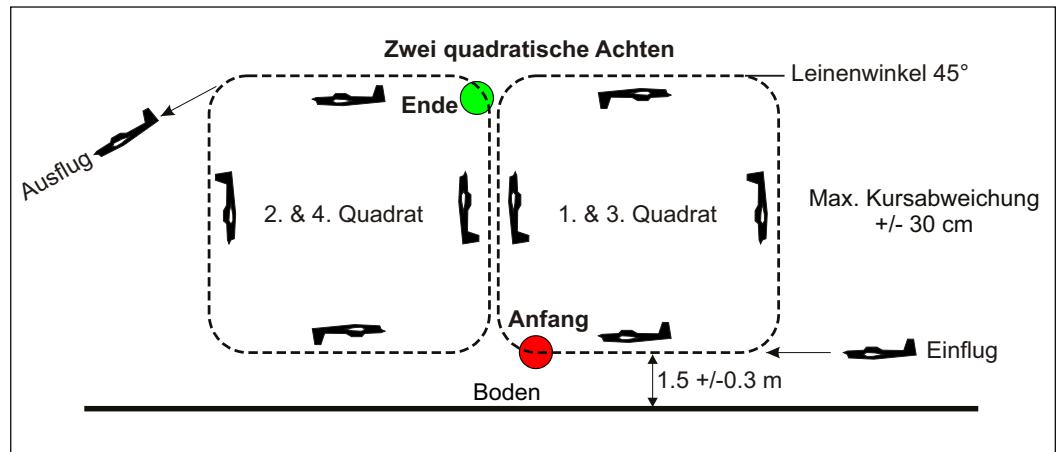
As far as rotational vertigo is concerned, this is generally not a problem at all after a brief adjustment period. What is certainly much more demanding, however, is that the prescribed flight paths in the 14 standardized maneuvers must be maintained within a tolerance of +/- 30 cm, and the required intercept heights from a vertical dive are just 1.5 m. Meeting these criteria at a speed of 25 m/sec and over a flight duration of 6 minutes is a very special—and therefore thoroughly fascinating—challenge. The prerequisites for this are a model that is designed and tuned as perfectly as technically possible, and a pilot who has trained very diligently over many years. Today, more than 60 years after
tethered flight was recognized as a model aviation sport by the FAI, several hundred model aviators worldwide participate in the F2B aerobatics category—both as a competitive sport up to the level of the World Championship
as well as a demanding, more or less intensive recreational activity. A short video on this topic can be found here:
https://www.mycloud.ch/s/S00F572C10969F3214A34AA0A0A6C15994E575CF879
With a wingspan of about 1.5 m and a takeoff weight in the range of 1.8 kg, F2B models are, on the one hand, lightweight and, on the other, extremely sturdy structures that must withstand load factors of 15 G over many hundreds of flights. While it is certainly
common to design the models with an attractive shape and paint them to a professional standard—while this doesn’t exactly make the design and construction process easy—it’s always a good reason to set out once again to build the “ultimate” model...
With the availability of composite construction methods, the use of ready-built, competition-ready models has become very widespread. These highly precise yet lightweight models have given F2B model flying a significant boost, and today they account for approximately 50% of the European and
represented at world championships. Depending on customer preference, the models are delivered either with a special F2B internal combustion engine or with an electric powerplant. The current purchase price for such a ready-to-fly model ranges from €2,500 to €3,500, with a delivery time of up to one year.
A globally popular version of the composite models is the Shark, which has been refined over many years and across a substantial fleet. The aircraft is built in Ukraine by top pilots, painted to an excellent standard upon request, and professionally test-flown and adjusted before shipment. The very lightweight ma-
aircraft arrives fully disassembled in its transport crate and is ready for immediate use. A reliable repair service is included with the delivery.
However, as has been the case for many decades, half the joy lies in designing an aircraft and building it to a high standard while keeping the weight low. Such a project can easily take half a year, which has the advantage that half the joy lasts just as long.
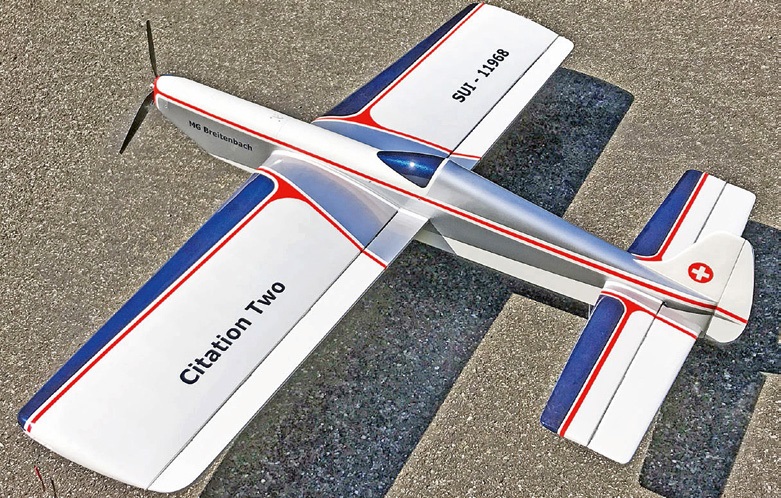
Using my Citation Two as an example, here is the basic structure of the fuselage:
The corresponding wing features a symmetrical airfoil with an 18% thickness and a
wingspan of 1,470 mm, constructed with a rib-and-stringer design and covered with Polyspan fleece and paper. Of particular note are the camber flaps, which are linked in the opposite direction to the elevator. These generate the considerable additional lift required when flying around sharp corners. The model is built entirely from carefully selected lightweight balsa wood. It is spray-painted with two coats of automotive paint and weighs 1,800 grams ready for launch. This results in a wing loading of 40 g/m².
F2B powerplants operate completely autonomously throughout the entire flight time of approximately 6 minutes; that is, the pilot must not influence their performance. However,
however, the power required to maintain speed—and thus the centrifugal force on the control lines, which is essential for controllability—varies depending on the model’s position on the flight hemisphere; this necessitates the automatic delivery of the correct power at the right moment.
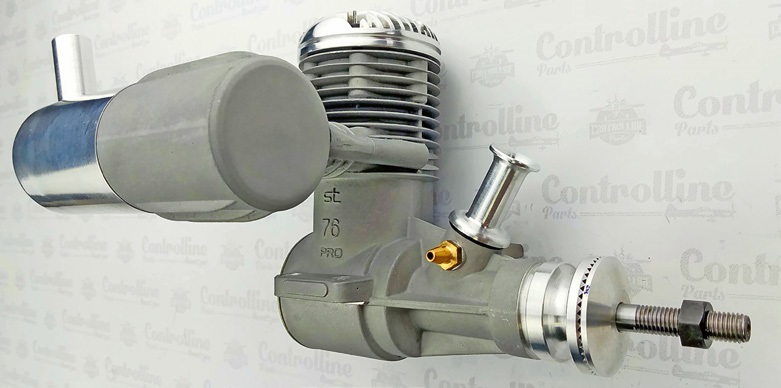
Manufacturers of highly specialized F2B internal combustion engines have, through many years of work, designed their engines so that their power output automatically adjusts to the flight conditions based on the load.
Through appropriate sizing of components, carefully selected materials, precisely matched propellers and mufflers—and, not least, the composition of the fuel—the power delivery is thus adapted to the flight profile of an F2B model.
For some time now, the industry has been providing us with lightweight and very powerful electric motors and suitable batteries. While the F2B community initially used such powerplants with constant-speed control, advanced systems are now capable of determining the power required at any given position on the hemisphere by measuring in-flight accelerations and delivering it without delay.
A 25 × 25 mm sensor mounted horizontally near the aircraft’s center of gravity contains both a 2-axis—
An accelerometer as well as a freely programmable computer for generating control signals for a controller that, while modified, is largely standard off-the-shelf equipment (Jeti Spin 66). With fully automatic power control for electric drives—which can be freely programmed via a Jeti Box—electric F2B competition models represent the state of the art today.
For the "Citation Two" aircraft, there are detailed drawings, parts lists, and very comprehensive building instructions with information on all material sources. The complete documentation is freely available at:
https://www.mycloud.ch/sS000CA232F1DD053AA0362EEE8DE257AE1EF2C533E5
The website of Technical Commission F2 of the Swiss Model Aircraft Association (SMV) provides an overview of tethered flight events in Switzerland and contains a wealth of useful information, including regulations, schedules, and technical tips:
A forum on this topic, updated daily in English and primarily from the perspective of the very active aerobatics community in the U.S., can be found here:
https://stunthanger.com/smf/index.php#8
You can also find numerous Facebook groups from all over the world under the term “Control Line Flying.”
Tethered model aircraft require a level, very short-cut field measuring approximately 50 x 50 m. If the field is also free of obstacles and the landowner gives permission, flying can take place both at suitable model airfields and, for example, on soccer fields.
Electric-powered models are quiet. For this reason, and because of their maximum flight altitude of 25 meters, operating them generally isn't a real problem. For safety reasons, however, it's always a good idea to have a knowledgeable flight assistant on hand.
Designing and building F2B models, and then flying them during training and at competitions among fellow enthusiasts, is a difficult, demanding, and quite time-consuming endeavor. It involves endless technical deliberations, constant learning and
with friends, and the often challenging task of sourcing materials and components from all over the world. But it also involves the experience of lifelong friendships among like-minded people. Yes, F2B really isn’t easy, but it’s truly rewarding in the long run.


News from HEBU

TEAM MANAGER "THIS" BOSSHARD
 Rodito Nussbaumer

YOU KNOW WHAT I MEAN? 125 YEARS OF THE SWISS AERO CLUB
 Emil Giezendanner

F3A EUROPEAN CHAMPIONSHIPS IN ST-MACAIRE, FRANCE
 Matthias Bosshard

SUMMER FUN 2026 AT MG USTER
Martin Wunderli
TRY-OUT DAY AT MFV WETTINGEN
Urs Keller
52. 2026 ALPS CUP
Emil Giezendanner
BY YOUTH, FOR YOUTH
Lorena Betschen
ATOM, THE NEW DOUBLE-DECKER FROM CPLR
Matthias Bosshard
CORSAIR F4U – A WARBIRD WITH A MEMORABLE LOOK
Jürgen Rosenberger, Jürgen Prinz
SMALL, MODEL-LIKE SAILBOATS
Res Dauwalder
What's New at Leomotion.com

TWIN TOWN PARTNERSHIP
Wolfgang Voeller
EURO CONTEST GLIDER ACRO TOUR AUSTRIA 2026

INSIGHTS INTO THE HISTORY OF SEAPLANES

34th HAHNENMOOS ALPINE MODEL AIRPLANE CAMP
Res Dauwalder
WELCOME, NEW MEMBER!
Andrea Bolliger
HORIZON HOBBY/LEMACO NEWS: MICRO OV-10 BRONCO 645 MM BY E-FLITE

FREE FLIGHT IN THE MIDDLE OF SUMMER
Urs Muntwyler
COUPE DES ALPES – OBSERVE AND LEARN
Rodito Nussbaumer
PRIDE AND GOOD IDEAS
 Markus Nussbaumer

THE PC-21 STORY
Emil Giezendanner
NEWS FROM HEBU
 Julia Bucher

FROM 0 TO 100
Markus Nussbaumer
MEMORIES
Wolfgang Völler
NOS REGION – A HUB FOR ELECTRIC AVIATION
Emil Giezendanner
Have you almost forgotten about aircraft that take off and land vertically?
Emil Giezendanner
DO YOU KNOW WHAT I MEAN IN THE LAND OF SMILES?
Emil Giezendanner