
A charming lady from Belgium
How about a model made entirely of wood—and a biplane, to boot? The answer: a faithfully reproduced Stampe, prefabricated down to the last detail. What passionate model builder could resist that?
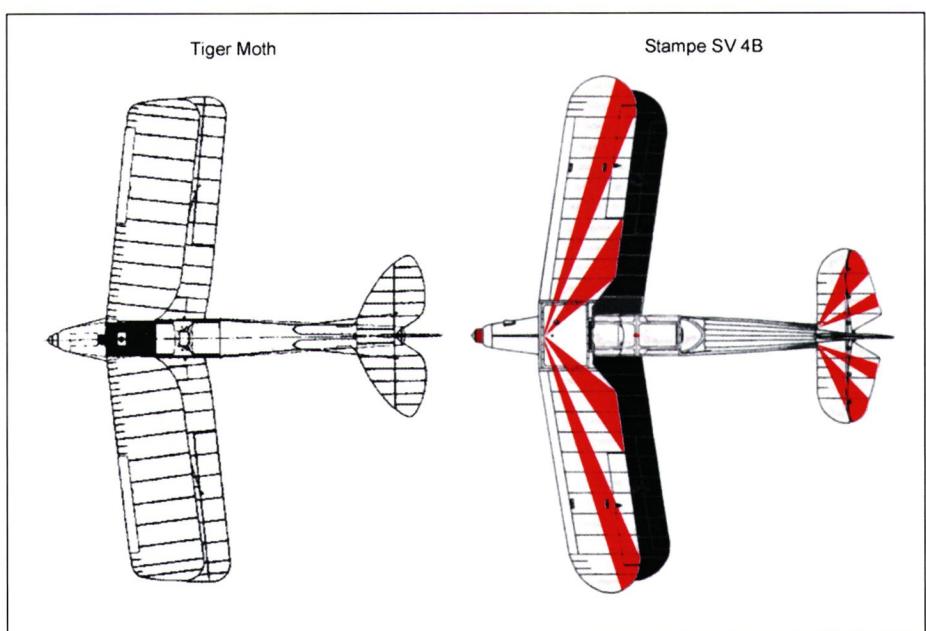
Stampe & Vertongen was a Belgian aircraft manufacturer. The company was founded in Antwerp in 1922 by Jean Stampe and Maurice Vertongen. Among other models, it built the Stampe SV 4, a training aircraft that made its maiden flight in 1933. The aircraft, which was later also built under license in France and Algeria for basic Air Force training, has a captivating charm. The Belgian version is equipped with a 147 PS De Havilland Gipsy Major 10 MK1 underhanging 4-cylinder engine, with which it reaches speeds of about 200 km/h. The aircraft is capable of aerobatics, although it is not certified for certain maneuvers (according to the flight manual, the following are not permitted: inverted loops and direction changes during an inverted spin, pulling up from a dive into an inverted flight, and barrel rolls exceeding 65 kts. or 120 km/h). Unlike the Tiger Moth—from which the Stampe differs primarily in wing geometry and rudder shape—it has ailerons on all four wings and is therefore particularly maneuverable around the longitudinal axis. The two-seat aircraft with dual controls has no landing flaps and is constructed entirely of ash wood strips and covered with fabric. Only the fittings, bracing, and engine mount are made of metal. A unique feature was that the engine was started using a mounted compressed-air cylinder, which was continuously refilled by an engine-driven compressor. Of course, it could also be started manually.
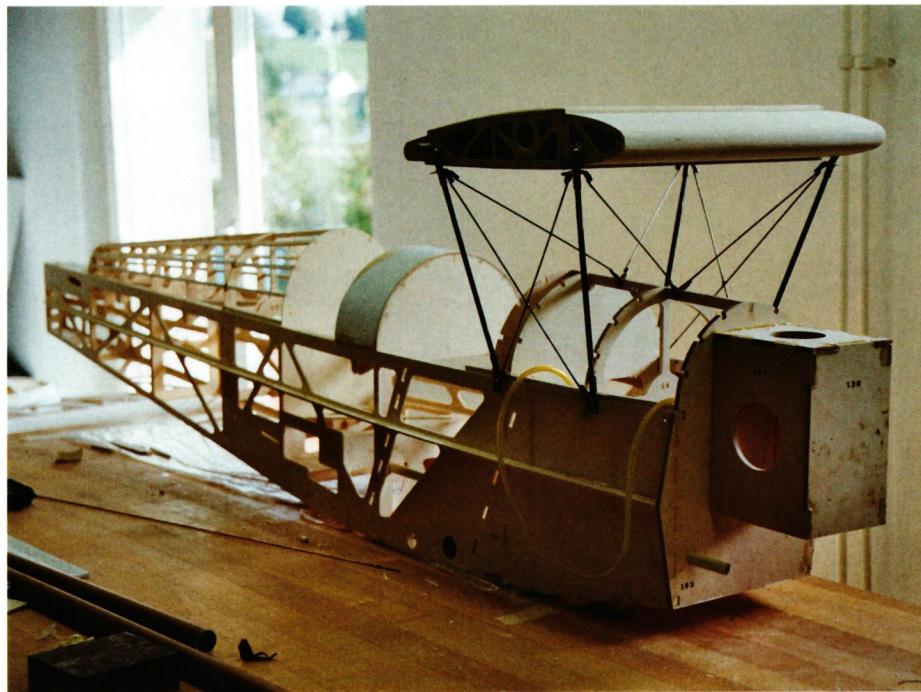
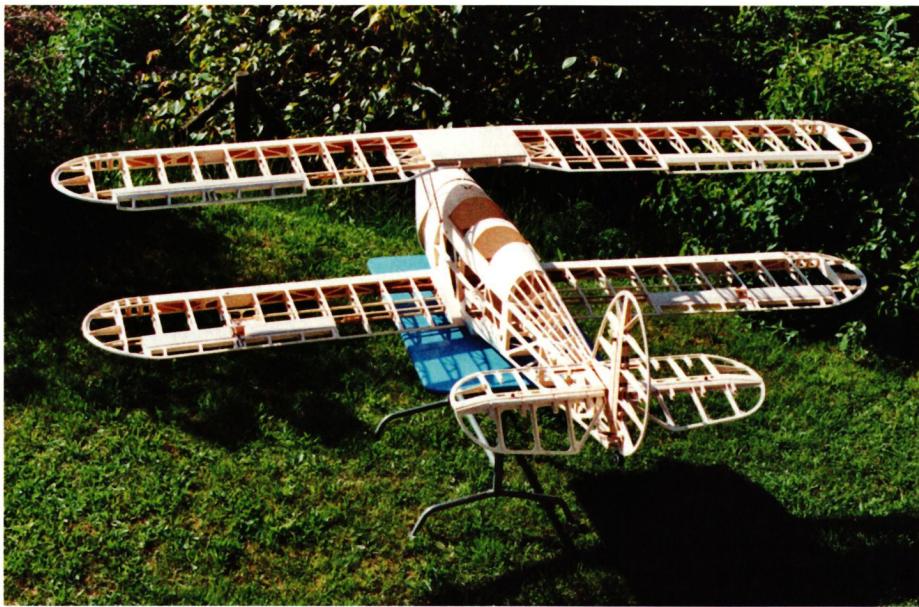
Modellbau Schlundt has taken this unconventional yet beautiful biplane as the model for its latest large-scale model. Mr. Schlundt, the designer of the Fly-Baby large-scale model—which became a legend even during his lifetime—planned and developed the kit over months of meticulous work based on the original blueprints and on-site research. Once again, he has succeeded in combining absolute fidelity to the original with a highly rigid structure and light weight—all while ensuring simple and quick assembly. Like the original, the model is constructed entirely of wood. What makes it special, however, is that this
The design is based on a perfectly interlocking system in which all parts are interlocked and self-supporting, allowing the individual components to be assembled in a very short time without the need for supports or jigs. This makes it possible to assemble the full-scale model on a simple kitchen table. The system is perfected by the fact that each part has a number milled into it at the factory. Furthermore, all—and I mean absolutely all—drilled holes and milled recesses are already finished, so that no adjustments or rework are necessary, and the canopy struts are fully soldered. Schlundt thus enables even the less experienced model builder to construct a model of the highest quality. They don’t have to worry about the often-dreaded issues—especially with a biplane—such as differences in trim angles, aileron deflection, engine pitch, and lateral pull. All of this is automatically accounted for by the design. Schlundt has also made it his goal to provide his customers with a kit that truly deserves the word “complete.” He has more than succeeded in this. In any case, in my forty years of model building, I have never held a kit in my hands that was crafted with such attention to detail and completeness. The large box contains all CNC-milled wooden parts, the engine cowling and oil tank, pre-assembled wing struts, landing gear, solid rubber wheels, a ready-to-install steerable tailwheel, a fuel tank with fittings, a fuel filler neck, a fuel hose, RC linkage parts, connectors, tension cables, turnbuckles, control cables, push rods for an absolutely scale-accurate aileron linkage, pre-cut and pre-drilled cockpit windows, lovingly milled cockpit instruments, templates for assembling the canopy (EWD!), and, last but not least, even special tools for quickly assembling the model at the field. Schlundt has truly left nothing out. Above all, however—and this is what makes the kit so special—all parts are of the highest quality and meet the high standards expected of such a model. To further simplify the assembly process, Schlundt has created an 80-page-plus instruction manual featuring several hundred detailed photos. Each step is described in detail with many valuable tips and tricks, from the start of construction all the way to the final finish with fabric sheeting. In this context, it’s worth mentioning that Mr. Schlundt takes the time to provide telephone consultation whenever needed—even on weekends, since that’s when most people are building.
| Scale: | 1:2.7 |
| Wingspan: | 3.10 m |
| Fuselage length: | 2.45 m |
| Powerplant: | ZG 45/60 with 2.5:1 gearbox |
| Takeoff weight: | 18.5 to 19.5 kg |
| Manufacturer and Distributor: | Modellbau Schlundt Martin-Luther Str. 11a D-46325 Borken www.modellbau-schlundt.de |
Schlundt recommends a ZG 45 or 62 engine, each paired with an in-house developed 2.5:1 gearbox. This powertrain has already more than proven itself in the Fly Baby. It drives a 34×20 propeller at approximately 3,000 revolutions per minute. Both variants provide sufficient power and delight with their true-to-prototype sound. Another advantage of these powerplants is that everything is already set up in the model. The engine cowling features the correct holes and the necessary camber and lateral offset. In addition, a pre-soldered stainless steel muffler—which also has pre-drilled holes—can be installed inside it. Transporting this large model is straightforward, as the horizontal stabilizer and the entire vertical stabilizer can be completely removed by simply loosening two Allen screws. Without the vertical stabilizer, the fuselage is then only 220 cm long, so it can fit in any mid-size car. The landing gear can also be made removable—if desired—so that the fuselage’s considerable height—caused by the biplane’s canopy—can be reduced for transport. Those who opt for a fixed landing gear configuration for faster setup at the airfield can, if necessary, lay the fuselage on its side for transport. Assembly at the airfield is relatively straightforward thanks to the snap-on connectors for the RC linkage and the wing and tailplane bracing designed for practical use, even if it does require a bit more time than with a model that fits in a trunk.
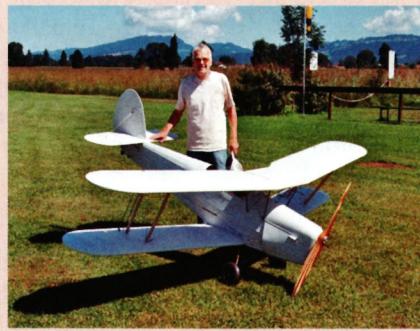
Once the engine is tuned and the transmission belts are retensioned, it’s time for the maiden flight. However, due to a poor solder joint that I made while assembling the landing gear, the model ends up making a belly landing before it even reaches the runway threshold. So here’s a note to add: Experience with brazing is recommended for the canopy and the landing gear. On the second attempt, the model takes off just like the original after a short roll-out and transitions into a gentle climb without requiring even the slightest trim adjustment. The model proves to be perfectly suited for aerobatics, and the maneuvers look simply fantastic and true to the original due to its size and the resulting visual inertia—after all, we’ve grown accustomed to nothing but frantic, jerky 3D displays. This is especially true for low flybys, during which you feel as though you can see the propeller spinning. Of course, the approach and landing are also a feast for the eyes. Despite the lack of landing flaps, the model touches down as smoothly as walking pace thanks to its high frontal drag. Truly a delight! Mr. Schlundt, your effort—I know there were setbacks in the planning—has been well worth it. You’re making it possible for model aircraft enthusiasts who enjoy building wooden models to quickly construct a very high-quality aircraft that will attract admirers at every air show.


News from HEBU

TEAM MANAGER "THIS" BOSSHARD
 Rodito Nussbaumer

YOU KNOW WHAT I MEAN? 125 YEARS OF THE SWISS AERO CLUB
 Emil Giezendanner

F3A EUROPEAN CHAMPIONSHIPS IN ST-MACAIRE, FRANCE
 Matthias Bosshard

SUMMER FUN 2026 AT MG USTER
Martin Wunderli
TRY-OUT DAY AT MFV WETTINGEN
Urs Keller
52. 2026 ALPS CUP
Emil Giezendanner
BY YOUTH, FOR YOUTH
Lorena Betschen
ATOM, THE NEW DOUBLE-DECKER FROM CPLR
Matthias Bosshard
CORSAIR F4U – A WARBIRD WITH A MEMORABLE LOOK
Jürgen Rosenberger, Jürgen Prinz
SMALL, MODEL-LIKE SAILBOATS
Res Dauwalder
What's New at Leomotion.com

TWIN TOWN PARTNERSHIP
Wolfgang Voeller
EURO CONTEST GLIDER ACRO TOUR AUSTRIA 2026

INSIGHTS INTO THE HISTORY OF SEAPLANES

34th HAHNENMOOS ALPINE MODEL AIRPLANE CAMP
Res Dauwalder
WELCOME, NEW MEMBER!
Andrea Bolliger
HORIZON HOBBY/LEMACO NEWS: MICRO OV-10 BRONCO 645 MM BY E-FLITE

FREE FLIGHT IN THE MIDDLE OF SUMMER
Urs Muntwyler
COUPE DES ALPES – OBSERVE AND LEARN
Rodito Nussbaumer
PRIDE AND GOOD IDEAS
 Markus Nussbaumer

THE PC-21 STORY
Emil Giezendanner
NEWS FROM HEBU
 Julia Bucher

FROM 0 TO 100
Markus Nussbaumer
MEMORIES
Wolfgang Völler
NOS REGION – A HUB FOR ELECTRIC AVIATION
Emil Giezendanner
Have you almost forgotten about aircraft that take off and land vertically?
Emil Giezendanner
DO YOU KNOW WHAT I MEAN IN THE LAND OF SMILES?
Emil Giezendanner