
Greek god or Chinese toy?
Review of Herakles by HEBU
Hercules, or Herakles, was the son of Zeus, the father of the gods, and Alcmene, the wife of Amphitryon, the king of Thebes. Hercules was known above all for his strength. He was accorded divine honors and was admitted to Mount Olympus. Whether this all-FRP Herakles, manufactured in the Far East, is worthy of such honors—and whether it can even ascend to the model aviator’s Olympus—is a question we’ll at least begin to address here.
It’s common knowledge that the Chinese are masters at copying. Word has likely spread by now that they’ve also become quite skilled at building model airplanes. Quite a few model airplane enthusiasts in Switzerland own some kind of jet-like foam model—or something along those lines. Most of them are quite taken with them. The models fly well, look pretty good, and in most cases come fully equipped—all at prices that are truly astonishing. Whether this has only advantages is open to debate. But what must be
must be said outright is that the Chinese have learned a great deal and can now compete with—or even surpass—many high-end models from established manufacturers.
A few years ago, the Entlebuch-based company HEBU also jumped on the Far East trade bandwagon. Heinz Bucher, the company’s CEO, has long specialized in sales, primarily via the Internet and, specifically, through the Ricardo e-commerce platform. A top priority for HEBU is ensuring that customers receive competent and courteous service even after their purchase. To this end, the company is constantly improving its service, maintains a well-stocked spare parts inventory, and resolves any issues in its own workshop. My own consistently positive experiences with HEBU prompted the author of this report to try out a somewhat more expensive model for myself. To cut to the chase: I was not disappointed.
A trip through Entlebuch gave me the opportunity to pick up the model right there at HEBU. I also picked up six Futaba 3151 digital metal-gear “servos” while I was there. To ensure the model could be used virtually anywhere, I converted it to the
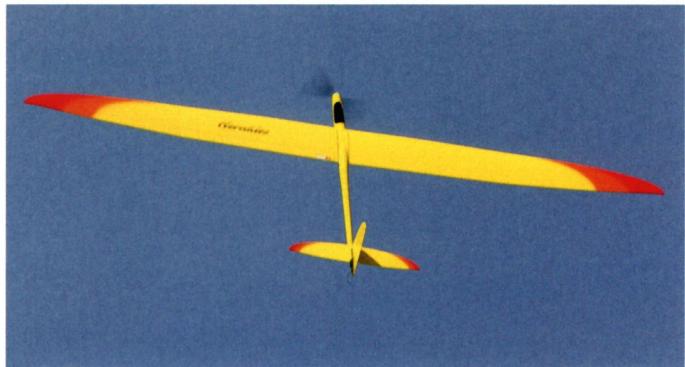
The electric glider was a done deal. Once I got home, I first subjected the parts to an even more thorough visual inspection. Even with the best will in the world, I couldn’t find any pits, dents, specks of dust, or other imperfections. However, anyone bothered by the clearly visible fuselage seam will have no choice but to paint the fuselage—
. The wings were quickly attached on a trial basis. The sturdy carbon fiber connector fits snugly, and the precision of the fit at the wing-fuselage junction is also impressive. The same applies to the tail unit, which is designed as a pendulum rudder. The linkage mechanism for it is excellent, functions smoothly, and is absolutely
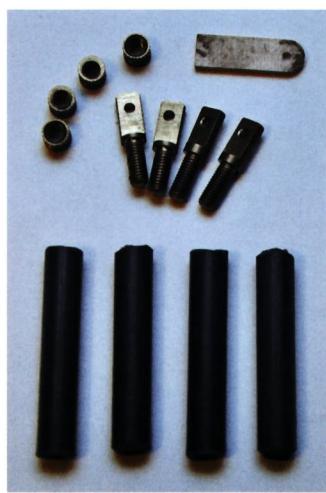
The play-free mechanism is already installed in the fuselage. The rudder linkage, which uses a carbon pushrod, is also installed. The canopy is fully assembled. Other than that,
in this kit, you’ll find only a few servo bay covers, torsion pins for the wings, a fiberglass servo board, and threaded pins with nuts for the control surface linkage. Even the high-gloss wings, which are very impact-resistant and thus suitable for everyday use, show no defects. The composite materials used suggest that this model is virtually indestructible in flight, no matter how hard it’s put through its paces.
Anyone who wants to convert the Herakles into an electric model should first think about how to install the necessary components. For an experienced model builder, the whole process should be a breeze
. However, anyone venturing for the first time into building a full-FRP F3B glider—which is how this model is classified—would appreciate a few installation tips and, above all, information on setup parameters such as center of gravity, EWD, control surface travel, or the position of the launch hook. Unfortunately, this pre-production model didn’t include any information along those lines.
An “ancient” but still in top shape Kontronik Fun 500/27 with a 5.2:1 gear ratio and a 14×9 carbon propeller, powered by four 2450 mAh LiPo cells, should have no trouble getting this model airborne. For the author, the Herakles was not meant to be a quick-launcher, although this would be
relatively easy to achieve today. Rather, what was needed was a powerplant that would get the model up to a good starting altitude quickly, smoothly, and ideally multiple times, so I could do some aerobatics, look for thermals, or simply sweep across the field for fun. As the saying goes, there’s room even in the smallest hut, but with two servos, a ESC, the motor, and the 4-cell LiPo, things still get pretty tight inside the Herakles’ fuselage. The pushrods for elevator and aileron should move freely. The massive carbon fiber connector and the receiver hidden behind it also needed to be factored into the design. One goal was to be able to remove the battery from the fuselage without having to disassemble the servos or other components—
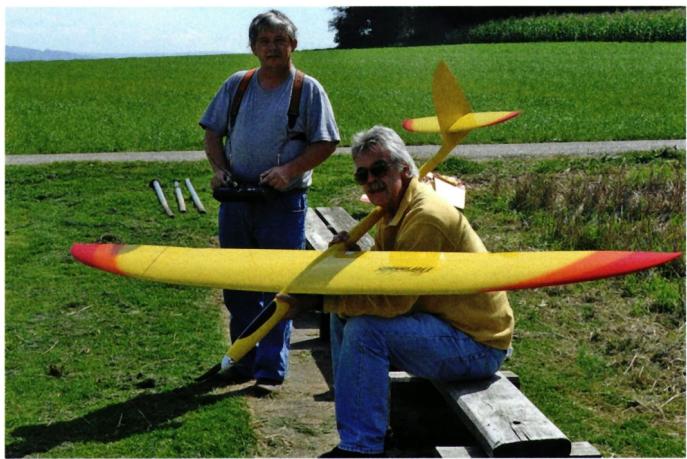
to be able to remove them. The very stiff carbon pushrod—which, unfortunately, isn’t quite aligned with the rudder linkage—is, along with the lack of adjustment specifications, the second and final point of criticism regarding this model. The author made do here with a steel wire, which worked without any problems. How to mount servos in the wings is likely just as well known as how to wire them using Multiplex connectors. These were simply glued into the wing, making the entire setup suitable for everyday use and allowing for easy replacement if necessary or in the event of a malfunction.
Admittedly, the rudders could have been mounted so they were completely hidden from view. There are two reasons why the author chose the simpler version: 1. Convenience. I’m just not cut out for all that tedious fiddling. The whole thing is, in
simpler form is also much easier to maintain, simpler to tune, and doable for anyone. 2. A not insignificant reason: When asked about the aileron linkages running openly beneath the wing and the associated performance losses, a multiple F5B world champion explained to me that these losses are not measurable. Fortunately, this is the case; otherwise, the author might actually have had to hide the linkages.
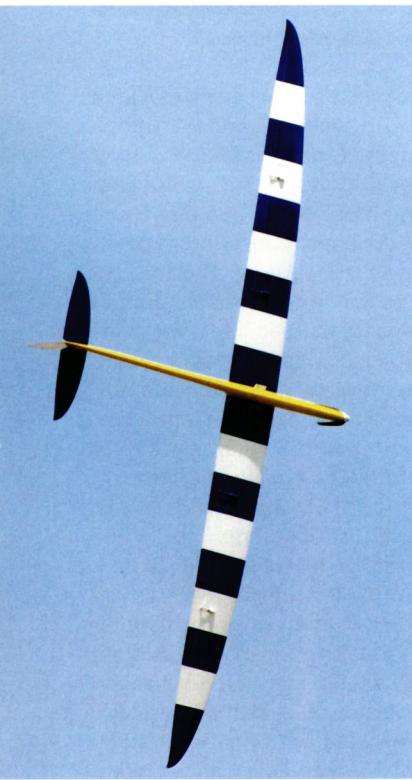
Three meters of solid fiberglass splendor, with a high-gloss finish and the zebra pattern on the underside of the model clearly visible even to older gentlemen, was now ready for its maiden flight. Pushed over the edge of the slope in a light breeze, I found myself wondering just a few seconds later what the motor sitting in the nose was good for. The Herakles revealed its incredible
flight performance right from its first flight. It responds smoothly, calmly, and directly to the ailerons and elevator. It circles effortlessly and picks up speed quickly when given a nudge. With the dihesion flaps set 2 mm upward, it moves forward even more briskly. With the dihesion flaps set 3 mm downward, you can even perform hovering maneuvers in the air. Its thermal performance is just as impressive as its “acrobatic” capabilities. The built-in powerplant is also impressive and corresponds quite closely to what the author had intended. With a center of gravity at 102 mm and an EWD of 1.3°, the Herakles flies well right out of the box. With the ailerons set 17 mm up and 13 mm down, the rudder set as far as possible, and the elevator set 15 mm up and 15 mm down—with these settings, you won’t encounter any surprises. On my Herakles, I have 30% Expo set for the ailerons and elevator. The flaps set 2°
up provide extra speed, and setting them 3 mm down turns it into an Amigo. With the flapperon set this way, the Herakles lands like a beginner’s model—slowly and with pinpoint accuracy. All settings were adjusted at my discretion and based on gut feeling, since the assembly instructions offered no guidance. The model flies well and cleanly this way; a bit more performance can still be expected with the center of gravity set slightly further back. Fine-tuning is still underway, and it’s also tailored to each individual pilot.
The Herakles is a model that’s very easy to fly and land. Thanks to its sturdy and impact-resistant construction, it’s suitable for everyday use and offers a very high level of performance and fun. Anyone with a little aileron experience will have no trouble handling it. It’s clear that the Herakles isn’t a cheap model. Considering its construction, workmanship, performance, and suitability for everyday use, it’s a very good deal. It has already ascended to my personal model-airplane pantheon. Thus, the Herakles is just as much a Greek god as it is a Chinese fun plane.
*Martin Zürcher*


News from HEBU

HORIZON HOBBY/LEMACO NEWS: MICRO OV-10 BRONCO 645 MM BY E-FLITE

PRIDE AND GOOD IDEAS
 Markus Nussbaumer

TEAM MANAGER "THIS" BOSSHARD
 Rodito Nussbaumer

YOU KNOW WHAT I MEAN? 125 YEARS OF THE SWISS AERO CLUB
 Emil Giezendanner

F3A EUROPEAN CHAMPIONSHIPS IN ST-MACAIRE, FRANCE
 Matthias Bosshard

ATOM, THE NEW DOUBLE-DECKER FROM CPLR
Matthias Bosshard
SUMMER FUN 2026 AT MG USTER
Martin Wunderli
What's New at Leomotion.com

52. 2026 ALPS CUP
Emil Giezendanner
TWIN TOWN PARTNERSHIP
Wolfgang Voeller
34th HAHNENMOOS ALPINE MODEL AIRPLANE CAMP
Res Dauwalder
CORSAIR F4U – A WARBIRD WITH A MEMORABLE LOOK
Jürgen Rosenberger, Jürgen Prinz
SMALL, MODEL-LIKE SAILBOATS
Res Dauwalder
TRY-OUT DAY AT MFV WETTINGEN
Urs Keller
WELCOME, NEW MEMBER!
Andrea Bolliger
COUPE DES ALPES – OBSERVE AND LEARN
Rodito Nussbaumer
EURO CONTEST GLIDER ACRO TOUR AUSTRIA 2026

BY YOUTH, FOR YOUTH
Lorena Betschen
INSIGHTS INTO THE HISTORY OF SEAPLANES

FREE FLIGHT IN THE MIDDLE OF SUMMER
Urs Muntwyler
THE PC-21 STORY
Emil Giezendanner
NEWS FROM HEBU
 Julia Bucher

FROM 0 TO 100
Markus Nussbaumer
MEMORIES
Wolfgang Völler
NOS REGION – A HUB FOR ELECTRIC AVIATION
Emil Giezendanner
DO YOU KNOW WHAT I MEAN IN THE LAND OF SMILES?
Emil Giezendanner
Have you almost forgotten about aircraft that take off and land vertically?
Emil Giezendanner