
Passat Electric Sports Model by Carrera
The Passat can be equipped with either an electric motor or an internal combustion engine. The model is delivered as a nearly finished kit with a fiberglass fuselage and balsa-covered Styrofoam wings, which are attached with screws.
| Wingspan approx. | 1,400 mm |
| Overall length approx. | 900 mm |
| Flight weight, depending on equipment, approx. | 2,000 g |
The model kit is well-equipped, featuring many plastic parts as well as push rods, clips, and a landing gear with wheels. The Ferran fuselage is sure to come as a shock to any electric model aircraft enthusiast at first, since this material is really very heavy. The wing, which is machined from a single piece and features the correct V-shape, is already equipped with the mounts for the nylon screws and is still quite light. On my wing, the lower skin had been applied quite unevenly, which I didn’t particularly like. Unfortunately, I couldn’t sand these irregularities out, as I would have sanded through to the core in some places. Printed balsa wood strips are included for the elevator and rudder. Detailed assembly instructions with an exploded view allow even less experienced model builders to easily assemble the model. A construction plan is also included, though I can’t quite figure out what purpose it serves.
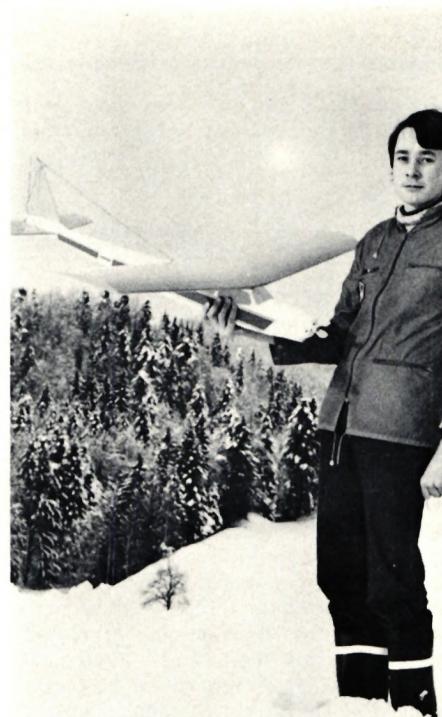
To complete the fuselage, the plastic skin parts must first and foremost be screwed to the fuselage, since Ferran cannot be glued. Installing the appropriate motor mount for the motor being used is no problem, though be sure not to forget the shims for the motor pitch. The fuselage can then be decorated a bit further with the included decals.
For the wings, all that remains is to glue on the leading edges and wing tips and sand them down neatly.
The elevator and rudder were first cut out from the pre-printed balsa strips, fitted with the wing tips, and shaped accordingly. The attachment of the elevator is very well designed. It could be replaced very easily in the event of a break.
The wing, elevator, and rudder were then covered with a plastic film.
Left: Takeoff in the snow. Do not pull the model too hard after takeoff!
After installing the servos and connecting them to the control surfaces, I was able to install the rest of the system. For the first time, I used a very small 100 mA/h receiver battery that is recharged after every 5–10-minute flight. So far, this has worked very well.
For the motor, I used the recommended Bühler motor with an 8/6 propeller and a 12-cell battery at 1.2 Ah. My model weighed 2030g ready to fly. This put me 100g below the specified minimum weight, which is primarily due to the lightweight receiver system.
The process for swapping out the power batteries is a bit unusual but well designed. After removing the lower part of the cowl, the batteries can be slid into the fuselage from the front. The cowl can then be snapped back into place with the snap-lock.
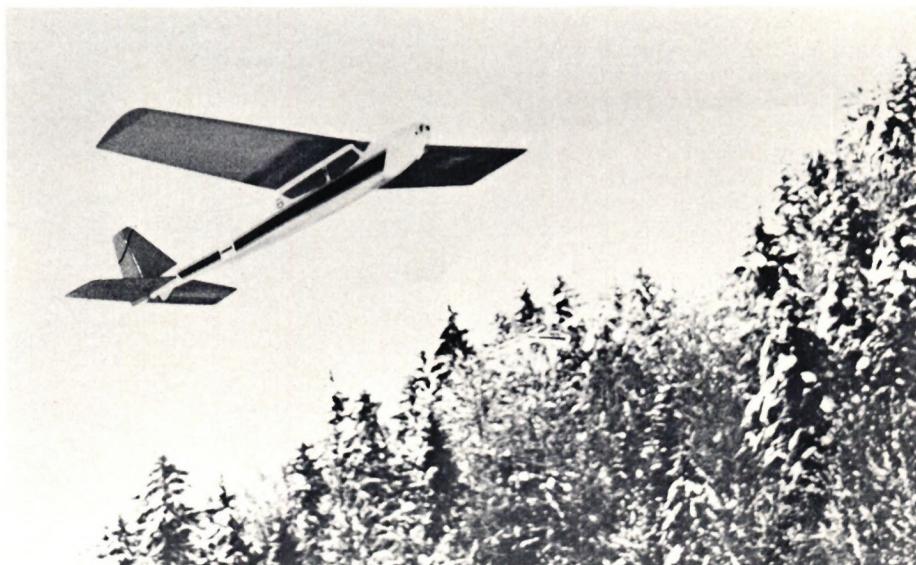
With the motor running at full throttle, the model is propelled forcefully into the air against the wind. After a short straight flight, depending on the motorization, altitude can be gained to a greater or lesser extent by pulling back on the controls. The model was then finely trimmed, and its flight performance was evaluated. In this version, you shouldn’t pull too hard to climb, since the model isn’t overly powerful. After turning off the motor, I was surprised to discover how slowly the Passat can fly. My model was difficult to get into a stall. The model also flies very smoothly otherwise. The controls respond softly but quickly. Landing on snow is no problem when executed correctly. Loops and turns can be executed cleanly. If you want to increase the model’s power, there’s nothing stopping you; the battery compartment can accommodate up to 18 cells of 1.2 Ah each. The increased weight will have virtually no negative effect; it will merely increase the speed slightly.
Even less experienced model builders can complete the Passat in a relatively short time. Its flight characteristics can be described as very forgiving, so it can be recommended even to a beginner in powered flight who has some gliding experience.


News from HEBU

HORIZON HOBBY/LEMACO NEWS: MICRO OV-10 BRONCO 645 MM BY E-FLITE

PRIDE AND GOOD IDEAS
 Markus Nussbaumer

TEAM MANAGER "THIS" BOSSHARD
 Rodito Nussbaumer

YOU KNOW WHAT I MEAN? 125 YEARS OF THE SWISS AERO CLUB
 Emil Giezendanner

F3A EUROPEAN CHAMPIONSHIPS IN ST-MACAIRE, FRANCE
 Matthias Bosshard

ATOM, THE NEW DOUBLE-DECKER FROM CPLR
Matthias Bosshard
SUMMER FUN 2026 AT MG USTER
Martin Wunderli
TRY-OUT DAY AT MFV WETTINGEN
Urs Keller
What's New at Leomotion.com

52. 2026 ALPS CUP
Emil Giezendanner
TWIN TOWN PARTNERSHIP
Wolfgang Voeller
34th HAHNENMOOS ALPINE MODEL AIRPLANE CAMP
Res Dauwalder
CORSAIR F4U – A WARBIRD WITH A MEMORABLE LOOK
Jürgen Rosenberger, Jürgen Prinz
SMALL, MODEL-LIKE SAILBOATS
Res Dauwalder
WELCOME, NEW MEMBER!
Andrea Bolliger
FREE FLIGHT IN THE MIDDLE OF SUMMER
Urs Muntwyler
COUPE DES ALPES – OBSERVE AND LEARN
Rodito Nussbaumer
EURO CONTEST GLIDER ACRO TOUR AUSTRIA 2026

BY YOUTH, FOR YOUTH
Lorena Betschen
INSIGHTS INTO THE HISTORY OF SEAPLANES

THE PC-21 STORY
Emil Giezendanner
NEWS FROM HEBU
 Julia Bucher

FROM 0 TO 100
Markus Nussbaumer
MEMORIES
Wolfgang Völler
NOS REGION – A HUB FOR ELECTRIC AVIATION
Emil Giezendanner
DO YOU KNOW WHAT I MEAN IN THE LAND OF SMILES?
Emil Giezendanner
Have you almost forgotten about aircraft that take off and land vertically?
Emil Giezendanner