
Region 3 Championships: Regional Helicopter Championship (F3C/B) and Beginners' Competition (F3C/C)
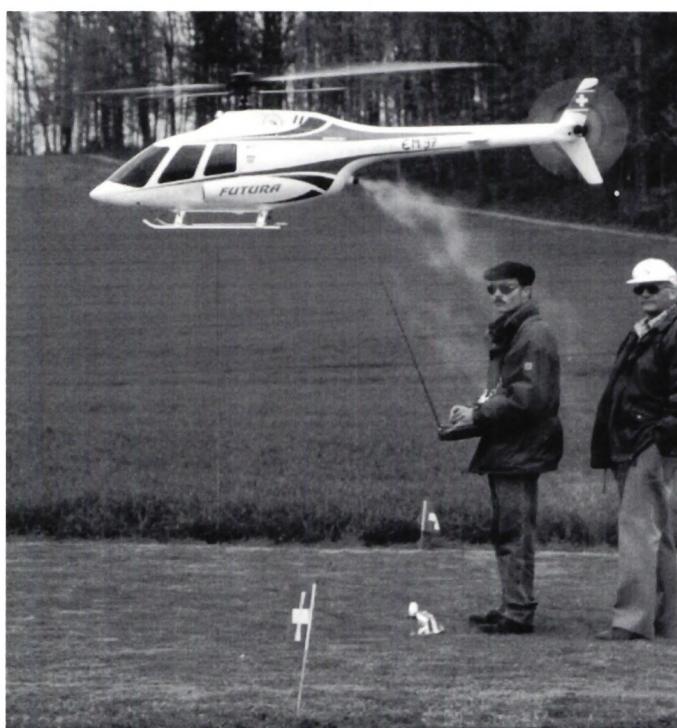
The 4th Regional Helicopter Championships were held on April 22, 1995, in Bonstetten at the idyllic helicopter airfield operated by the Interessengemeinschaft Amt. At the same time, the beginners’ competition—organized for the third time since 1993—took place. The relatively simple flight program for this “introductory competition” has proven successful so far. The idea is to promote the regional competition scene on a broader basis.
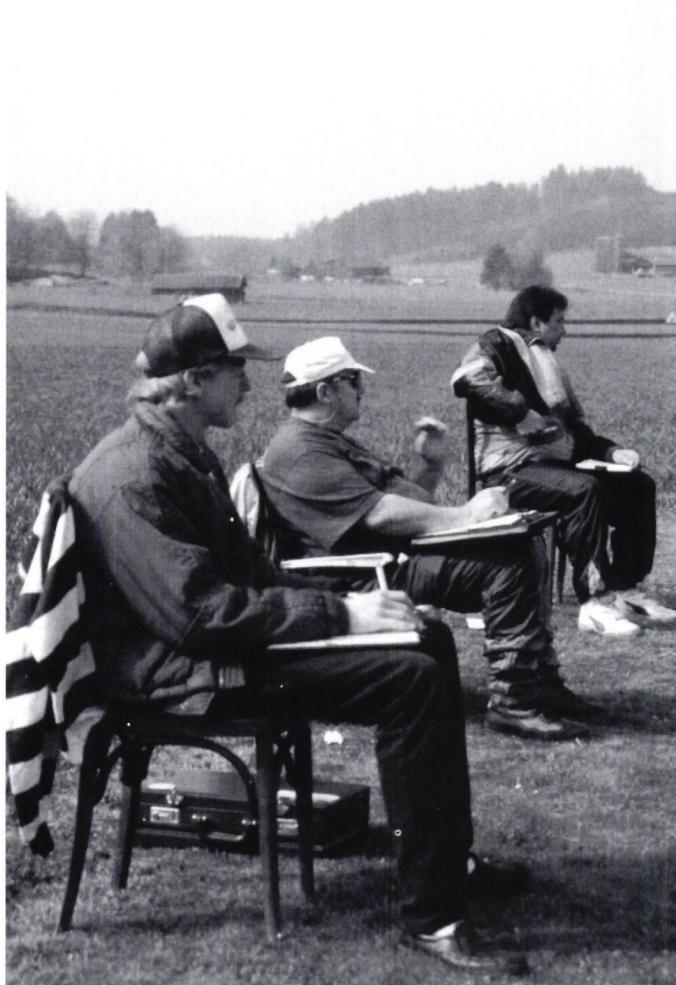
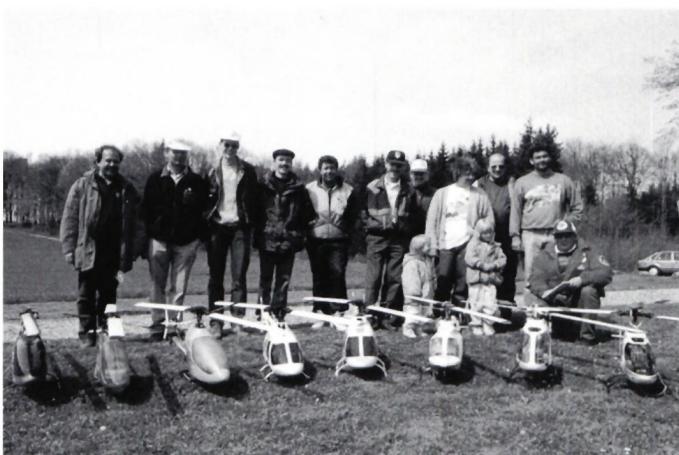
The competition was organized and conducted by members of MG Swipair and the IG Amt. Leading the effort was Sven Wiesendanger, who served as competition director. With his friendly and down-to-earth manner, he succeeded in conveying to the eight participating pilots the relaxed and camaraderie-filled competition atmosphere they had come to expect from previous events.
A team of three judges—comprising regional and national judges—was on hand; together with the participants, they were briefed on the local field conditions by Sven Wiesendanger during the morning briefing. In partly sunny weather with a brisk westerly wind, two rounds from each program were flown in the morning. After lunch at a nearby forest rest area, the third scoring flight took place in the afternoon in the same efficient manner.
The F3C/B flight program consists of seven required maneuvers. The pilot has 10 minutes to complete his flight. He may not change his position during the flight demonstration. Sequence of maneuvers: (1) Hover “M,” (2) Tail circle, (3) Circling flight, (4) Simple hat, (5) Turn, (6) Loop, (7) Approach and landing.
The F3C/C flight program (beginner competition) consists of five required maneuvers. The pilot has 8 minutes to complete the flight. If the pilot changes position during the flight demonstration, one-fifth of the maximum possible score for that maneuver will be deducted. Figure sequence: (1) Hover, (2) “M” hover, (3) Tail circle, (4) Sideways flight, (5) Forward and backward flight.
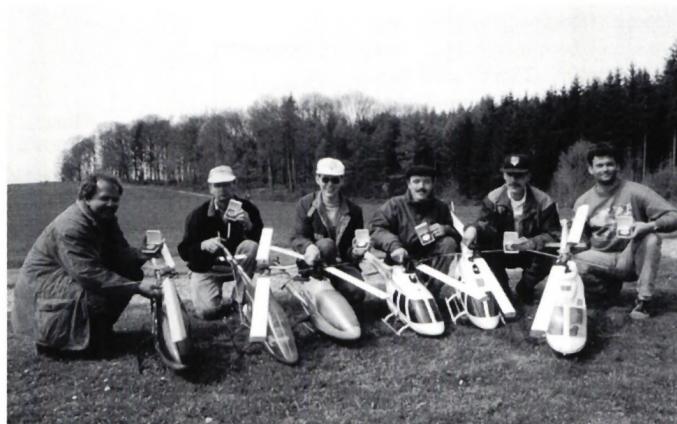
Sven Wiesendanger presented six well-deserved medals during the awards ceremony. The deserving regional champion, Josef Schmidiger from the Emmen/Seetal group, also had reason to celebrate as the recipient of the challenge trophy, which, however, will not be presented until the upcoming chairpersons’ conference.
In the subsequent debriefing, Joseph Schmid discussed the most common mistakes in accordance with the competition rules; it became clear that, aside from the pilots’ varying levels of training and the resulting flight errors, mistakes were primarily made in maneuver technique and flight tactics:
- The helicopter’s rotor shaft was not centered above the marker flag or the landing field.
- During hovering maneuvers, the skid height did not correspond to the pilot’s eye level.
- The tail was angled away from the pilot.
- Climbs and descents were not vertical.
- The pilot’s position for the “tail circle” or “circling flight” was chosen eccentrically (not in the center of the circle).
- For the “Approach and Landing” maneuver, no pilot adhered to the maximum permitted spatial envelope.
- A turn usually consisted of a successful pull-up turn with a climb and a 180° turn; however, this was followed by a turn with an uneven radius and at a different flight level.
- Aerobatic maneuvers: A continuous presentation was often lacking here. Maintaining a consistent distance and altitude relative to the judges also posed difficulties.
The fact that consistently well-tuned trainer and fuselage models were used is not to be taken for granted; it shows that the young pilots in our region have already successfully completed quite a few “lessons” in this regard. Despite the use of computer systems, this—along with the pilot’s mental fitness (i.e., training)—remains a key requirement for safe, precise, and performance-optimized flying with a model helicopter.
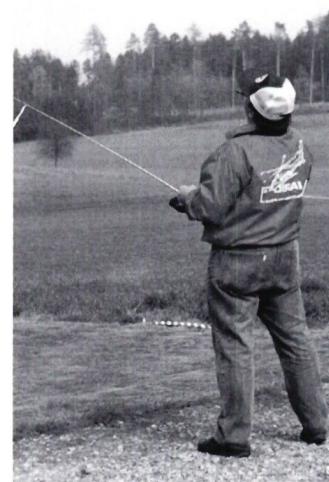
| 1. Josef Schmidiger | Emmen/Seetal | 290.00 |
| 2. Roman Bachmann | Emmen/Seetal | 251.50 |
| 3. Zgraggen, Josef | Schwyz/Uri | 245.50 |
| 4. Sven Wiesendanger | Swipair | 217.50 |
| 1. Franz Betschart | Schwyz/Uri | 180.00 |
| 2. Daniel Kunz | Swipair | 151.00 |
| 3. Erwin Gwerder | Schwyz/Uri | 146.50 |
| 4. Rolf Roppel | Swipair | 143.50 |
... is not just about practicing individual maneuvers. The very first requirement is that the mechanical systems be perfectly adjusted. The subsequent fine-tuning of the mechanics and electronics takes a lot of time and must be worked out step by step. A thorough study of the flight regulations is essential; the pilot must be thoroughly familiar with the maneuvers and the possible point deductions. The training environment and conditions should be realistic: hover only over a marked field and in all weather conditions; once the individual maneuvers have been mastered, the entire flight program should be practiced repeatedly in both directions. In doing so, a good overall presentation of the aerobatic maneuvers in space is important. Even experienced pilots often pay too little attention to this point. In summary, the following approach applies:
- Proper calibration of mechanical and RC components
- Thorough study of the flight regulations
- Basic training in individual maneuvers on a marked airfield
- Training of all maneuvers in sequence (flight program) on a marked airfield
- Mastery of flight tactics (the art of arranging the overall picture in space)
Regional competitions serve a twofold purpose: On the one hand, they certainly foster genuine competition and, thereby, the development of young talent; on the other hand, they are also intended to promote a friendly exchange of experiences among model airplane enthusiasts in a particular category.
To further motivate pilots, judges, and organizers in the future, there are plans to hold the 1996 Regional Championship on a larger scale: Regional model aviation associations 2, 3, 4, 7, and 8 are interested in such an “interregional” event. Uniform flight regulations, the recruitment, development, and exchange of judges, as well as technical forums and training camps, are some of the areas that will certainly be worth addressing together.
Joseph Schmid, Helicopter Flight Director, RMV 3


News from HEBU

TEAM MANAGER "THIS" BOSSHARD
 Rodito Nussbaumer

YOU KNOW WHAT I MEAN? 125 YEARS OF THE SWISS AERO CLUB
 Emil Giezendanner

PRIDE AND GOOD IDEAS
 Markus Nussbaumer

ATOM, THE NEW DOUBLE-DECKER FROM CPLR
 Matthias Bosshard

SUMMER FUN 2026 AT MG USTER
Martin Wunderli
F3A EUROPEAN CHAMPIONSHIPS IN ST-MACAIRE, FRANCE
Matthias Bosshard
52. 2026 ALPS CUP
Emil Giezendanner
HORIZON HOBBY/LEMACO NEWS: MICRO OV-10 BRONCO 645 MM BY E-FLITE

TWIN TOWN PARTNERSHIP
Wolfgang Voeller
CORSAIR F4U – A WARBIRD WITH A MEMORABLE LOOK
Jürgen Rosenberger, Jürgen Prinz
TRY-OUT DAY AT MFV WETTINGEN
Urs Keller
EURO CONTEST GLIDER ACRO TOUR AUSTRIA 2026

BY YOUTH, FOR YOUTH
Lorena Betschen
INSIGHTS INTO THE HISTORY OF SEAPLANES

SMALL, MODEL-LIKE SAILBOATS
Res Dauwalder
What's New at Leomotion.com

COUPE DES ALPES – OBSERVE AND LEARN
Rodito Nussbaumer
34th HAHNENMOOS ALPINE MODEL AIRPLANE CAMP
Res Dauwalder
WELCOME, NEW MEMBER!
Andrea Bolliger
FREE FLIGHT IN THE MIDDLE OF SUMMER
Urs Muntwyler
THE PC-21 STORY
Emil Giezendanner
NEWS FROM HEBU
 Julia Bucher

FROM 0 TO 100
Markus Nussbaumer
MEMORIES
Wolfgang Völler
NOS REGION – A HUB FOR ELECTRIC AVIATION
Emil Giezendanner
Have you almost forgotten about aircraft that take off and land vertically?
Emil Giezendanner
DO YOU KNOW WHAT I MEAN IN THE LAND OF SMILES?
Emil Giezendanner