
Circuit Flight (F2A/B/C) in Lausanne
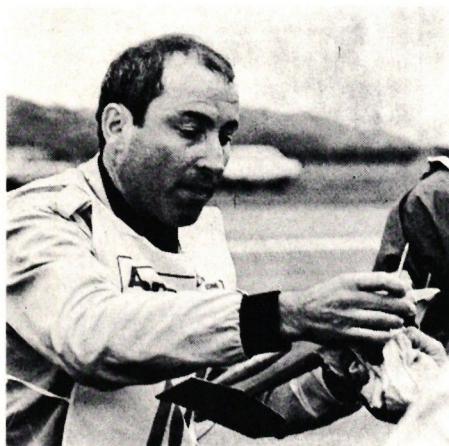
Louis Bilat, MBZ Basel, multiple Swiss champion and 1978 F2A world runner-up. Photo: Aero Modeller.
About a quarter of a century ago, the heyday of aerobatics began in Switzerland. Clubs were founded, several aerobatics runways were built, and everywhere people were training—crashing—and building new models. Some gave up. Many persevered and achieved success.
Meanwhile, at least in our region, it seems as though circuit flying has become an antiquated—even forgotten—branch of model aviation. Sure, there have been—and still are—plenty of reasons for this, which have led to the practical extinction of this discipline in most regions, but I believe and hope that, with a little understanding and goodwill, circular flight will regain its relevance and popularity in our region as well and once again be recognized as a fully-fledged discipline of model aviation.
The basic idea was to fly a model aircraft equipped with an internal combustion engine and controlled from the ground. After a lengthy development period, this led to today’s circling models.
The official FAI designation for control line flying is CL = Control Line (abbreviation: F2). Control line or tethered flight (F2) is divided into four different classes, which correspond to the four classes flown today.
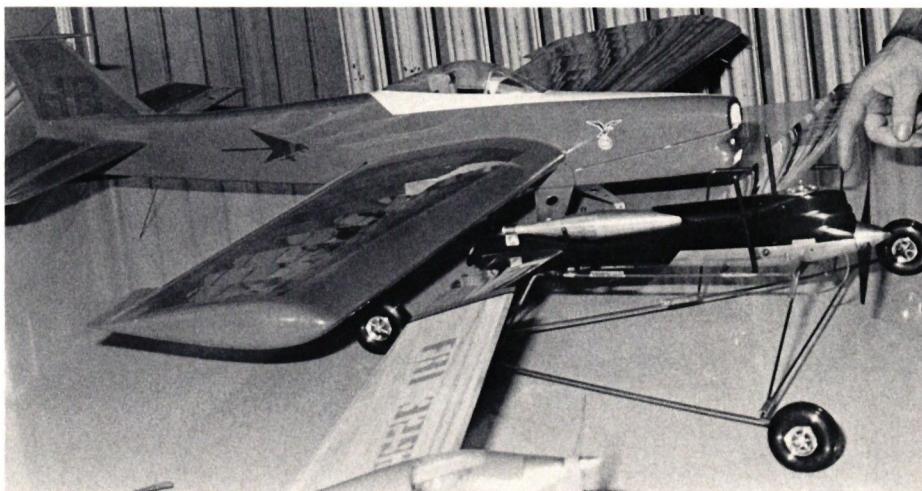
Models from three control line categories: on the left, an aerobatic model (F3B); on the right, a speed model (F2A); below, a model for team racing (F2C).
This is the official FAI designation for speed models.
Definition of the model:
A model aircraft powered by one or more piston engines, with fixed wings and a control flap (elevator).
Circuit radius: 15.92 m.
Purpose of the model: To fly a precisely defined course (10 laps with a radius of 15.92 m = 1 km) in the shortest possible time, using the engine(s).
Model specifications:
Maximum cylinder displacement: 2.5 ccm.
Minimum total wing area: 2 dm² per ccm of cylinder displacement.
The model must be launched from the ground.
Scoring: Each competitor is entitled to three flights, the best of which determines the final score and ranking, subject to passing the model inspection.
A flight is valid only if:
- the competitor holds the handle in the fork during the entire duration of the timed flight (10 laps) (fork = rotating central post in the center of the circular flight course);
- the competitor maintains the prescribed flight altitude of at least 1 m and no more than 3 m during the entire timing period.
This is the official FAI designation for aerobatic models.
Definition of the model:
A model aircraft powered by one or more piston engines, with fixed wings except for the ailerons.
Line length (circle radius): minimum 15.00 m, maximum 21.5 m.
Purpose of the model: To complete, as a rule, three scoring flights featuring 14 different flight maneuvers within a time limit of 7 minutes, including takeoff and landing.
| 1. Louis Bilat | MBZ Basel |
| 2. Willy Kühnis | MBZ Basel |
| 3. Heiner Borer | Breitenbach |
| 4. Martin Gafner | MBZ Basel |
| 1. Toni Salathé | MBZ Basel |
| 2. Yves Sedlatchek | Sion |
| 3. Arthur Keller | Breitenbach |
| 4. Peter Thüring | MBZ Basel |
| 5. Heinz Christen | La Côte |
| 6. Hugo Borer | Breitenbach |
| 7. Peter Hofacker | MBZ Basel |
| 8. Martin Gafner | MBZ Basel |
| 1. Borer, D. – Studer | Breitenbach |
| 2. Christen – Saccarino | MBZ Basel |
| 3. Borer H. – Schraner | Breitenbach |
| 4. Sedlatchek – Miny | Sion |
| 5. Christen – Büchler | La Côte |
| 6. Keller – Borer A. | Breitenbach |
| 1. Martin Gafner | MBZ Basel |
| 2. Michael Disler | MBZ Basel |
| 3. Walter Christen I | MBZ Basel |
| 4. Walter Christen II | MBZ Basel |
| 5. Silvan Borer | Breitenbach |
| 6. Walter Lehmann | MBZ Basel |
| 7. Edi Preiswerk | MBZ Basel |
| 8. Thomas Greber | MBZ Basel |
| 9. Peter Thüring | MBZ Basel |
Model Specifications:
Maximum cylinder displacement: 10 ccm.
Maximum total wing area: 150 dm².
Maximum wing loading: 100 g/dm².
Maximum flight weight: 5 kg.
The engine(s) must be equipped with effective mufflers.
The model must be launched from the ground. Scoring
: Three judges evaluate the flight and the individual flight maneuvers with scores between 0 and 10, which are then multiplied by the difficulty factor K (1–10) assigned to each maneuver. The resulting scores are then
added together to determine the total score for the completed flight.
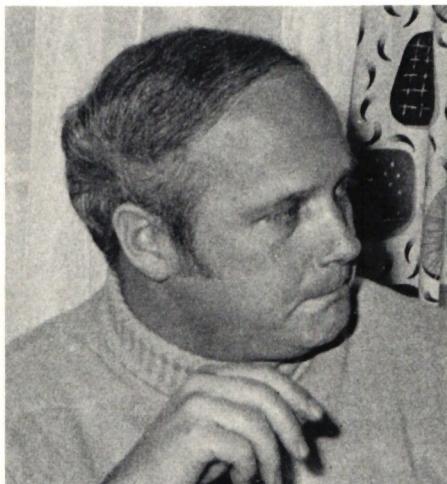
Heiner Borer, of Breitenbach, is considered the greatest advocate of the Swiss circuit flying movement.
Two qualifying flights and a final round are held. The top 15 from the previous qualifying flights are admitted to the final, based on their better of the two qualifying flights.
A flight is valid only if:
- if the model performs the 14 flight maneuvers in the correct order;
- if the model completes the scoring flight(s) without losing any parts;
- if the model complies with the technical guidelines.
This is the official FAI designation for team races (1 pilot, 1 mechanic, 1 model = 1 team).
Definition of the model:
A model aircraft powered by one or more piston engines, with fixed wings and a control flap (elevator). It must have its own landing gear—either fixed or retractable—as well as a canopy with a visible pilot figure.
Line length (circle radius): 15.92 m.
Purpose of the model: To fly a race consisting of 100 or 200 laps in the shortest possible time, including refueling stops required by the prescribed fuel tank capacity and engine size.
Model specifications:
Maximum cylinder displacement: 2.5 ccm.
Minimum projected area (wing area + elevator): total 12 dm².
Maximum flight weight (including fuel): 700 g.
Scoring: The primary scoring time is the average time recorded by the two timekeepers assigned to the team, rounded up to the nearest tenth of a second, provided there is no disqualification by the judging panel.
A disqualification is issued by the judging panel (consisting of three judges) if the same team has received three warnings. Reasons for a warning (also issued by the judging panel) are:
- Conduct by the pilots during the flight that does not comply with the rules.
- Erroneous or negligent handling by the mechanic during refueling stops on the ground.
- Failure to pass the model inspection before or after the race.
I'll report on this category at a later date, since I don't have the final regulations yet.
In closing, I would like to note that the above remarks, insofar as they concern the explanations regarding the individual categories, should be considered merely a summary or abridgment of the official technical regulations.
For further information regarding circuit flying—or, if this brief article has rekindled your interest in “circuit flying”—please contact me. My address is as follows:
Georg Biber, Talweg 122, 8610 Uster
Tel. 01 / 79 76 49 (evenings). Starting Nov. 22, 1978:
Tel. 01 / 941 26 49 (evenings).


News from HEBU

PRIDE AND GOOD IDEAS
 Markus Nussbaumer

TEAM MANAGER "THIS" BOSSHARD
 Rodito Nussbaumer

YOU KNOW WHAT I MEAN? 125 YEARS OF THE SWISS AERO CLUB
 Emil Giezendanner

F3A EUROPEAN CHAMPIONSHIPS IN ST-MACAIRE, FRANCE
 Matthias Bosshard

HORIZON HOBBY/LEMACO NEWS: MICRO OV-10 BRONCO 645 MM BY E-FLITE

ATOM, THE NEW DOUBLE-DECKER FROM CPLR
Matthias Bosshard
SUMMER FUN 2026 AT MG USTER
Martin Wunderli
52. 2026 ALPS CUP
Emil Giezendanner
TWIN TOWN PARTNERSHIP
Wolfgang Voeller
CORSAIR F4U – A WARBIRD WITH A MEMORABLE LOOK
Jürgen Rosenberger, Jürgen Prinz
SMALL, MODEL-LIKE SAILBOATS
Res Dauwalder
TRY-OUT DAY AT MFV WETTINGEN
Urs Keller
WELCOME, NEW MEMBER!
Andrea Bolliger
What's New at Leomotion.com

COUPE DES ALPES – OBSERVE AND LEARN
Rodito Nussbaumer
EURO CONTEST GLIDER ACRO TOUR AUSTRIA 2026

BY YOUTH, FOR YOUTH
Lorena Betschen
INSIGHTS INTO THE HISTORY OF SEAPLANES

34th HAHNENMOOS ALPINE MODEL AIRPLANE CAMP
Res Dauwalder
THE PC-21 STORY
Emil Giezendanner
FREE FLIGHT IN THE MIDDLE OF SUMMER
Urs Muntwyler
NEWS FROM HEBU
 Julia Bucher

FROM 0 TO 100
Markus Nussbaumer
MEMORIES
Wolfgang Völler
NOS REGION – A HUB FOR ELECTRIC AVIATION
Emil Giezendanner
DO YOU KNOW WHAT I MEAN IN THE LAND OF SMILES?
Emil Giezendanner
Have you almost forgotten about aircraft that take off and land vertically?
Emil Giezendanner