
Calls for a cross-manufacturer and cross-system standard for RC remote controls
In our view, it is time to establish a cross-manufacturer and cross-system standard for RC remote controls based on the new 2.4-GHz technology. We are striving for complete compatibility among products, similar to what we have seen with the PPM standard, which has been in use for over 30 years.
The multi-unit control systems (MZS) used in the model railroading industry—which have been standardized using the DCC protocol for over ten years—should serve as a model for this. To facilitate migration to the new system, the new components must not only support the new protocols but also be compatible with the servo pulses of the previous standard. Our goal is a cross-sector protocol
which covers all areas of RC model building. Buyers and users should not have to decide from the outset whether they want to control an airplane, a ship, a truck, or a functional model such as construction machinery or similar vehicles. The system must be flexibly configurable. A data protocol must be defined that includes proportional channels and status channels. The number of channels should be limitable on the transmitter as needed. To reduce latency, only the active channels should be transmitted. To accommodate future technological advancements and expansions that cannot yet be foreseen, a preamble should distinguish between a standardized base signal (Layer 1) and an extended, manufacturer-
“special control signal” (Layer 2). The integration of bidirectional communication must be optional. EU and Swiss radio regulations must be complied with. Given that there are hundreds of thousands of RC users, compatible systems are a must. An Open-RC protocol represents a win-win situation for all manufacturers and customers. The customer is completely free to choose which product to buy. All systems should already be compatible with one another at the basic functional level.
Dear RC Model
Manufacturers and Suppliers: We ask all manufacturers to sit down with their competitors and work together to address our call for a new
RC standard. The long-overdue transition and standardization to a modern RC system is long overdue. With a common standard, hundreds of thousands would likely be willing to switch to such a system within a short time. Simple backward compatibility will be an additional incentive, as no one will be willing to replace their equipment—which often costs several thousand euros—all at once. With this initiative, we have set ourselves the goal of developing a data protocol compatible with all RC components. For more information, please contact the email address below or visit the wiki page.
URL: http://ngrc.sub-etha.de/wiki/Hauptseite
Bruno Eberle
b.eberle@vtxmail.ch
The desire for greater safety—but especially for greater independence—has led to an increasing number of members in many model aircraft clubs, both in Germany and abroad, switching to the new 2.4-GHz bands. Owners of RC systems with HF modules are eagerly awaiting the corresponding 2.4-GHz modules.
Once again: 40 MHz systems are not being banned!
Time and again, model aviators report that they were told at a “specialty store” that they now have to buy a 35-MHz system because the 40-MHz systems are banned or are no longer being produced. This is, of course, difficult to verify. If this were the case, those responsible would have to be called liars. Officially, we will retain four channels in the 40-MHz band (see box), and since a large portion of RC systems are produced for Japan,
The 40 MHz band will remain in use anyway, thanks to the globalization of the market.
On the manufacturer's side, there are already quite a few promising products currently available in stores or set to hit the market in the coming weeks.
Spectrum, USA—under this name, RC systems for cars and airplanes, as well as modules for JR and Futaba, are being offered. Spectrum RC systems are distributed by Horizon Hobby in Champaign, Illinois, USA. Spectrum has no connection to Futaba Corp.—as was sometimes stated in brochures—other than the fact that Spectrum produces Futaba-compatible RF modules and receivers.
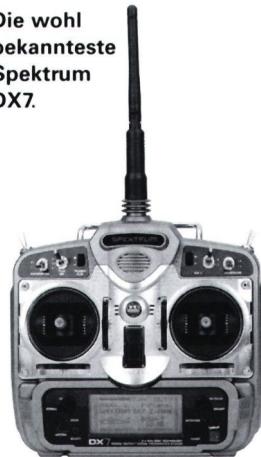
The most well-known Spectrum model is probably the DX7.


News from HEBU

TEAM MANAGER "THIS" BOSSHARD
 Rodito Nussbaumer

YOU KNOW WHAT I MEAN? 125 YEARS OF THE SWISS AERO CLUB
 Emil Giezendanner

F3A EUROPEAN CHAMPIONSHIPS IN ST-MACAIRE, FRANCE
 Matthias Bosshard

SUMMER FUN 2026 AT MG USTER
Martin Wunderli
TRY-OUT DAY AT MFV WETTINGEN
Urs Keller
52. 2026 ALPS CUP
Emil Giezendanner
BY YOUTH, FOR YOUTH
Lorena Betschen
ATOM, THE NEW DOUBLE-DECKER FROM CPLR
Matthias Bosshard
CORSAIR F4U – A WARBIRD WITH A MEMORABLE LOOK
Jürgen Rosenberger, Jürgen Prinz
SMALL, MODEL-LIKE SAILBOATS
Res Dauwalder
What's New at Leomotion.com

TWIN TOWN PARTNERSHIP
Wolfgang Voeller
EURO CONTEST GLIDER ACRO TOUR AUSTRIA 2026

INSIGHTS INTO THE HISTORY OF SEAPLANES

34th HAHNENMOOS ALPINE MODEL AIRPLANE CAMP
Res Dauwalder
WELCOME, NEW MEMBER!
Andrea Bolliger
HORIZON HOBBY/LEMACO NEWS: MICRO OV-10 BRONCO 645 MM BY E-FLITE

FREE FLIGHT IN THE MIDDLE OF SUMMER
Urs Muntwyler
COUPE DES ALPES – OBSERVE AND LEARN
Rodito Nussbaumer
PRIDE AND GOOD IDEAS
 Markus Nussbaumer

THE PC-21 STORY
Emil Giezendanner
NEWS FROM HEBU
 Julia Bucher

FROM 0 TO 100
Markus Nussbaumer
MEMORIES
Wolfgang Völler
NOS REGION – A HUB FOR ELECTRIC AVIATION
Emil Giezendanner
Have you almost forgotten about aircraft that take off and land vertically?
Emil Giezendanner
DO YOU KNOW WHAT I MEAN IN THE LAND OF SMILES?
Emil Giezendanner