
Slope Flying with Compass Control (F1E)
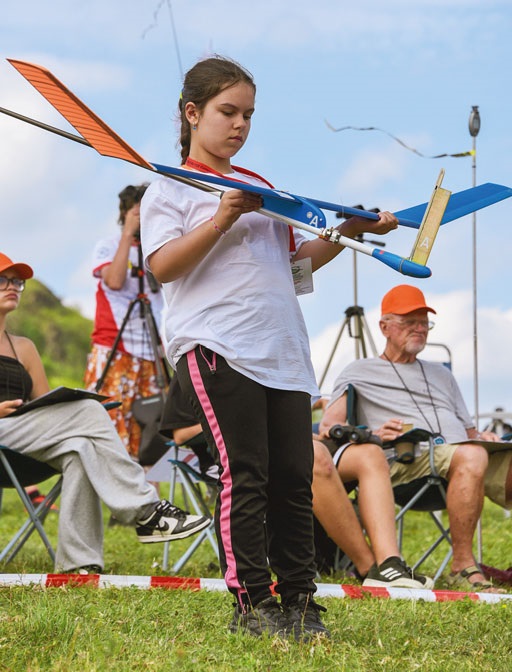
Once launched, free-flight models with compass control can no longer be steered. This applies to all free-flight classes and makes the entire sport very exciting. Unlike free-flight models in other classes, which are launched from flat ground, pilots push or throw their models off a hill. Once they leave the pilot’s hands, they are at the mercy of the winds—in other words, nature itself.
Unlike free-flight models in other classes, slope-soaring models (FAI Class F1E) are equipped with a compass-controlled system. The system is at least 100 years old and consists of a “compass needle”—a strong magnetic rod that moves the rudder smoothly and effortlessly. The rudder is set to the desired flight direction, while the compass always points north. If the model deviates from the set direction during flight, the compass corrects the course. Instead of a mechanical compass, electronic devices can also be used to move the rudder via a small servo.
The hang glider model can not only maintain a straight course, but also fly circular or other patterns using an electronic or mechanical timer. The timers can also trigger the so-called thermal brake, which terminates the flight by raising the elevator. It is not possible to directly influence the model’s behavior during flight. Everything must be programmed before takeoff—including the addition of weights.
Once the pilot has released the model and can no longer influence it—neither its flight path, climb, nor descent—the pilot watches his or her model with bated breath. Will it stay in the air for the required (for example) four minutes, or will it land early? Flight times are set by the competition director. In a tiebreaker, these can last up to seven or eight minutes. Flight times depend, among other things, on the altitude of the launch site above the flat terrain, as well as on wind direction and wind speed. After takeoff, the pilot can only watch his aircraft and hope for the best. This is when it becomes clear whether all the settings and the timing of the launch were chosen optimally. If the model lands too early, he’ll try to fine-tune everything in his next flight and observe the weather conditions even more closely. It’s possible he was simply unlucky with the interplay of wind and sun. As a free-flight enthusiast, he learned that early on.
It’s not uncommon for the models to have to be retrieved from kilometers away. Landings in trees are almost a given. The Swiss team experienced this several times. The models have to be back in the air by the next launch window. That requires some physical fitness. The calm in the launch area is a welcome relief. The Swiss team appeared calm and focused—exemplary teamwork—in contrast to teams that forgot all about flying amid the commotion of their smartphones. Shortly before this, our free-flight pilots had achieved outstanding results at the European Championships in Romania. This time, they were unable to repeat that success. The World Championships are scheduled to take place at the same location in 2025. Let’s hope the organizer can step up and be able to host the event in a manner befitting a World Championship. For the Swiss free-flyers, the lack of suitable sites is a major challenge. They deserve our utmost respect.


News from HEBU

TEAM MANAGER "THIS" BOSSHARD
 Rodito Nussbaumer

YOU KNOW WHAT I MEAN? 125 YEARS OF THE SWISS AERO CLUB
 Emil Giezendanner

ATOM, THE NEW DOUBLE-DECKER FROM CPLR
 Matthias Bosshard

SUMMER FUN 2026 AT MG USTER
Martin Wunderli
F3A EUROPEAN CHAMPIONSHIPS IN ST-MACAIRE, FRANCE
Matthias Bosshard
52. 2026 ALPS CUP
Emil Giezendanner
TWIN TOWN PARTNERSHIP
Wolfgang Voeller
PRIDE AND GOOD IDEAS
 Markus Nussbaumer

CORSAIR F4U – A WARBIRD WITH A MEMORABLE LOOK
Jürgen Rosenberger, Jürgen Prinz
TRY-OUT DAY AT MFV WETTINGEN
Urs Keller
HORIZON HOBBY/LEMACO NEWS: MICRO OV-10 BRONCO 645 MM BY E-FLITE

EURO CONTEST GLIDER ACRO TOUR AUSTRIA 2026

BY YOUTH, FOR YOUTH
Lorena Betschen
INSIGHTS INTO THE HISTORY OF SEAPLANES

SMALL, MODEL-LIKE SAILBOATS
Res Dauwalder
What's New at Leomotion.com

COUPE DES ALPES – OBSERVE AND LEARN
Rodito Nussbaumer
34th HAHNENMOOS ALPINE MODEL AIRPLANE CAMP
Res Dauwalder
WELCOME, NEW MEMBER!
Andrea Bolliger
FREE FLIGHT IN THE MIDDLE OF SUMMER
Urs Muntwyler
THE PC-21 STORY
Emil Giezendanner
NEWS FROM HEBU
 Julia Bucher

FROM 0 TO 100
Markus Nussbaumer
MEMORIES
Wolfgang Völler
NOS REGION – A HUB FOR ELECTRIC AVIATION
Emil Giezendanner
Have you almost forgotten about aircraft that take off and land vertically?
Emil Giezendanner
DO YOU KNOW WHAT I MEAN IN THE LAND OF SMILES?
Emil Giezendanner