
Model Aircraft Flight Between Heaven and Earth
Neither the airspace nor the ground offers unlimited possibilities for model aircraft flying. Land is becoming scarcer in Switzerland, and airspace is becoming increasingly congested.
Without land beneath our feet, nothing works (anymore). When certain circles are already talking about a Switzerland with a population of 11 million, we cannot remain indifferent. All of us want a place to live, and some of us also want to work. To preserve the rest of Switzerland—or what’s left of it—more and more land is being placed under protection. Seen this way, outdoor sports would be doubly shortchanged.
We model airplane enthusiasts “share” the landscape with numerous other outdoor sports enthusiasts. Unlike many other sports, we rely on a permanent infrastructure, albeit a modest one. The bare minimum consists of a strip of grass (150 m × 50 m) and a lawn mower shed. “Luxury setups” with structures or paved runways must undergo a very complex planning process and are likely to become increasingly difficult to implement.
*“Sports and recreational uses in the countryside are becoming increasingly common and, at the same time, are meeting with growing skepticism. A large portion of these are spontaneous, unregulated uses that ‘just happen’ and are beyond anyone’s control. Consequently, this unease is all the more projected
onto those cases that provide a platform for such activities. Out of fear of urban sprawl, noise, and the loss of nature, opponents and authorities often paint a picture of doom and gloom.”*
*Professor Andreas Schneider,
OST University of Applied Sciences, Rapperswil*
I remember all too well how much persuasion it took 10 years ago before a few colleagues were willing not only to look up
at the sky, but also to seriously address the issue of airfields within a broader context (spatial development). We were too entrenched in one-dimensional thinking: “We must defend our airfields against a growing opposition.” That is certainly not the case today.
*Our technological advances—electric propulsion systems, large internal combustion engines with low RPMs—as well as improvements in operational practices (non-aggressive flying, spatial restrictions, etc.) have clearly improved public acceptance.*
The question remains whether the environmental organizations are out to get us. Although some individuals dig their heels in completely when it comes to model flying, I am convinced that even in these circles, there will be a growing realization that hundreds of model flyers without a permanent location will cause far more damage to nature than a tightly organized flying operation at a single site. Since
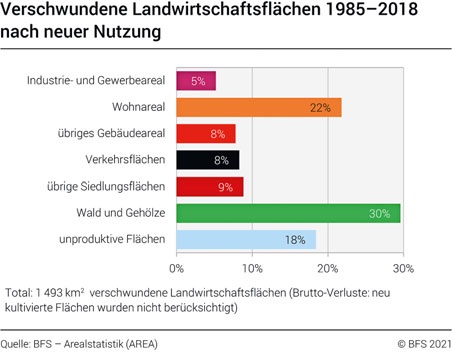
Unfortunately, we still have a major communication gap. Studies and expert reports are of limited help, as the saying goes: “Don’t trust any study you didn’t fund yourself.” All the discussions about bird conservation are hardly tenable from a scientific standpoint. The reality on and around our flying fields tells a different story.
*Organized local model aircraft fields are worthy of support from the perspective of pragmatic—that is, effective—nature conservation.*
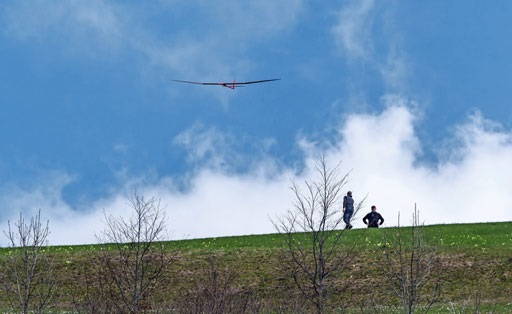
Model aircraft flying requires space—just like other outdoor sports. As land becomes increasingly “lost” or used more intensively, careful planning and development are essential. Uncontrolled and excessive use driven by a variety of needs and desires would further intensify the struggle for resources based on the “law of the jungle.” The entire regulatory framework aims to steer the management of our landscape resources in an orderly direction—a constant balancing act. Despite this difficult balancing act, I believe a liberal spirit prevails in the Spatial Planning Act (RPG). It’s just a shame that the cantons apply their permitting procedures inconsistently and, in some cases, disproportionately restrictively.
*An overbuilt, “fragmented” landscape would make the hobby of model aircraft flying much more difficult.*
Article 24 of the Spatial Planning Act (RPG) provides that airfields that do not significantly impact the landscape may be approved through a simplified process (exceptions
). Unfortunately, authorities are often unwilling to do so. Instead of granting an exemption without requiring construction measures, they demand a full planning process—even though, as in the canton of Zurich, for example, construction projects are not approved. This borders on administrative arbitrariness. We can help prevent this by keeping our projects as simple as possible (see also “Increasing Leisure Activities”).
*Why keep it simple when it can be complicated? One must repeatedly ask oneself whether the complication of planning procedures by various agencies is systematic.*
"From the IRAP's1) perspective, the cantonal licensing authorities can have no interest whatsoever in unauthorized flying or 'unregulated' flying at numerous locations. Consequently, they would have to restrict model flying clubs in their—
Spatial Planning Act (RPG) of June 22, 1979
(as of January 1, 2019)
Art. 22 Building Permit
- 1 Buildings and structures may be erected or altered only with official approval.
- 2 A permit is granted provided that:
- a. the buildings and structures are consistent with the purpose of the land-use zone; and
- b. the land is serviced.
Examples
- Ski slope
- Sports center
- Golf course
- Boat harbor
- etc.
Art. 2449 Exceptions for Buildings and Structures Outside Building Zones
Notwithstanding Article 22(2)(a), permits may be granted to construct buildings and facilities or to change their purpose if:
- a. the purpose of the buildings and facilities requires a location outside building zones; and
- b. there are no overriding interests that preclude such a decision.
Examples
- Rope course in the forest
- Downhill trail in the forest
- Model airplane airfields
- etc.
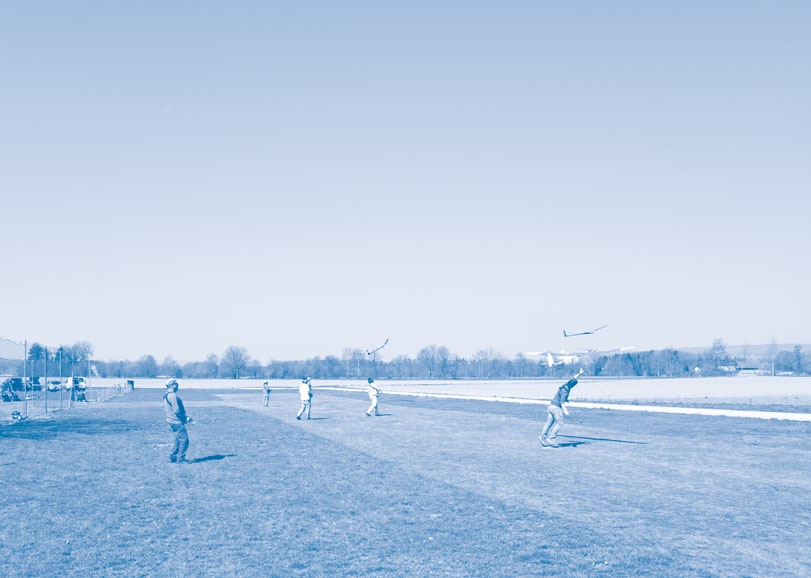
However, taking off and landing on private property requires permission from the landowner.
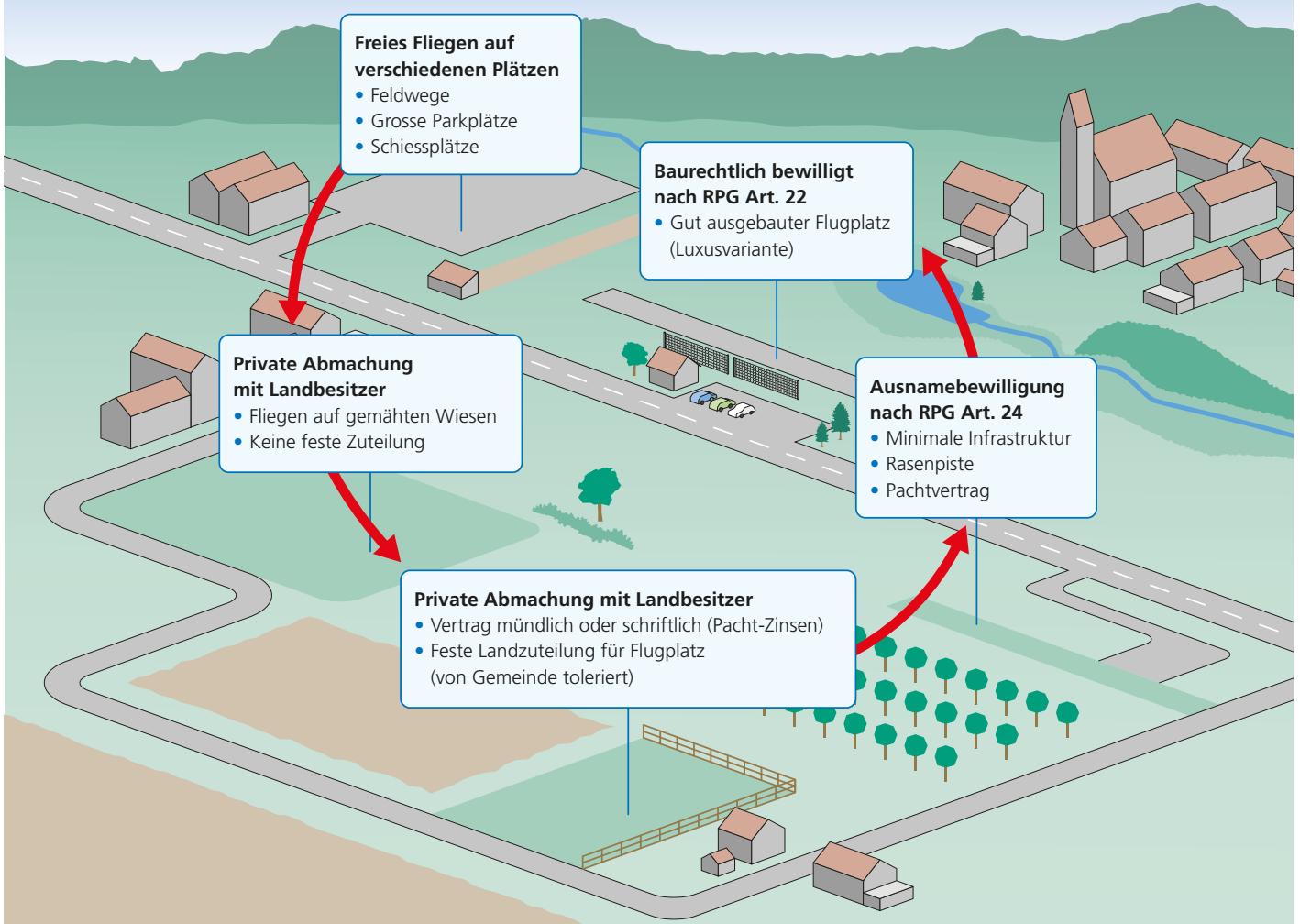
In Switzerland, model aircraft flying is permitted. I can fly at any suitable location with the owner’s permission (legal requirements, such as restrictions around airfields, must be observed). The advantages of a “private” flying site: the shortest possible commute (environment), and a tried-and-true temporary setup could later become an officially approved site. Most importantly: requests to landowners must be well prepared. Here, model aviators must step out of their anonymity. Who are we, what do we want, how many people, a detailed description of our hobby, flight schedules, etc. It takes a lot of work to build the necessary trust. A lease would be the next step. There, too—patience is key.
*Private flying sites authorized by landowners have time and again served as the starting point for airfields that were later officially approved.*
The Aviation Act is a massive piece of legislation comprising 111 articles (the accompanying ordinance has 144 articles). The term “model aircraft flying” no longer appears in the Act following its deletion. This dates back to the tenure of Federal Councilor Leon Schlumpf, who served as head
of the Federal Department of Transport and Energy from 1979 to 1987. Model aircraft are mentioned in the Act—including the VLK (DETEC Ordinance on Special Categories of Aircraft)—only in a few sentences and keywords. This means that
Aviation Act, LFG1), of December 21, 1948
(as of May 1, 2022)
Art. 1
Aircraft are defined as flying machines that can remain in the atmosphere through the action of air, but without the action of air against the ground (hovercraft).
2. Registered Aircraft and Missiles
Art. 2 Subject to paragraph 2, the following are authorized to operate in Swiss airspace:
- c. Aircraft of special categories subject to special rules (Art. 51 and 108).
The Federal Council shall issue regulations governing the classification of aircraft into individual categories.
In particular, it shall determine:
- b. which aircraft of special categories are subject to special rules (Art. 2; Art. 51; Art. 108).
It may authorize the cantons to take measures to reduce environmental impact and the risk to persons and property on the ground for certain categories of unmanned aircraft.
Art. 51
The Federal Council shall issue regulations governing the classification of aircraft into individual categories.
In particular, it specifies:
- b. which aircraft in specific categories are subject to special rules (Art. 2 and 108).
IV. Special Rules
The Federal Council may provide that certain provisions of this Act do not apply to aircraft of specific categories.
The following are considered as such:
- c. unmanned, motor-powered2) aircraft;
VLK1) of November 24, 1994 (as of January 1, 2019)
Art. 1742
Restrictions on Model Aircraft
Anyone operating a model aircraft weighing up to 30 kg must maintain direct visual contact with the aircraft at all times and be able to control it at all times.
The operation of model aircraft weighing between 0.5 and 30 kg is prohibited:
- a. within a distance of less than 5 km from the runways of a civil or military airfield;
- b. within active CTRs, provided that an altitude of 150 m above ground level is exceeded;
- c. within a radius of less than 100 meters of outdoor gatherings of people, unless the event is a public aviation event as defined in Article 4.
Model aircraft flying is virtually insignificant in the law and is therefore, fortunately, regulated very liberally for our model aviators.
We have learned to live with restrictions around airports and airfields. However, certain regions are heavily affected. The expansion of the CTR altitude ceiling is, in some cases, disproportionately large. Thanks to support from Skyguide, the affected clubs are managing to get by on a case-by-case basis. I assume that the operation of modern drones and air taxis will have no impact on our flying sites.
*The future of model flying in Switzerland will not be determined by the Aviation Act, the VLK, or any EASA lawyers. Ultimately, access to and use of suitable sites remain the decisive factors.*
1) IRAP Institute for Spatial Development | OST, University
of Applied Sciences of Eastern Switzerland 2) Aren't RC sailors affected?


News from HEBU

HORIZON HOBBY/LEMACO NEWS: MICRO OV-10 BRONCO 645 MM BY E-FLITE

PRIDE AND GOOD IDEAS
 Markus Nussbaumer

TEAM MANAGER "THIS" BOSSHARD
 Rodito Nussbaumer

YOU KNOW WHAT I MEAN? 125 YEARS OF THE SWISS AERO CLUB
 Emil Giezendanner

F3A EUROPEAN CHAMPIONSHIPS IN ST-MACAIRE, FRANCE
 Matthias Bosshard

ATOM, THE NEW DOUBLE-DECKER FROM CPLR
Matthias Bosshard
SUMMER FUN 2026 AT MG USTER
Martin Wunderli
TRY-OUT DAY AT MFV WETTINGEN
Urs Keller
What's New at Leomotion.com

52. 2026 ALPS CUP
Emil Giezendanner
TWIN TOWN PARTNERSHIP
Wolfgang Voeller
34th HAHNENMOOS ALPINE MODEL AIRPLANE CAMP
Res Dauwalder
CORSAIR F4U – A WARBIRD WITH A MEMORABLE LOOK
Jürgen Rosenberger, Jürgen Prinz
SMALL, MODEL-LIKE SAILBOATS
Res Dauwalder
WELCOME, NEW MEMBER!
Andrea Bolliger
FREE FLIGHT IN THE MIDDLE OF SUMMER
Urs Muntwyler
COUPE DES ALPES – OBSERVE AND LEARN
Rodito Nussbaumer
EURO CONTEST GLIDER ACRO TOUR AUSTRIA 2026

BY YOUTH, FOR YOUTH
Lorena Betschen
INSIGHTS INTO THE HISTORY OF SEAPLANES

THE PC-21 STORY
Emil Giezendanner
NEWS FROM HEBU
 Julia Bucher

FROM 0 TO 100
Markus Nussbaumer
MEMORIES
Wolfgang Völler
NOS REGION – A HUB FOR ELECTRIC AVIATION
Emil Giezendanner
DO YOU KNOW WHAT I MEAN IN THE LAND OF SMILES?
Emil Giezendanner
Have you almost forgotten about aircraft that take off and land vertically?
Emil Giezendanner