
Taking Off and Landing on Wheels—My Experience with the E-flite Turbo Timber as a Beginner Pilot
After the flight training sessions on the flight simulator and with Styro-E gliders had really tested my patience, I had the opportunity to learn and improve my flying skills with the well-known high-wing model Turbo Timber from E-flite (imported by LEMACO SA in Ecublens) to learn and improve my flying skills. The electronic attitude control system (SAFE®Select attitude limitation), which can be turned on and off, promised to be a major advantage.
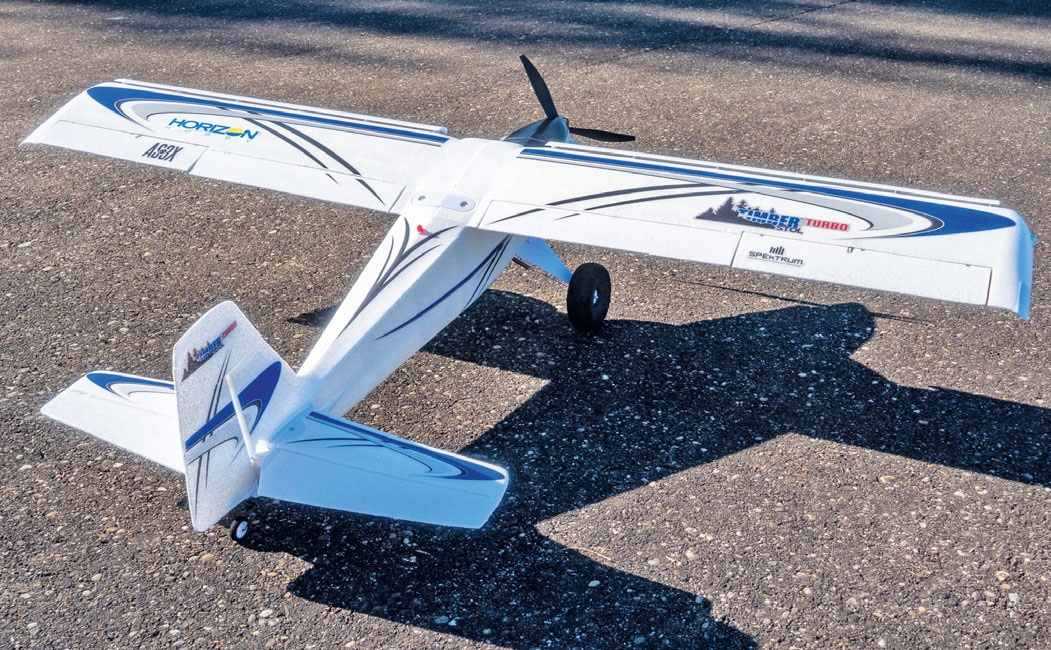
I begin flight preparation by placing the Turbo Timber on its back, turning on the transmitter, and connecting the built-in battery to the onboard electrical system. This activates the pairing process for the RC system. Then I make sure the SAFE-Select control switch on the transmitter is set to stabilized mode and place the model, wheels down, on a level surface. This causes the SAFE-Select control to store this position as the reference attitude for horizontal flight and confirms it by moving the flaps twice. Next, with the model secured in place, I move the throttle stick from idle to full throttle and back to transmit these control movements as well.
During the first phase of training, I was able to practice takeoffs and landings right away with attitude control enabled. This allowed me to focus more on regulating my airspeed using the engine RPM stick, since the SAFE-Select system kept the aircraft’s attitude within safe limits. Once I had mastered circuit flights with takeoffs and landings, I gradually practiced the same flight phases—first at a safe altitude, then at a lower altitude—with attitude control turned off. I always kept my little finger on the switch so that, in the event of an uncontrolled flight attitude, I could immediately switch from unlimited mode to electronically controlled flight mode. To get used to this emergency procedure, I practiced this switch and recovery at a safe altitude with astonishing success.
| Manufacturer: | Horizon Hobby, E-flite, China, USA |
| Construction: | Hollow-core construction made of EPO material |
| Wingspan: | 1500 mm |
| Fuselage length: | 1,040 mm |
| Center of gravity: | 60 mm behind the leading edge |
| Weight: | 1.7 kg |
| Motor: | 10BL brushless outrunner, 800 kV |
| Propeller: | 11 × 7.3", 3-blade |
| Servos: | 6 metal-gear servos |
| Gyro: | SAFE®Select flight attitude limit |
| Receiver: | Spectrum AR636A, 6-channel |
| Battery: | 11.1V, 3S 2200 mAh 30C Li-Po |
| Transmitter: | Spectrum DX6, 6-channel |
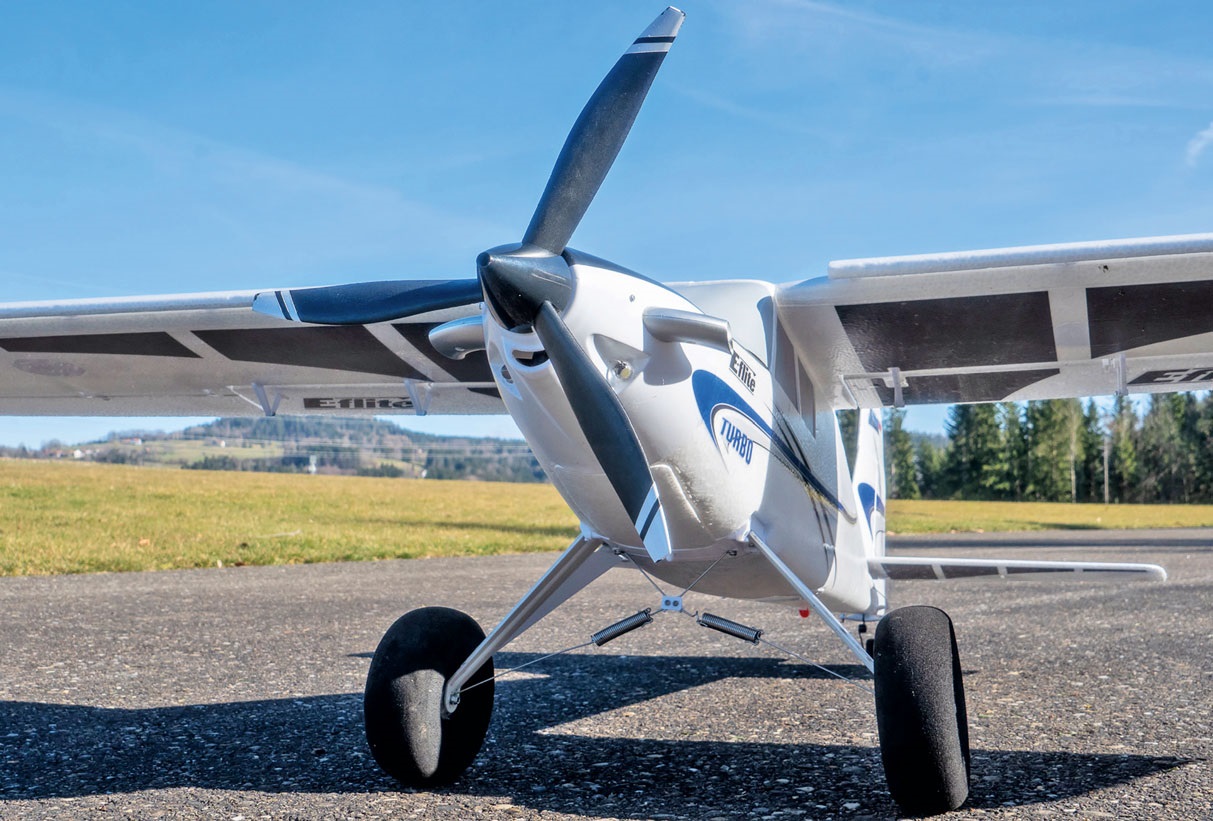
I was extremely impressed by the flights with flight attitude control engaged and in gusty crosswinds. I was delighted to see how the Turbo Timber corrected for the crosswind while flying parallel to the runway at a yaw angle of approximately 30°. Thanks to the stable, well-sprung landing gear with its large Tundra tires, takeoffs and landings on unpaved runways or even on grass are possible without any problems. The Turbo Timber can usually withstand even hard landings without sustaining damage. The 3-blade propeller, with its relatively small outer diameter, also helps reduce the risk of damage thanks to the increased ground clearance. If, however, a rollover does occur during landing and the engine is still running, the replacement cost for a new propeller (< CHF 10.00) is very reasonable.
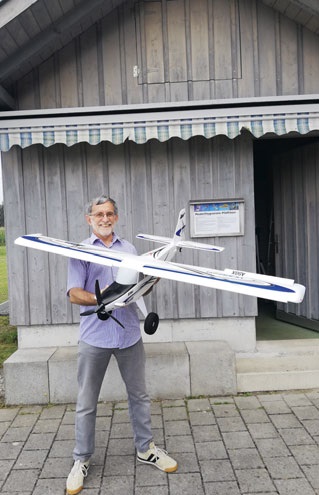
If there’s one thing I don’t like, it’s the cumbersome process of “turning the Turbo Timber on its back” when turning the power on or off at the beginning and end of a flight. Access from the top to change the battery, or a main switch that can be operated while the model is in an upright position, would significantly improve the situation. If the Turbo Timber is transported with its wings removed, the cables to the servos and position lights are a hassle to untangle and time-consuming to reconnect. To avoid having to go through this hassle every time, the model—thanks to its moderate dimensions—can be transported fully assembled in most station wagons and passenger cars with rear hatch doors.
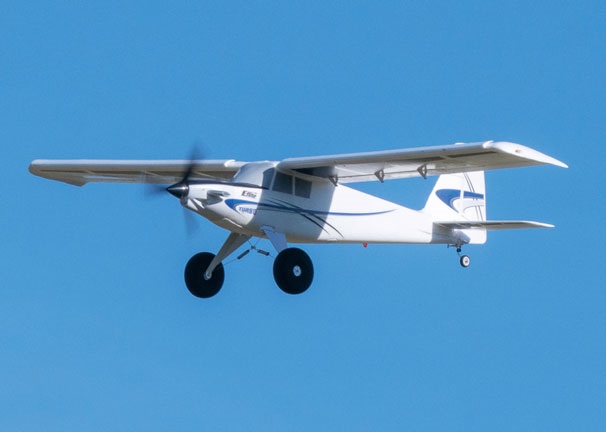
I’ve made encouraging progress with flying it. Apart from a few scratches, the model is still in impeccable condition. Flying the Turbo Timber feels as if it were being guided on a long leash. Perhaps the only thing missing is that, like a trained dog, it comes back to its owner when you whistle for it.
Styrofoam Sailboats Limit Success
For a long time, I followed the junior development program using the well-known Styrofoam sailplane models. After just a short while, our beginners were soaring through the sky like wild things, come rain or shine. Observers quickly come to the conclusion that the kids are great at flying. But when they switch to a real, larger glider model, disillusionment sets in. The rudder is hardly ever used, and, for example, a proper landing approach is usually missing—somehow, everyone has managed to land safely so far.
Many model flying clubs are fortunate enough to have access to a field with a level grass, synthetic, or hard-surface runway. This raises the question: Why not practice with an airplane equipped with a landing gear? Instead of relying on the popular instructor-student setups, why not enjoy the major advantages of an electronic stabilization system? For grass, use the largest possible wheels. The “flight instructor” stands nearby and calmly gives a few instructions. See the report for the results.
*Good luck! Emil Giezendanner*
I've gotten pretty used to my Turbo Timber by now. After about 50–80 landings over the past few months, I've


News from HEBU

TEAM MANAGER "THIS" BOSSHARD
 Rodito Nussbaumer

YOU KNOW WHAT I MEAN? 125 YEARS OF THE SWISS AERO CLUB
 Emil Giezendanner

HORIZON HOBBY/LEMACO NEWS: MICRO OV-10 BRONCO 645 MM BY E-FLITE

PRIDE AND GOOD IDEAS
 Markus Nussbaumer

TRY-OUT DAY AT MFV WETTINGEN
Urs Keller
F3A EUROPEAN CHAMPIONSHIPS IN ST-MACAIRE, FRANCE
 Matthias Bosshard

52. 2026 ALPS CUP
Emil Giezendanner
ATOM, THE NEW DOUBLE-DECKER FROM CPLR
Matthias Bosshard
SUMMER FUN 2026 AT MG USTER
Martin Wunderli
What's New at Leomotion.com

COUPE DES ALPES – OBSERVE AND LEARN
Rodito Nussbaumer
TWIN TOWN PARTNERSHIP
Wolfgang Voeller
34th HAHNENMOOS ALPINE MODEL AIRPLANE CAMP
Res Dauwalder
CORSAIR F4U – A WARBIRD WITH A MEMORABLE LOOK
Jürgen Rosenberger, Jürgen Prinz
SMALL, MODEL-LIKE SAILBOATS
Res Dauwalder
WELCOME, NEW MEMBER!
Andrea Bolliger
FREE FLIGHT IN THE MIDDLE OF SUMMER
Urs Muntwyler
EURO CONTEST GLIDER ACRO TOUR AUSTRIA 2026

BY YOUTH, FOR YOUTH
Lorena Betschen
INSIGHTS INTO THE HISTORY OF SEAPLANES

THE PC-21 STORY
Emil Giezendanner
NEWS FROM HEBU
 Julia Bucher

FROM 0 TO 100
Markus Nussbaumer
MEMORIES
Wolfgang Völler
NOS REGION – A HUB FOR ELECTRIC AVIATION
Emil Giezendanner
DO YOU KNOW WHAT I MEAN IN THE LAND OF SMILES?
Emil Giezendanner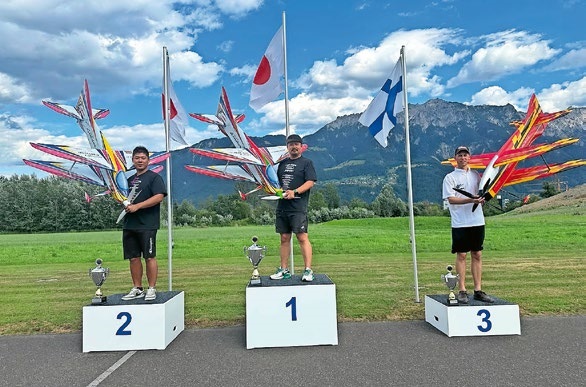
A SPECTACULAR F3A WORLD CUP IN THE PRINCIPALITY OF LIECHTENSTEIN
Emil Giezendanner