
F5A Aerobatics with Electric Models
Long Live the Difference
! Once again, this year’s Swiss Electric Aircraft Championships will feature not only the glider class (F5B) and helicopters (F5C) but also the Swiss Aerobatics Championships (F5A). Why is there still a separate electric aerobatics class when almost everything in the F3A scene is already electric anyway?
In fact, in the 1980s, the FAI regulations had governed electric aerobatics practically on the basis of the F3A rules. FAI European Championships were even held twice. Today, electric aerobatics has evolved in a different direction. This becomes clear quite quickly when you look at F5A aerobatics: maneuvers are still maneuvers. There is no difference here compared to piloted aerobatics, F3A aerobatics, or glider aerobatics. Loops are simply loops, rolls are clearly defined, and so on. What are the key differences from F3A or F3M?
1. Only electric models are permitted.
2. The models may weigh no more than three kilograms.
3. The F5A program is not performed in a “flat,” angle-limited flight window, but rather in a box—it is flown in three dimensions.
4. Each pilot puts together their own programs based on their skill level using the maneuver catalog. Only the maximum total coefficient and the maximum number of maneuvers are specified.
5. Turning is not counted as a maneuver but is factored into the overall impression.
6. The maneuvers are only roughly defined, allowing the pilot some leeway: e.g., a loop with a roll—the roll can be performed at the top or bottom of the loop, etc.
7. The final routine may be accompanied by music.
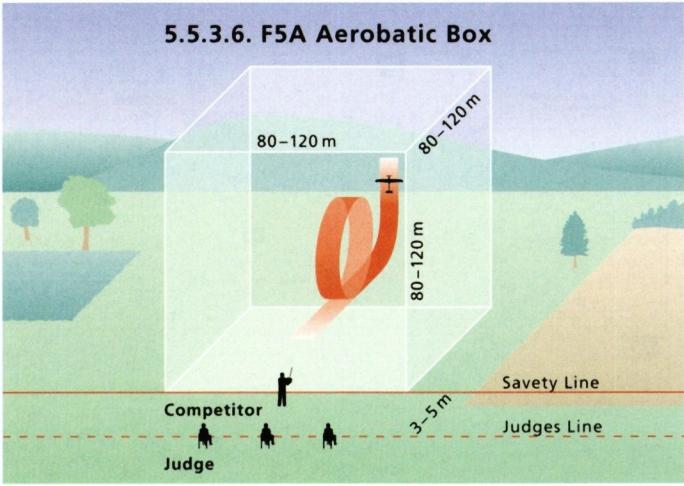
Judges and spectators can enjoy a wide variety of routines—there’s never a dull moment. Experienced and well-trained competitors tend to choose shorter routines with more difficult moves. Conversely, less experienced skaters opt for more moves, but easier ones. The final round in particular features some truly beautiful and thrilling routines. Accompanying the whole thing with music then becomes quite a challenge. The catalog of figures consists of one “base figure” and three “options” (knife flight: seven options). For example, two loops as the base figure with options 1: loop with roll, option 2: loop with snap, and option 3: loop rosette.
| No. | Basic figure | K | Option 1 | K | Option 2 | K | Option 3 | K |
|---|---|---|---|---|---|---|---|---|
| 1 | Positive loops (at least 2) | 2 | with roll(s) | 3 | with a snap | 4 | Rosette | 7 |
| 2 | Inverted loops (at least 2) | 3 | with roll(s) | 4 | with snap | 5 | Rosette | 8 |
| 3 | Square Loop | 3 | with 2 half rolls | 4 | with 4 half rolls | 5 | with 4 full rolls | 6 |
| 4 | Cuban Eight | 3 | Horizontal Square Eight | 4 | Vertical square figure-eight | 5 | Vertical square eight with two half rolls | 6 |
| 5 | One roll | 2 | Two rolls | 3 | Slow roll | 4 | 2 counter-rotating rolls | 5 |
| 6 | Dotted rolls (at least 2) | 3 | 4-point | 4 | 8-point | 5 | 4-Reverse-Point Roll | 6 |
| 7 | Knife Cut | 3 | Reversed with a half roll | 4 | Reversed with a full roll | 5 | Reverse with a snap | 6 |
| 7a | Knife-fly circle | 6 | Knife Flight Figure-8 | 7 | Messerflight Loop | 8 | Messerflug Horizontal Figure-8 | 9 |
| 8 | Roll Circle with 4 Half-Rolls | 4 | with 4 full rolls | 5 | with 4 full rolls in opposite directions | 7 | with one roll | 8 |
| 9 | Twist | 1 | 3 turns | 2 | 2 counter-rotating turns each | 3 | 3 rotations on the back | 4 |
| 10 | Immelman | 2 | combined with half rolls | 3 | combined with full rolls | 4 | combined with a reel and a snap | 5 |
| 11 | Positive Humpty Bump | 2 | Humpty Bump negative | 3 | Humpty Bump Negative or Positive combined with half rolls and dotted rolls | 4 | Humpty Bump (negative or positive) combined with a roll(s) and a snap | 5 |
| 12 | Torque roll(s) (at least 1) | 3 | two | 5 | three | 6 | More than three | 8 |
| 13 | Positive cylinder with 2 half-rolls | 3 | positive with full rolls | 4 | negative with half or dotted rolls | 5 | negative with a full roll and a snap | 6 |
| 14 | Turn | 2 | up and down with half rolls | 3 | Up and down with full rolls | 4 | Up with a roll and down with a snap | 5 |
A few years ago, I suggested creating an F3A class in Switzerland for models with a wingspan of up to about 140 cm—similar to the very successful system in Japan. Anyone who wants to fly F3A successfully these days has to dig pretty deep into their pockets—otherwise, they’d be better off not bothering. Such a class would have been particularly beneficial for young people or model aviators who would like to participate but prefer to invest less. The idea didn’t gain majority support on the committee at the time—perhaps the smaller Japanese model kits weren’t popular enough here. But in electric aerobatics today, we have access to an almost immeasurable selection of models weighing between two and three kilograms at very affordable prices (180 to 350 francs). The motors, three- to five-cell LiPo batteries, and charging equipment also cost only a fraction of what a competitive F3A aircraft would cost.
The “Open Swiss Electric Flight Nationals” are being held for the 10th time. It is a Swiss championship—similar to the circuit flight competition—in which the three official Swiss championship classes are contested over two days during a single weekend. This year, the event will take place at the Erlen airfield of the MG Breitenbach. On Saturday, the F5B glider competition will take place—likely the final test for our team before the World Championships in Kyiv. On Sunday, the helicopter and fixed-wing aerobatics championships will take place. Since the championships are also open to foreign competitors, the Swiss Gliding Championship in particular is popular among competitors from neighboring countries. This enhances the prestige of our championship.
Holding “pure” electric aerobatics competitions in the F3A style, as is the case in Germany, for example, was certainly appropriate in the past given the significant differences in performance. Today, however, this must be considered outdated, since—as mentioned—the majority of F3A aircraft are equipped with electric powerplants anyway. This results in two F3A classes, which no longer makes sense. F5A aerobatics represents a new culture in powered aerobatics. Complemented by freestyle flights as the highlight, it also establishes an ideal link to F6A Airplane Artistic Aerobatics in the FAI’s Aerosports Promotion Classes. On October 5, another international F5A competition will take place at the Pfäffikon airfield in conjunction with a selection competition in Artistic Aerobatics (F6A and F6C). See also the agenda on page 50. For more information, such as the maneuver diagrams, visit: www.silentwings.ch
Models weighing up to 3 kg
| Criteria | Qualifications | Final | ||
|---|---|---|---|---|
| K max. | Max. Points | K max. | Max. Points | |
| Precision of each figure, perfection | 25 (max. 8 figures) | 250 | 50 (max. 12 figures) | 500 |
| Overall impression (including turn maneuvers, takeoff, and landing), presentation of the maneuvers, landing inside or outside the landing area | 25 (15 without landing gear) | 250 (150) | 25 (15 without landing gear) | 150 (150) |
| Harmony, rhythm, elegance (with music) | – | – | 25 | 250 |
| Total | 50 | 500 | 100 | 1,000 |
2 × Qualifying
Program, 1 × Final Program
The points from the final program are added to the higher-scoring qualifying program.
*Emil Giezendanner,
Electric Flight Technical Committee*


News from HEBU

TEAM MANAGER "THIS" BOSSHARD
 Rodito Nussbaumer

YOU KNOW WHAT I MEAN? 125 YEARS OF THE SWISS AERO CLUB
 Emil Giezendanner

F3A EUROPEAN CHAMPIONSHIPS IN ST-MACAIRE, FRANCE
 Matthias Bosshard

SUMMER FUN 2026 AT MG USTER
Martin Wunderli
TRY-OUT DAY AT MFV WETTINGEN
Urs Keller
52. 2026 ALPS CUP
Emil Giezendanner
BY YOUTH, FOR YOUTH
Lorena Betschen
ATOM, THE NEW DOUBLE-DECKER FROM CPLR
Matthias Bosshard
CORSAIR F4U – A WARBIRD WITH A MEMORABLE LOOK
Jürgen Rosenberger, Jürgen Prinz
SMALL, MODEL-LIKE SAILBOATS
Res Dauwalder
What's New at Leomotion.com

TWIN TOWN PARTNERSHIP
Wolfgang Voeller
EURO CONTEST GLIDER ACRO TOUR AUSTRIA 2026

INSIGHTS INTO THE HISTORY OF SEAPLANES

34th HAHNENMOOS ALPINE MODEL AIRPLANE CAMP
Res Dauwalder
WELCOME, NEW MEMBER!
Andrea Bolliger
HORIZON HOBBY/LEMACO NEWS: MICRO OV-10 BRONCO 645 MM BY E-FLITE

FREE FLIGHT IN THE MIDDLE OF SUMMER
Urs Muntwyler
COUPE DES ALPES – OBSERVE AND LEARN
Rodito Nussbaumer
PRIDE AND GOOD IDEAS
 Markus Nussbaumer

THE PC-21 STORY
Emil Giezendanner
NEWS FROM HEBU
 Julia Bucher

FROM 0 TO 100
Markus Nussbaumer
MEMORIES
Wolfgang Völler
NOS REGION – A HUB FOR ELECTRIC AVIATION
Emil Giezendanner
Have you almost forgotten about aircraft that take off and land vertically?
Emil Giezendanner
DO YOU KNOW WHAT I MEAN IN THE LAND OF SMILES?
Emil Giezendanner