
Jet Team Ticino
It was 1928 when a young Englishman, Frank Whittle, came up with the idea of using a steam turbine engine in an airplane.
In 1930, he presented a working prototype of a turbojet engine. Unfortunately, his project stalled due to bureaucratic hurdles.
In 1937, thanks to the support of two army officers, he managed to advance the development of the turbine engine, and on May 15, 1941, the first British turbine-powered aircraft took flight: the Gloster E 28/39.
During the same period in Germany, Hans von Ohain, who had been favored by the Nazi regime, was designing and building a turbine engine, which was installed on an aircraft that made its maiden flight on August 27, 1939: the Heinkel He-178.
In the early summer of 1944, in the midst of the war, the British built and flew the Gloster Meteor fighter, and Germany built and flew the Messerschmitt Me 262 fighter—both twin-engine aircraft. This marked the beginning of turbine propulsion as we know it today in our aircraft.
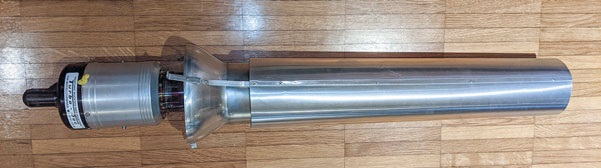
The turbine for model aircraft propulsion was developed in the 1980s and 1990s. It operates on the same principle as aircraft turbine engines (turbojets).
Lodrino, the former military airfield in Sopraceneri, invites you to fly freely in a jet on a beautiful paved runway with plenty of open space.
Jet enthusiasts and model airplane pilots living in Ticino have founded the Jet
Preparation
The candidate properly prepares the aircraft and carries out preflight checks according to the checklist. The candidate demonstrates knowledge of the aircraft’s characteristics and the propulsion system. The candidate places particular emphasis on safety, taking into account the conditions at the airfield.
Flight Plan
Start-up and Pre-flight Checks
- Takeoff and climb to 30 meters while maintaining alignment with the runway
- Slow flight at a constant altitude (approx. 30 meters), performing 2 180° turns, 1 to the right and 1 to the left
- Flying a figure-eight, maintaining slow flight and constant altitude
- Fast flight, prioritizing safety and maintaining airspace
- Correct approach, landing gear extended (landing pattern) with go-around
- Approach and landing
Evaluation
The flight will be judged based on the following criteria:
Safety – the pilot must clearly demonstrate the ability to fly the model through the various phases without any hesitation.
Airspace – the model may only fly within the airspace defined by the Lodrino operating regulations. Exceeding these limits will result in the immediate termination of the exam. A GPS logger will be installed on the model.
Landing – the pilot will perform a proper landing, centered on the runway, within a zone of +/- 50 meters.
Preparation
See Flight 1. The flight program for Flight 2 will cover the aerobatic routine and a simulated engine shutdown.
Flight Plan
Start-up and pre-flight checks.
- Takeoff and climb while maintaining alignment with the runway.
The aerobatic program must be appropriate for the model being used, but must include at least:
- 1 Loop
- 1 Tonneau
- 1 Slow barrel roll
- 1 Cuban Eight
- 1 Retournement
Additional maneuvers may be added by the pilot.
- Correct approach, landing gear extended, (landing pattern) with go-around
- Simulated engine failure ordered by the instructor
- Approach and landing without engine power
Evaluation
Flight 2 will be evaluated using the same criteria as the first flight. Aerobatic maneuvers must be recognizable and performed at a safe altitude. A maneuver that is not performed correctly may be immediately announced by the pilot and repeated. The landing without engine power must be performed safely, with no space restrictions on the runway.
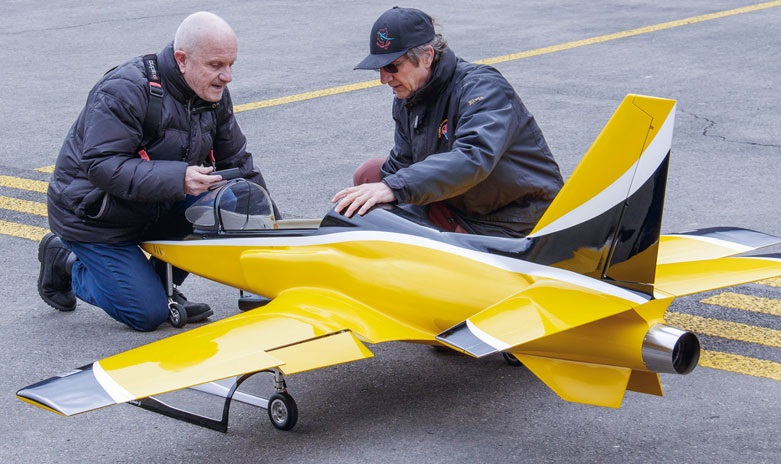
Team Ticino in 2006. Due to the mixed use of the airfield (military aviation and model aircraft flying) and its proximity to the highway, it was necessary to establish a robust set of flight regulations. With the help of Martin Sannwald, a set of regulations was developed that, among other things, includes a code of conduct and the conditions for authorization to fly a jet (test flight).
Today, the Jet Team is responsible for Jet flight operations on the Lodrino runway. Flying a Jet is permitted only when another member of the Jet Team is present. The “second pilot” serves as the mechanic and is responsible for monitoring the airspace. To facilitate airspace monitoring and improve the visibility of manned aircraft, the pilot approaching the runway activates a ground siren in conjunction with a call on the airport’s radio frequency.
During the test flight, two instructors must be present on site.
These are the background and requirements for flying. But there’s also the spectacle of watching a jet fly!
There’s the sound of the turbine, which, depending on its size, provides between 5 kg and 20 kg of thrust, accelerating the jet model airplanes to remarkable speeds that allow them to perform stunning acrobatic maneuvers in the sky, almost as if we were in zero gravity.
Then there are the model airplanes—all beautiful, whether modern, scale models, or warbirds—a feast for the eyes of enthusiasts and spectators alike.
This proves once again that passion, skill, and adherence to certain rules are just as important for this hobby as they are for full-scale aviation!
All of this always makes for a spectacular show. ■
Text: Rolf Walser, Wolf Völler
Photos: Wolf Völler, Rolf Walser Basic
Rules: Jet Team Ticino


News from HEBU

HORIZON HOBBY/LEMACO NEWS: MICRO OV-10 BRONCO 645 MM BY E-FLITE

PRIDE AND GOOD IDEAS
 Markus Nussbaumer

TEAM MANAGER "THIS" BOSSHARD
 Rodito Nussbaumer

YOU KNOW WHAT I MEAN? 125 YEARS OF THE SWISS AERO CLUB
 Emil Giezendanner

F3A EUROPEAN CHAMPIONSHIPS IN ST-MACAIRE, FRANCE
 Matthias Bosshard

ATOM, THE NEW DOUBLE-DECKER FROM CPLR
Matthias Bosshard
SUMMER FUN 2026 AT MG USTER
Martin Wunderli
What's New at Leomotion.com

52. 2026 ALPS CUP
Emil Giezendanner
TWIN TOWN PARTNERSHIP
Wolfgang Voeller
34th HAHNENMOOS ALPINE MODEL AIRPLANE CAMP
Res Dauwalder
CORSAIR F4U – A WARBIRD WITH A MEMORABLE LOOK
Jürgen Rosenberger, Jürgen Prinz
SMALL, MODEL-LIKE SAILBOATS
Res Dauwalder
TRY-OUT DAY AT MFV WETTINGEN
Urs Keller
WELCOME, NEW MEMBER!
Andrea Bolliger
COUPE DES ALPES – OBSERVE AND LEARN
Rodito Nussbaumer
EURO CONTEST GLIDER ACRO TOUR AUSTRIA 2026

BY YOUTH, FOR YOUTH
Lorena Betschen
INSIGHTS INTO THE HISTORY OF SEAPLANES

THE PC-21 STORY
Emil Giezendanner
FREE FLIGHT IN THE MIDDLE OF SUMMER
Urs Muntwyler
NEWS FROM HEBU
 Julia Bucher

FROM 0 TO 100
Markus Nussbaumer
MEMORIES
Wolfgang Völler
NOS REGION – A HUB FOR ELECTRIC AVIATION
Emil Giezendanner
DO YOU KNOW WHAT I MEAN IN THE LAND OF SMILES?
Emil Giezendanner
Have you almost forgotten about aircraft that take off and land vertically?
Emil Giezendanner