
Scale Helicopter
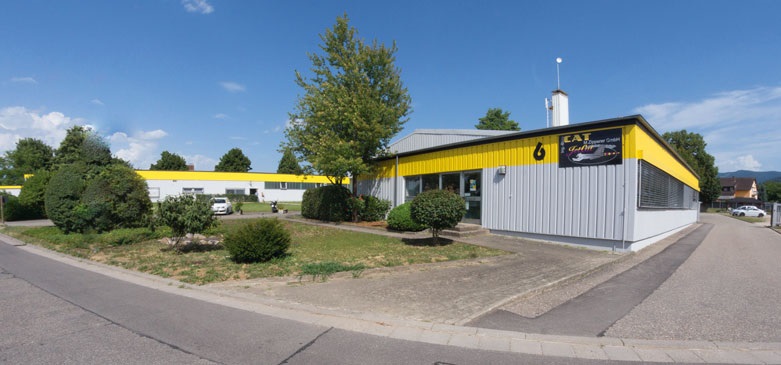
JetCat is the largest manufacturer of model turbines. At its manufacturing facilities in Ballrechten-Dottingen, just 50 kilometers north of Basel, the engineering firm CAT M. Zipperer GmbH—with approximately 90 employees—not only develops solutions for laboratory applications but also manufactures model turbines. JetCat turbines are available for every model class.
Since 1976, the engineering firm CAT M. Zipperer GmbH has been developing customized, individual solutions for the laboratory sector. The product range extends from high-precision micro-dosing pumps to magnetic stirrers, shakers, dispersers, cell counters, and robots for laboratory automation. A completely different product line—the development and manufacture of model aircraft turbines for jet model aircraft—was added in 1998, and the “JetCat” brand was born.
The fascination with jet model aircraft has remained undiminished ever since. Today, these turbines are not only used in model aircraft sports but also for exciting industrial applications, such as in drones or in stationary setups at universities and colleges. The workforce of approximately 90 employees ensures the consistent delivery of comprehensive solutions that meet the individual needs of both private and industrial customers. JetCat also places a high priority on apprentice training. Currently, twelve young people are being given the opportunity to complete their apprenticeships in the fields of industrial mechanics, electronics, and business administration. JetCat places great emphasis on high-quality standards in all its products, services, and processes. Today, the company is led by Dipl.-Ing. Markus Zipperer and is experiencing steadily growing demand across all sectors. All JetCat turbines are designed and verified entirely using a 3D CAD system. The company’s own CNC machine park enables not only toolmaking but also the flexible production of all types of milled and turned parts. Plastic parts are manufactured on the company’s own injection molding machines. The precise welding of thin-walled metal parts (e.g., combustion chambers, etc.) is performed in-house on the company’s own laser welding systems. What makes JetCat particularly strong is “the short lines of communication” and the close collaboration between development engineers and the production team. In this way, new ideas and customer requests can be quickly implemented and tested in practice. All engines undergo a test run prior to delivery. For this purpose, JetCat has a specially equipped test room where, in addition to pure thrust measurements, shaft-driven engines can be tested for torque and power. The rotor assemblies of the engines are dynamically balanced on precision balancing machines. Finally, the complete engine is fine-tuned once more in its fully assembled state. A range of different balancing machines is available for this work. The engineering firm CAT M. Zipperer GmbH is ISO-certified (DIN ISO 9001 and DIN ISO 13485).
From the very beginning, JetCat set out to develop turbines for helicopters. Just one year after the first delivery of jet engines, JetCat’s first helicopter turbine, the PHT3, was launched in 2001. From that point on, certain turbines from JetCat’s rapidly expanding product line were also distributed through Graupner. This paved the way for global distribution via a large, existing dealer network. During this time, it was not always possible to keep up with the rapidly growing market, whether in production or service. But South German quality helped make up for this in an environment that was not always easy. With the PHT3, the company relied from the very beginning on a turbine with mechanical components, as well as speed reduction in the first and second stages via timing belts. Many skeptics scoffed at these timing belts at first, but time has proven JetCat right. This powertrain is available with the turbine mounted either above or below, and with various main and tail rotor speeds. The PHT3, a turbine powerplant that has become indispensable in model helicopters, is now used by tens of thousands of model pilots.
The PHT2, a turbine engine for models with a rotor diameter of approximately 1.6–1.7 meters, followed in 2007. Although the manufacturer always specifies the takeoff weight of nine kilograms as the upper weight limit, these engines are unfortunately often used in heavier models. Unfortunately, owners then deny this, and the product is unfairly disparaged. Another unique feature of this engine is the starter-generator, which acts as a buffer for the operating battery. With the PHT2 as well, various main and tail rotor speeds can be specified when ordering.
However, as models grew in size and rotor diameter over time, JetCat began developing twin-shaft turbines for model helicopters as early as 2004. With the SPT5-H, rated at 6 kilowatts, or the SPT10RX-H, rated at 9 kilowatts, JetCat covers the range starting at a 2.0-meter rotor diameter. Recently, both turbine types have been shipped with a new housing in the area of the exhaust outlets. Several modifications have resulted in significantly lower exhaust temperatures, which has a very positive effect on running performance. The SPT15-RX-H followed in 2012. This twin-shaft turbine, used in large and heavy models, has an output of 15 kilowatts.
A range of different mechanical configurations for the twin-shaft turbines rounds out the product lineup. Customers can choose the mechanical configuration that best suits their model from a variety of options. Various main and tail rotor speeds are also available to perfectly match each specific model.
JetCat also places great emphasis on service, whether it’s an inspection following a crash, a software update, or periodic maintenance. Normally, a turbine leaves the factory within about three weeks after service. Unfortunately, when there is a heavy workload, this time frame may be extended. However, one thing that always causes a great deal of trouble for the turbine manufacturer’s service center is when customers send in their turbine without mentioning a single word about what needs to be done. There have even been instances where no information or owner details were provided at all. However, engine owners will soon be able to perform software updates themselves. All software updates will then be available for download on the company’s website. Detailed and easy-to-understand instructions make this process straightforward and accessible even for inexperienced computer users. [www.jetcat.de](http://www.jetcat.de) info@cat-ing.de Facebook: JetCat
Various organizers of the Heli Scale categories have tried many different approaches in recent years, but unfortunately with only moderate success. This year, the FAKO plans to work intensively once again toward the goal of “more participants.” Unfortunately, the Heli Scale Contest held during the 2018 World Championships in Meiringen did not provide the desired boost to elevate the “Helicopter” category to world-class status for the Swiss Scale Championships. As things currently stand, a second Heli Scale Contest will not be held during the 2020 World Championships in Norway either. Consequently, a World Championship for scale helicopters is once again a distant prospect.
In recent years, it has been difficult to attract enough participants to hold a Swiss Championship in accordance with the rules. To award a Swiss Championship title, a minimum of five participants per category (Heli Scale and Heli Semiscale) must compete. Organizers hope to encourage new pilots to participate through a special beginner’s event. Competitors can enter the following two classes:
Judges in this category evaluate the build quality of the model based on at least one photo of the prototype. This means it is possible to compete even with simple models, since the main and tail rotors are not included in the evaluation. The weight must not exceed 29 kilograms. For the flight evaluation, the mandatory and optional maneuvers are the same as in the Heli Scale category. The evaluation is weighted 1/5 for construction and 4/5 for flight.
This category requires more detailed construction documentation. The construction evaluation covers the following points: fidelity to the original, color scheme, registration numbers, markings, surface texture and realism, construction quality of the main and tail rotor systems, and attention to detail in replicating the original. Due to technical requirements and safety considerations, the main and tail rotor systems are evaluated only in terms of the number of rotor blades and the direction of rotation of the rotor system. The flight evaluation consists of mandatory and optional maneuvers. The evaluation is weighted 1/2 for construction and 1/2 for flight.
With the aim of attracting and inspiring as many new pilots as possible to the Heli-Scale Championship, an information day will be held in Interlaken on March 21, 2020. The goal will be to help interested pilots overcome any hesitation they may have about this competitive discipline. During the morning theory session, participants will learn how to turn a scale model into a beginner’s model for the scale scene with relatively little effort, how to prepare construction documentation for a successful build evaluation, and how small, specific details can lead to more points. In the afternoon, participants will learn how to successfully fly the model in competition to earn as many points as possible. This session will also provide training for participants to fly under competition conditions. The flying portion is, of course, weather-dependent.
The event is aimed at interested helicopter pilots (scale or semi-scale) who do not yet have championship experience but would like to give it a try. Let’s hope that as many model pilots as possible sign up to participate, so that the Swiss Scale Championships on August 29 and 30, 2020, in Interlaken will feature a large field of participants for the first time in years. ■
Anton Laube
| March 14 and 15 | ROTOR live – Baden-Baden D |
| March 21 | Scale Helicopter Training – Interlaken, Switzerland |
| April 11 | Spring Helicopter Meet – Leuggern, Switzerland |
| May 1–3 | Coupe Vario 2020 – Argelès-sur-Mer, France |
| May 9 | 10th FFFF Meetup – Dorf, Switzerland |
| May 16 | 2nd Scale and Semiscale Helicopter Meet – Landquart, Switzerland |
| May 21 | Vario Event 2020 – Gräfendorf, Germany |
| May 23 | 17th Three-Country Corner Helicopter Meet – Bregenz, Austria |
| May 23 and 24 | HeliWorld – Hammelburg, Germany |
| May 23 and 24 | Heli-Divonne Symposium – Divonne, France |
| May 30 and 31 | ENGHIEN HeliDays – Petit-Enghien, Belgium |
| June 6 and 7 | Lama & Alouette II Meetup – Wieslet D |
| June 22 and 23 | 3rd FIAM Vario Italia Heli Day – Siena I |
| August 1 and 2 | 17th Loorholz Air Show – Leuggern, Switzerland |
| August 22 and 23 | Helicopter Rally – Stabio, Switzerland |
| August 28–30 | Hochsteiermark Airfest – Lanzen-Turnau, Austria |
| August 29 and 30 | Swiss Scale Championship – Interlaken, Switzerland |
| September 11–13 | Jet-Power Event – Donauwörth, Germany |
| September 26 | Scale Helicopter Meet – Leuggern, Switzerland |
| June 27 through July 4 | Helicopter Vacations with swiss-scale-helikopter.ch – Samnaun, Switzerland |
| August 22–29 | Helicopter Vacations with swiss-scale-helikopter.ch – Samnaun, Switzerland |
More info:
My name is Anton Laube; I’m 58 years old and live in Kappel, SO. I got started in model helicopter building in early 1977 with a Varioprop 12S and a Bell 47G from Graupner. After countless crashes and repairs to the Bell (the longest flight was certainly less than 10 seconds), I put everything away in the attic in the late 1970s to devote myself to glider flying. Toward the end of the 1980s, however, I unfortunately had to give that up for health reasons and suddenly, despite having a family, found myself with plenty of time for a hobby again.
Yes, there was still the Bell 47G in the attic, but to start flying it again? No—it had gone out of style in the meantime, along with its control system. (I still have both, though.) At that time, the first model helicopter flight schools were already around. After five lessons on a Futura—the gold standard back then—I was able to hover. Using a Kyosho Concept 30SE and a Multiplex 2020, I continued to teach myself hovering exercises and a bit of circuit flying, step by step. This was followed by models such as the Futura SE, Hirobo Freya and SDX, TREX 700, Vibe 50, and many more.
In 2001, I built my first turbine helicopter, a BK117 from Robbe powered by a JetCat PHT3. From then on, I was hooked on scale models. I currently fly several turbine-powered models—the Lama, Super Puma, and Bell 429—as well as electric models like an Agusta A109, a Gaui X5, and a LOGO 600.
Yes, you read that right—only RC helicopters; no, never RC fixed-wing aircraft—I could never get into them, or maybe they just weren’t for me (though I did try once).
In the mid-1990s, I founded the model-building company A. L. K. Modellbau & Technik GmbH, which specializes in model helicopters. I ran it part-time until the end of 2006, but the helicopter boom led me to take the leap into self-employment in early 2007. In 2015 and 2018, I sold a large portion of my company.
Today, I run swiss-scale-helikopter.ch, which specializes in large helicopters, helicopter vacations, and accessories. In addition, I organize loorholz-events.ch in Leuggern, Aargau, and serve as president of MG Swipair.
Since 2015, I have regularly contributed articles to the Swiss magazine “Helico”—and, starting in 2017, to “Helico-Sky-heli”—covering events, build reports, and news from the model helicopter scene. At the end of 2019, I ended this collaboration in favor of “Modellflugsport.” I took this step because I’m convinced that my work on model helicopters can be put to better use here in “Modellflugsport” and will also appeal to a wider audience.
But good articles always depend on the information provided to the writer. That’s why I’m making this appeal:
- You have an extraordinary model helicopter that you’d like to introduce to the readers of “Modellflugsport,” but you don’t want to write the article yourself.
- Your club is hosting a meetup or an air show with lots of model helicopters, but no one is writing a report.
- You have a helicopter-related topic that would be worth a report, but who will put it in writing?
- You know about something new in the helicopter scene but aren’t sure how to write about it.
Feel free to reach out to me—I’d be happy to take on this task for you. Only by working together can we introduce our wonderful hobby to those interested or attract new enthusiasts. I’m already looking forward to lots of great feedback, encounters, and events with you. ■
Anton Laube


News from HEBU

TEAM MANAGER "THIS" BOSSHARD
 Rodito Nussbaumer

YOU KNOW WHAT I MEAN? 125 YEARS OF THE SWISS AERO CLUB
 Emil Giezendanner

F3A EUROPEAN CHAMPIONSHIPS IN ST-MACAIRE, FRANCE
 Matthias Bosshard

CORSAIR F4U – A WARBIRD WITH A MEMORABLE LOOK
Jürgen Rosenberger, Jürgen Prinz
SUMMER FUN 2026 AT MG USTER
Martin Wunderli
TRY-OUT DAY AT MFV WETTINGEN
Urs Keller
52. 2026 ALPS CUP
Emil Giezendanner
BY YOUTH, FOR YOUTH
Lorena Betschen
ATOM, THE NEW DOUBLE-DECKER FROM CPLR
Matthias Bosshard
SMALL, MODEL-LIKE SAILBOATS
Res Dauwalder
What's New at Leomotion.com

HORIZON HOBBY/LEMACO NEWS: MICRO OV-10 BRONCO 645 MM BY E-FLITE

TWIN TOWN PARTNERSHIP
Wolfgang Voeller
PRIDE AND GOOD IDEAS
 Markus Nussbaumer

EURO CONTEST GLIDER ACRO TOUR AUSTRIA 2026

INSIGHTS INTO THE HISTORY OF SEAPLANES

34th HAHNENMOOS ALPINE MODEL AIRPLANE CAMP
Res Dauwalder
WELCOME, NEW MEMBER!
Andrea Bolliger
FREE FLIGHT IN THE MIDDLE OF SUMMER
Urs Muntwyler
COUPE DES ALPES – OBSERVE AND LEARN
Rodito Nussbaumer
THE PC-21 STORY
Emil Giezendanner
NEWS FROM HEBU
 Julia Bucher

FROM 0 TO 100
Markus Nussbaumer
MEMORIES
Wolfgang Völler
NOS REGION – A HUB FOR ELECTRIC AVIATION
Emil Giezendanner
Have you almost forgotten about aircraft that take off and land vertically?
Emil Giezendanner
DO YOU KNOW WHAT I MEAN IN THE LAND OF SMILES?
Emil Giezendanner