
A Journey Through the A-to-Z Construction of a De Havilland Venom FMBK 4 Model Airplane—or Living Out Your Passion
Building a model from a blueprint is becoming increasingly rare. Our busy lives move at a fast pace, and it’s hard to find time for a passion or a hobby. Building a scale model stands in contrast to our fast-paced lives. It requires patience, thoughtfulness, and perseverance.
On the market, models are either ready to fly or are so highly engineered that they leave little room for creativity.
Personally, I find pleasure in the building process, in seeking technical solutions, and in seeing a project come to fruition. It’s all the more motivating to think things through, plan, and carry out every phase of the build myself.
After building several models from plans such as the Space Shuttle, MD-11, Hercule S, A-10, and GB Sport, the De Havilland Venom project presented many challenges
that were likely to take up many evenings.
Choosing the right model is crucial: You need to understand the full-scale aircraft’s flight performance, the possible engine options, and the power-to-weight ratio, which determines its flight characteristics.
The plans: After cross-referencing several magazines and refining the drawings as accurately as possible, the plans were finalized at a scale of 1:1.4. This results in a—
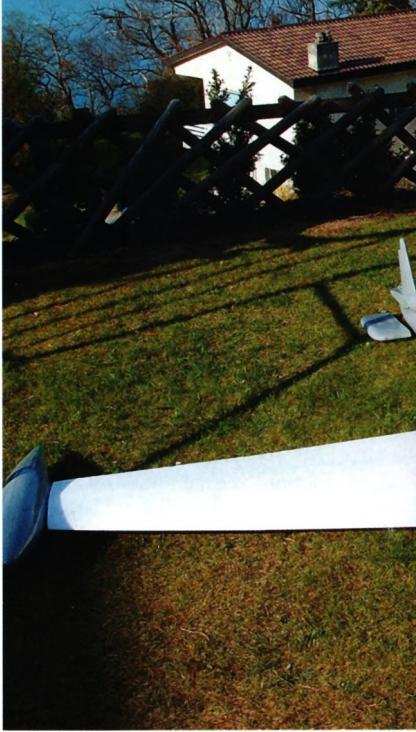
3.20 m wingspan, suitable for my personal vehicle.
Construction: I decided to make the fuselage and spars out of fiberglass, and the wings out of Styrofoam with a balsa wood skin. I made a wooden master model to create molds from which the final parts would be cast... easier said than done (about 500 hours of work!)
I finally have an “empty” fuselage and two spars. It’s quite a challenge to figure out how to assemble a fuselage with two spars, two wings, and an elevator—and it all has to be lightweight, sturdy, and disassemblable.
Fuselage and its few stringers: Two sturdy aluminum tubes as wing spars, and it’s starting to take shape. The landing gear—
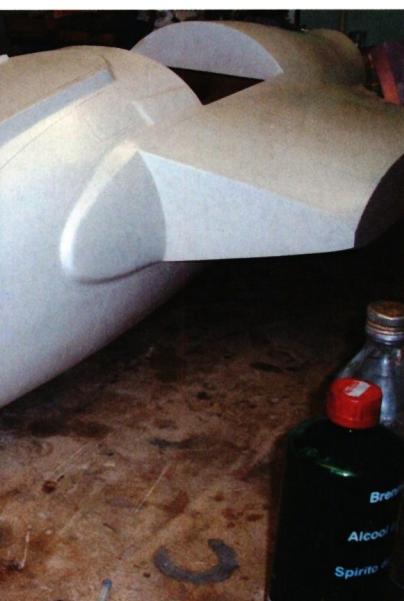
The kit is supplied by AWE in Germany after I send them photos, drawings, and animations. The train is sent back to me... it's magnificent!
The wings: This is where my club and friends step in: our chief engineer, Mr. Didier Lach, programs the computer-assisted hot-wire cutting (Stepfour) to cut the wing with two different profiles, a sweep, a dihedral, and a twist—all cut into four parts to the nearest millimeter. After programming, using 2 m³ of Styrofoam for trials and tests, it was Patrice Martin’s (President of GAM) turn to operate the Stepfour, and finally, one day, late at night, a perfect wing was born—which we celebrated by popping open a fine bottle!
That evening, I came home with eight pieces of Styrofoam. I was going to have to turn them into wings. The assembled pieces (the installation of the reinforcements, the
, the landing gear mount, the electrical wiring, and the 2 mm balsa veneer vacuum-pressed) covered the entire structure. After fitting them to the fiberglass fuselage, the wings were covered with 25 g/m² fiberglass cloth.
Installing the Jet-Cat P 160 engine is easy because there’s plenty of room. However, balancing this Venom is tricky due to its short nose.
The four-liter fuel tank is located in the center of the model and consists of two two-liter bottles that empty one after the other.
The receiver and electrical systems consist of a GRA SMC 19 receiver and a DPSI RU control unit that powers the sixteen servos with 6 volts.
After two years of work, the plane is ready. The first taxiing tests will take place in June 2007, and the maiden flight will follow if everything goes well. The story of the maiden flight will be covered in a future article...?
Laurent Chaperon


News from HEBU

HORIZON HOBBY/LEMACO NEWS: MICRO OV-10 BRONCO 645 MM BY E-FLITE

PRIDE AND GOOD IDEAS
 Markus Nussbaumer

TEAM MANAGER "THIS" BOSSHARD
 Rodito Nussbaumer

YOU KNOW WHAT I MEAN? 125 YEARS OF THE SWISS AERO CLUB
 Emil Giezendanner

F3A EUROPEAN CHAMPIONSHIPS IN ST-MACAIRE, FRANCE
 Matthias Bosshard

ATOM, THE NEW DOUBLE-DECKER FROM CPLR
Matthias Bosshard
SUMMER FUN 2026 AT MG USTER
Martin Wunderli
What's New at Leomotion.com

52. 2026 ALPS CUP
Emil Giezendanner
TWIN TOWN PARTNERSHIP
Wolfgang Voeller
34th HAHNENMOOS ALPINE MODEL AIRPLANE CAMP
Res Dauwalder
CORSAIR F4U – A WARBIRD WITH A MEMORABLE LOOK
Jürgen Rosenberger, Jürgen Prinz
SMALL, MODEL-LIKE SAILBOATS
Res Dauwalder
TRY-OUT DAY AT MFV WETTINGEN
Urs Keller
WELCOME, NEW MEMBER!
Andrea Bolliger
COUPE DES ALPES – OBSERVE AND LEARN
Rodito Nussbaumer
EURO CONTEST GLIDER ACRO TOUR AUSTRIA 2026

BY YOUTH, FOR YOUTH
Lorena Betschen
INSIGHTS INTO THE HISTORY OF SEAPLANES

THE PC-21 STORY
Emil Giezendanner
FREE FLIGHT IN THE MIDDLE OF SUMMER
Urs Muntwyler
NEWS FROM HEBU
 Julia Bucher

FROM 0 TO 100
Markus Nussbaumer
MEMORIES
Wolfgang Völler
NOS REGION – A HUB FOR ELECTRIC AVIATION
Emil Giezendanner
DO YOU KNOW WHAT I MEAN IN THE LAND OF SMILES?
Emil Giezendanner
Have you almost forgotten about aircraft that take off and land vertically?
Emil Giezendanner