
Insights into Indoor Flying
Indoor model flying is becoming increasingly popular in Switzerland as well. Especially during the winter months, when the days grow shorter and colder, it offers an incredibly interesting alternative to flying outdoors.
Here, I’d like to share the experiences I’ve gained over the past few years to make getting started a little easier. In this post, I’ll limit myself to electric-powered Depron models suitable for aerobatics. From a flying perspective, this demands quite a bit from the pilot in the hangar. With the right equipment, this hurdle can be lowered somewhat, and anyone who sticks with it will find it enjoyable. Which model should I buy? Should I build one myself? Which components should I use? These aren’t exactly simple questions. Here, I’ll try to share my indoor flying experiences. First, let’s talk about beginners. Ideally, a classic indoor model has a wingspan between 800 mm and 900 mm with roughly the same fuselage length. The takeoff weight of a modern model ranges from 120 g to 150 g. This applies to a monoplane built with off-the-shelf components. When building an indoor model, the takeoff weight should be kept as low as possible. This allows the model to be flown very slowly, which gives you more time for flight maneuvers.
If you save 13 g on a model that weighs 130 g, that’s a 10% weight reduction. You can really feel the difference when flying indoors. Still, it doesn’t make sense to cut weight at any cost—I’m talking about flight quality and control precision. Any weight reduction only makes sense if it doesn’t negatively affect performance. In principle, simply leave out everything that isn’t really needed and is superfluous. I actually take the same approach when flying outdoors as well.
- Drive motor in the 18-gram weight class
- Controller rated at approximately 8 amps, weighing around 8 g
- Receiver weighing around 5 g
- Power battery: 2S LiPo 7.4 V, between 300 mAh and 450 mAh, weighing around 18 g
- GWS propellers, approx. 8 × 3.8
- Servos weighing around 6 g
If you use the dimensions described above as a guide, you really can’t go far wrong.
Today, the most common models feature a cross-shaped fuselage and unprofiled “wings.” This design has become the standard in the hangar and has proven itself. It’s simply the lightest and most practical option.
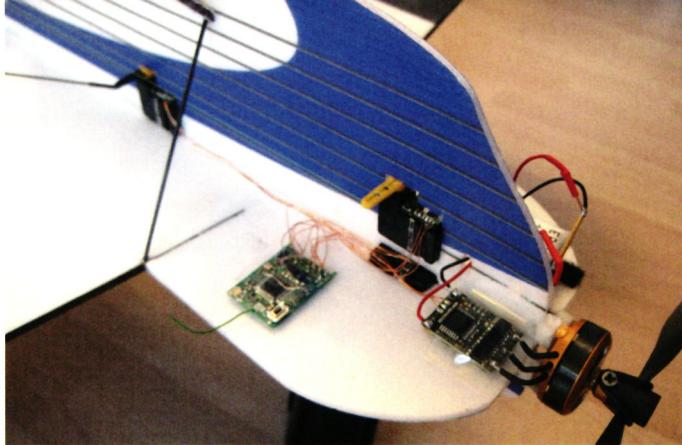
Here are a few insights and ideas on how to modify the components to reduce the takeoff weight. First off: These time-consuming modifications aren’t absolutely necessary for “normal indoor flying.” The model flies perfectly with the off-the-shelf components available today. The driving force is the sheer enjoyment of it all, which is also what motivated me to write this report. In indoor flying, there’s, among others, the F3P competition class. As in the F3A class, predefined maneuvers are flown indoors.
Don't apply too much paint; use it sparingly. It's amazing how much paint weighs. If you have an airbrush, highly pigmented, opaque paints work best. These can be applied thinly. A tip: Refill cartridges for Edding felt-tip pens are available at specialty stores (red, black, blue, green, yellow). These are ideal for airbrushing on Depron.
With that in mind, have fun with indoor flying. In any case, there are almost no limits to your imagination.
Michel Hauser


News from HEBU

HORIZON HOBBY/LEMACO NEWS: MICRO OV-10 BRONCO 645 MM BY E-FLITE

PRIDE AND GOOD IDEAS
 Markus Nussbaumer

TEAM MANAGER "THIS" BOSSHARD
 Rodito Nussbaumer

YOU KNOW WHAT I MEAN? 125 YEARS OF THE SWISS AERO CLUB
 Emil Giezendanner

F3A EUROPEAN CHAMPIONSHIPS IN ST-MACAIRE, FRANCE
 Matthias Bosshard

ATOM, THE NEW DOUBLE-DECKER FROM CPLR
Matthias Bosshard
SUMMER FUN 2026 AT MG USTER
Martin Wunderli
What's New at Leomotion.com

52. 2026 ALPS CUP
Emil Giezendanner
TWIN TOWN PARTNERSHIP
Wolfgang Voeller
34th HAHNENMOOS ALPINE MODEL AIRPLANE CAMP
Res Dauwalder
CORSAIR F4U – A WARBIRD WITH A MEMORABLE LOOK
Jürgen Rosenberger, Jürgen Prinz
SMALL, MODEL-LIKE SAILBOATS
Res Dauwalder
TRY-OUT DAY AT MFV WETTINGEN
Urs Keller
WELCOME, NEW MEMBER!
Andrea Bolliger
FREE FLIGHT IN THE MIDDLE OF SUMMER
Urs Muntwyler
COUPE DES ALPES – OBSERVE AND LEARN
Rodito Nussbaumer
EURO CONTEST GLIDER ACRO TOUR AUSTRIA 2026

BY YOUTH, FOR YOUTH
Lorena Betschen
INSIGHTS INTO THE HISTORY OF SEAPLANES

THE PC-21 STORY
Emil Giezendanner
NEWS FROM HEBU
 Julia Bucher

FROM 0 TO 100
Markus Nussbaumer
MEMORIES
Wolfgang Völler
NOS REGION – A HUB FOR ELECTRIC AVIATION
Emil Giezendanner
DO YOU KNOW WHAT I MEAN IN THE LAND OF SMILES?
Emil Giezendanner
Have you almost forgotten about aircraft that take off and land vertically?
Emil Giezendanner