
F16 – AN OLD CHILDHOOD DREAM
It’s the summer of 2025. Jürgen Prinz is showcasing his F-16 to a large audience at the air show hosted by the Franco-German club Ailes de la Nied in Bouzonville, France. Infected by the “Top Gun” bug, Maverick and Iceman seem to defy the laws of physics in the sky with their F-14 Tomcats.
Jürgen Prinz feels the urge to emulate his virtual hero through model aircraft building. Over the course of a 20-year journey, he first builds an F-16 on a 1:4.8 scale. The design is based on a Revell model at a scale of 1:48. Step by step, Jürgen shapes a fuselage cavity out of Styrofoam and plaster, onto which he later laminates the actual aircraft body, sheet by sheet. The wings are constructed using the Styrofoam-balsa method. For the maiden flight, a Jetcat P120 turbine (12 kg of thrust) is used; the flight performance achieved is “well, okay!”—acceptable, but by no means “Top Gun”-level.
The dream of a superjet continues to simmer. Model turbine development continues, and so today we have increasingly powerful engines at our disposal—we’re now talking about 26 kg of thrust; the only limit is our budget. Eventually, the prototype will be sold; the positive mold will be retained but will be refined millimeter by millimeter over the course of many months
Fuselage shape below.
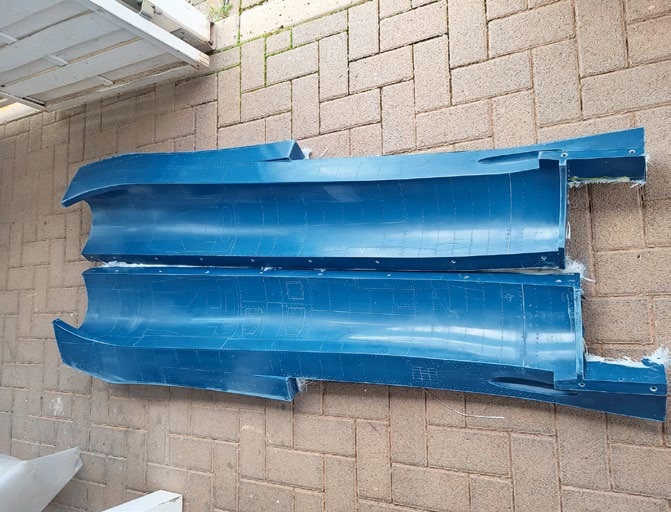
Thrust nozzle and laminating die.
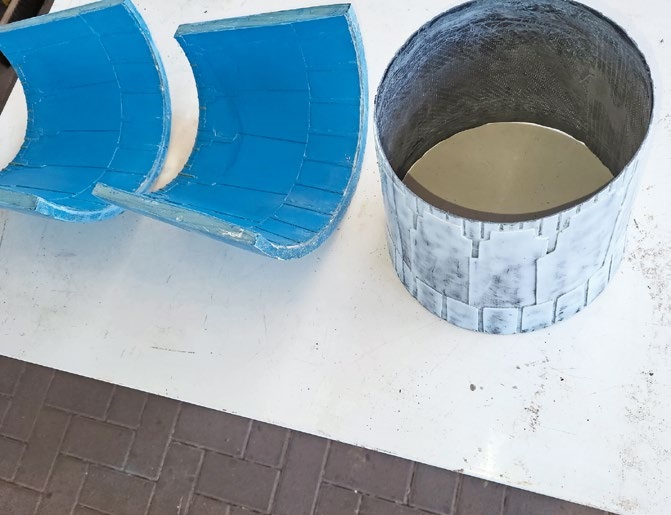
Refined. J.P. is obsessed with the idea of getting as close as possible to the original—which means that transitions, sheet metal joints, and rivets are painstakingly, and above all very time-consuming, incorporated into the positive mold. The 1:4.8 scale of the first model remains unchanged. We’re talking about a wingspan of 2.05 m and a fuselage length of 3.20 m, with a weight limit of 25 kg—ultimately, the takeoff weight is 24.8 kg!
Starting with the original model from the early days, the next step—which took a full two years of work—involved creating the negative molds for the wings, fuselage, and tail surfaces.
Another major challenge is ultimately the showpiece of any jet: the landing gear. The latter is CNC-machined in collaboration with Wolfgang Reipplinger using a CAD data model. By dividing up the tasks, two aircraft are built: Jürgen constructs the fuselages and wings, while Wolfgang is responsible for the mechanics and 3D printing. The challenge in designing the landing gear lies in ensuring it functions correctly at scale: Not only must the landing gear doors close properly after takeoff, but the landing gear legs and wheels must also retract at a 90° angle—in other words, everything must disappear beneath the fuselage contour during flight. Essential—after all, we’re discerning model builders—is a pilot’s cockpit that matches reality. The cockpit panel is produced via 3D printing. A pilot figure we made ourselves turned out to be too heavy and cost a fortune, so it was replaced with a store-bought product. Next
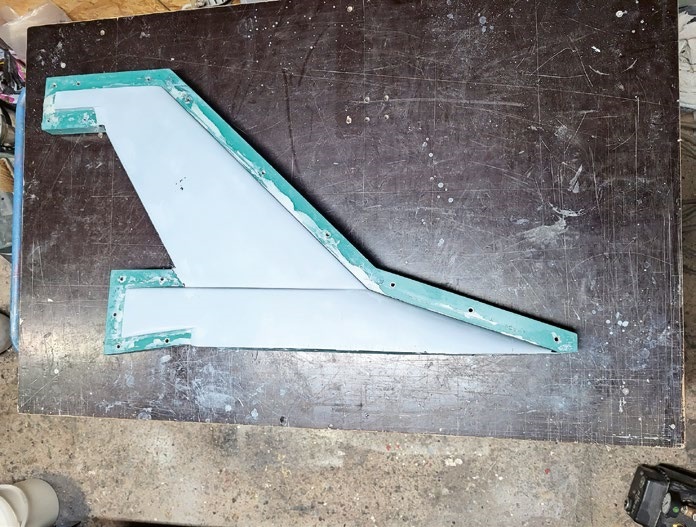
One of the items in the requirements specification is a pilot's cockpit that can be opened. The initial plan to open it using a servo was rejected for weight reasons; manual operation!
The turbine must be mounted behind the center of gravity. Since the takeoff weight must not exceed 25 kg, the electronics and battery are placed in the front. To stay within the weight limit, lightweight yet sturdy tail surfaces must be fabricated from an aramid-carbon hybrid fabric. The material is placed into the negative molds mentioned above using a vacuum process and cured with the addition of resin.
Let’s turn our attention to the canopy. Thermoplastic (Bayer Vivac), stretched across a frame, is formed using a vacuum process. The material must remain stable and transparent after forming. Furthermore, it must not break during cutting.
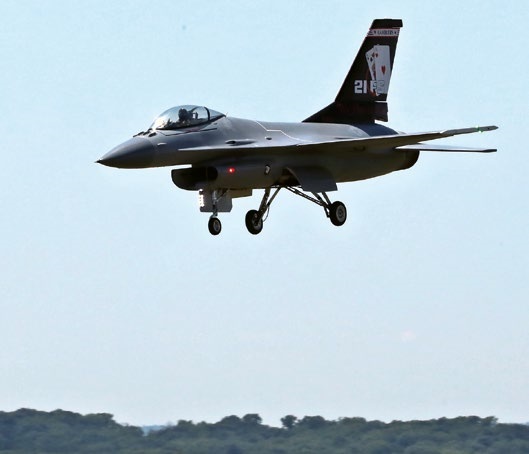
Three years have passed since construction began; now it’s time to decide on the color scheme, which should match that of an American squadron and be clearly distinguishable from commercially available versions. The 56th TH Fighter Wing and 21st TH Fighter Squadron (Gamblers) in South Korea serve as models.
| Manufacturer | Homemade |
| Wingspan | 2,050 mm |
| Length | 3,200 mm |
| Weight | 24.8 kg |
| Area load | 125 g/dm² |
| Turbine | Kingtech K260 G4 |
| Speed | 50–300 km/h |
| Servos | Savox |
| Lighting | uniLight.at |
| Transmitter | Hacker Jeti DS 24 V2 |
| Power Supply | Jeti Centralbox 210 |
| Gyro | Cortex PRO |
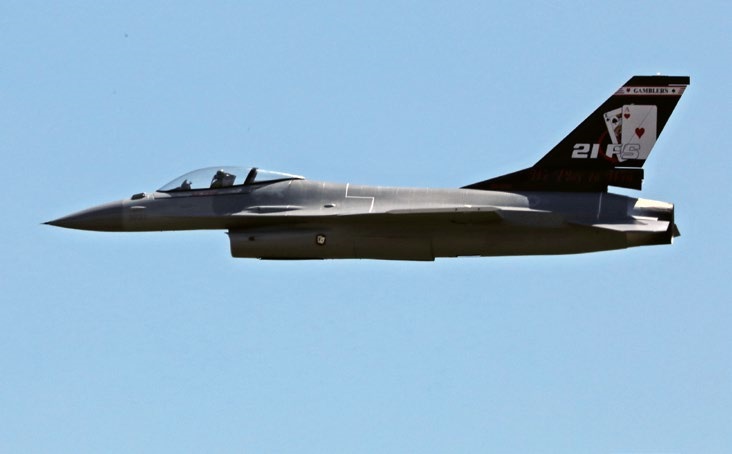
A reinforced thrust tube is being manufactured for the engine by Bernreiter according to Jürgen’s specific requirements. With the turbine initially installed at 0°, the entire unit must be capable of minimal angular adjustment should subsequent test flights require it. 260 Newtons at speeds exceeding 300 km/h exert high forces on the control surfaces; consequently, servos with high actuation and holding forces (pitch control surface 75 kg, aileron 35 kg) are a must. After roughly 500–700 hours of work, let us now turn our attention to flight testing.
Careful takeoff roll, lift-off after 50 m, initially erratic behavior, trim adjustment. The F16 is now stable in the air. The first landing reveals a suboptimal center of gravity. The calculated CG at 40 cm proves
to be too nose-heavy. The aircraft approaches very quickly, touches down awkwardly on the three-legged retractable landing gear, with the obvious consequence being damage to the delicate mechanics.
Initial briefing: Reinforce the landing gear. Move the center of gravity 2 cm aft. During the first test flight, the ailerons are still set downward at 40° in the landing flap position, presumably causing turbulence in the elevator. On subsequent flights, the angle was reduced to 30°; the elevator now responds better, and the aforementioned disturbances appear to have ceased.
It is recommended to fly jets in this category with gyros. Specifically, a Damon Kortex Plus is used. With each subsequent takeoff, the pilot and the aircraft become increasingly attuned to one another. In conclusion: Full aerobatic capability is a given; landings—Maverick couldn’t have done it better—are a delight for the pilot as well as for the awestruck audience.


News from HEBU

TEAM MANAGER "THIS" BOSSHARD
 Rodito Nussbaumer

YOU KNOW WHAT I MEAN? 125 YEARS OF THE SWISS AERO CLUB
 Emil Giezendanner

F3A EUROPEAN CHAMPIONSHIPS IN ST-MACAIRE, FRANCE
 Matthias Bosshard

SUMMER FUN 2026 AT MG USTER
Martin Wunderli
TRY-OUT DAY AT MFV WETTINGEN
Urs Keller
52. 2026 ALPS CUP
Emil Giezendanner
BY YOUTH, FOR YOUTH
Lorena Betschen
ATOM, THE NEW DOUBLE-DECKER FROM CPLR
Matthias Bosshard
CORSAIR F4U – A WARBIRD WITH A MEMORABLE LOOK
Jürgen Rosenberger, Jürgen Prinz
SMALL, MODEL-LIKE SAILBOATS
Res Dauwalder
What's New at Leomotion.com

TWIN TOWN PARTNERSHIP
Wolfgang Voeller
PRIDE AND GOOD IDEAS
 Markus Nussbaumer

EURO CONTEST GLIDER ACRO TOUR AUSTRIA 2026

INSIGHTS INTO THE HISTORY OF SEAPLANES

34th HAHNENMOOS ALPINE MODEL AIRPLANE CAMP
Res Dauwalder
WELCOME, NEW MEMBER!
Andrea Bolliger
HORIZON HOBBY/LEMACO NEWS: MICRO OV-10 BRONCO 645 MM BY E-FLITE

FREE FLIGHT IN THE MIDDLE OF SUMMER
Urs Muntwyler
COUPE DES ALPES – OBSERVE AND LEARN
Rodito Nussbaumer
THE PC-21 STORY
Emil Giezendanner
NEWS FROM HEBU
 Julia Bucher

FROM 0 TO 100
Markus Nussbaumer
MEMORIES
Wolfgang Völler
NOS REGION – A HUB FOR ELECTRIC AVIATION
Emil Giezendanner
Have you almost forgotten about aircraft that take off and land vertically?
Emil Giezendanner
DO YOU KNOW WHAT I MEAN IN THE LAND OF SMILES?
Emil Giezendanner