
RC Aerobatics – Stability and Innovations
After a good 50 years of rapid development—but also stability—in RC powered aerobatics (F3A), a few additional aerobatic classes have emerged in recent years in conjunction with broader new trends in RC aviation. In particular, freestyle flying—which originated in Japan many years ago—has now also found its way into the FAI.
RC aerobatics has been a well-established discipline within the FAI for about half a century. As is well known, the first World Championships took place in Dübendorf in 1960. It’s also worth noting that RC powered aerobatics—now known as F3A—was the FAI’s very first remote-control class. Gliders, helicopters, scale models, and so on came decades later. F3A—which has been repeatedly written off yet remains extremely successful and widespread internationally—has set something of a standard in the FAI’s RC model aviation. Over the years, the FAI’s Model Aviation Commission—CIAM—developed a set of rules for F3A that serves as a model for the other classes in many areas. Particularly noteworthy is the transparent and democratically functioning judging system, which, for example, also specifies how many judges each region of the world is allowed to provide for world and continental championships, etc.
Building on the vast potential for experience in F3A aerobatics, the “Indoor F3A”—or, more precisely, F3P—as well as the former F3A-X for large aerobatic aircraft, now known as F3M, were incorporated into the F3A rulebook on very short notice two years ago. A hasty decision with political undertones. Simply moving F3A indoors doesn’t exactly demonstrate much imagination or innovation.
Much like in other sports, the “freestyle philosophy” has also found its way into model aviation. Two points in particular caught my attention last year:
- The term “freestyle” encompasses a wide variety of aerobatic styles
- The demands placed on participants are often underestimated
- Judges’ evaluations are even more subjective than in fixed routines
There is still a great deal of work to be done in the near future to provide information and education on these points. In my view, this topic should definitely be promoted and developed in order to foster a new generation of aerobatic pilots.
With the conception and realization of the FAI World Air Games (WAG)—a sort of “Olympics of aviation”—the desire arose early on to create air sports disciplines that would be as appealing as possible to spectators. While, for example, F3B was held practically behind closed doors during the 1st WAG in Turkey, spectacular disciplines are now set to be showcased in model aviation this year in Turin. Unfortunately, the officials at CIAM have unleashed a massive avalanche of regulations, which means that the overarching goal of increasing the event’s appeal—at least from the participants’ perspective—has been significantly undermined. To offer model aviation that is attractive to spectators, it must foster the participants’ enthusiasm for the sport as well as the creativity and originality of the demonstrations. However, this is pretty much the opposite of “regulationitis”—copying pages upon pages of existing, outdated rules, and so on. This year’s World Air Games are just around the corner. But for the future, those in charge will undoubtedly have to go back to the drawing board.
By the way, it’s a shame that our launch glider community didn’t respond: F6C would be a wonderful glider class—challenging both athletically and in terms of flying skill—and very attractive to spectators.
| Discipline | F6A Artistic Aerobatics | F6B Aeromusical | F6C RC Gliders |
|---|---|---|---|
| Model Classes | 1. Aerobatic fixed-wing models 2. Helicopters 3. Jet models | Indoor Models | Throw Gliders/Catapult Gliders |
| Model Size | 1. Max. 2 x 2 m 2. Max. rotor area: 300 dm² 3. Min. wingspan: 180 cm | Unrestricted | Wingspan: Max. 150 cm |
| Weight | 1. Max. 5 kg 2. Max. 6 kg 3. Max. 15 kg | Subclass A: Max. 500 g Subclass B: Max. 1000 g Subclass C: Max. 2000 g | Max. 600 g |
| Propulsion | Internal combustion (unrestricted), electric (max. 42 V), and gas turbines (max. 150 N) | Electric (max. 42 V) | – |
| Events | Freestyle with preselected music (120 s) and free music accompaniment (240 s) | Freestyle with free musical accompaniment 2- and 4-minute programs | Time flight and precision landing using the “knockout system” Max. flight duration: 5 min |
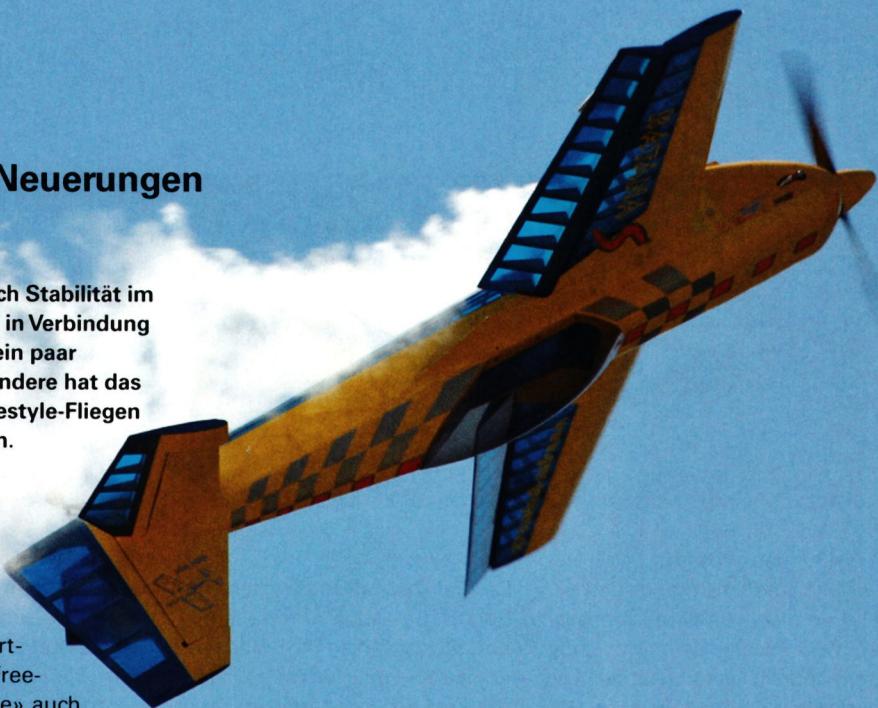
Freestyle flying is also gaining popularity in the indoor scene and is particularly appealing to spectators. The “FAI Airsports Promotion Classes for Model Aircraft” aims to promote this in the F6B “Aeromusical” class.
Aerobatics using exclusively electric models has a long tradition. In fact, FAI European Championships were held more than twenty years ago. Today, with the establishment of electric propulsion, electric aerobatics has developed its own distinct culture, even within F3A aerobatics. While models weighing up to 5 kg, with a maximum size of 2×2 meters are permitted even with internal combustion engines, the 3-kg weight limit and the restriction to electric propulsion mean that the models are considerably smaller and, as a result, significantly less powerful in terms of their propulsion systems. Aerobatics with such strictly limited equipment requirements is not only an attractive and cost-effective way for juniors to get started in RC aerobatics, but also presents a real challenge for experienced aerobatic pilots.
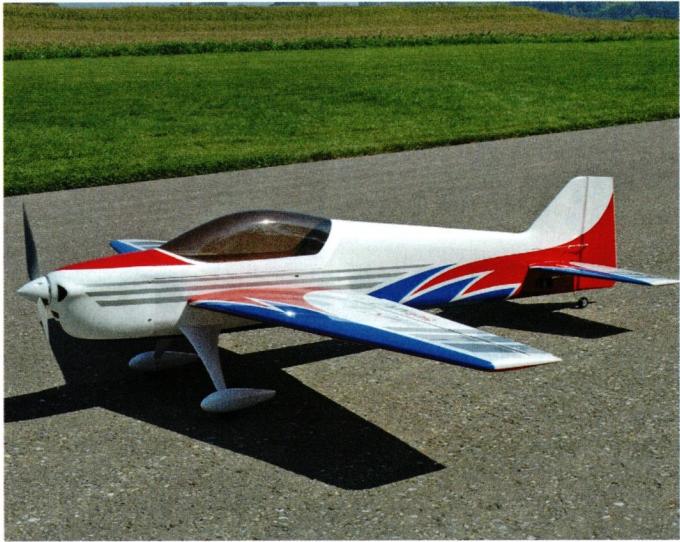
| Model size | N/A |
| Weight | Max. 3 kg |
| Drive | Electric (max. 42 V) |
| Flight envelope | Aerobatics box measuring 110 x 75 x 75 m |
| Programs | Qualifying Round: Max. 12 maneuvers from the catalog, with a maximum difficulty rating of K 50 . Final: Freestyle with a free choice of music. Max. 6 minutes, including a 2-minute warm-up period |
| Scoring | The scores from the two best qualifying flights are added to the final flight score (two final flights are also possible). |
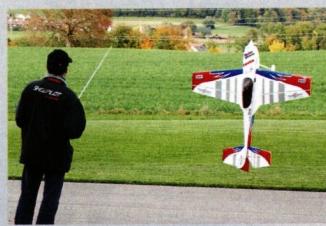
Since each participant puts together their own routine based on their personal skill level, the competitions are varied. This has by no means made the judges’ job any easier; they must adapt to each participant individually. Nevertheless, the judges’ reactions have been consistently positive. We electric model airplane enthusiasts are looking forward to the upcoming season. GZ


News from HEBU

TEAM MANAGER "THIS" BOSSHARD
 Rodito Nussbaumer

YOU KNOW WHAT I MEAN? 125 YEARS OF THE SWISS AERO CLUB
 Emil Giezendanner

F3A EUROPEAN CHAMPIONSHIPS IN ST-MACAIRE, FRANCE
 Matthias Bosshard

SUMMER FUN 2026 AT MG USTER
Martin Wunderli
TRY-OUT DAY AT MFV WETTINGEN
Urs Keller
52. 2026 ALPS CUP
Emil Giezendanner
BY YOUTH, FOR YOUTH
Lorena Betschen
ATOM, THE NEW DOUBLE-DECKER FROM CPLR
Matthias Bosshard
CORSAIR F4U – A WARBIRD WITH A MEMORABLE LOOK
Jürgen Rosenberger, Jürgen Prinz
SMALL, MODEL-LIKE SAILBOATS
Res Dauwalder
What's New at Leomotion.com

TWIN TOWN PARTNERSHIP
Wolfgang Voeller
PRIDE AND GOOD IDEAS
 Markus Nussbaumer

EURO CONTEST GLIDER ACRO TOUR AUSTRIA 2026

INSIGHTS INTO THE HISTORY OF SEAPLANES

34th HAHNENMOOS ALPINE MODEL AIRPLANE CAMP
Res Dauwalder
WELCOME, NEW MEMBER!
Andrea Bolliger
HORIZON HOBBY/LEMACO NEWS: MICRO OV-10 BRONCO 645 MM BY E-FLITE

FREE FLIGHT IN THE MIDDLE OF SUMMER
Urs Muntwyler
COUPE DES ALPES – OBSERVE AND LEARN
Rodito Nussbaumer
THE PC-21 STORY
Emil Giezendanner
NEWS FROM HEBU
 Julia Bucher

FROM 0 TO 100
Markus Nussbaumer
MEMORIES
Wolfgang Völler
NOS REGION – A HUB FOR ELECTRIC AVIATION
Emil Giezendanner
Have you almost forgotten about aircraft that take off and land vertically?
Emil Giezendanner
DO YOU KNOW WHAT I MEAN IN THE LAND OF SMILES?
Emil Giezendanner