
Ugly enough to fall in love with
Man, is that thing ugly. My first impression—a far cry from love at first sight. As teenage glider pilots, we watched the Fieseler Storch approach our glider field in Schmerlat. A steep approach, a short landing. No sooner had it come to a stop than it turned around and was parked; the propeller lost momentum, and the glider came to a halt.
A somewhat older pilot, who seemed quite content, hoisted himself out of his seat and climbed out of the Storch as if from a hunting blind. We greeted the pilot and took the opportunity to examine the aircraft a little more closely. Steel tubes, fabric covering, aluminum slats—everything looked incongruous and angular. To us, it didn’t look right—or was simply ugly. Neither its STOL capabilities nor the option for glider towing could change our minds. Our final verdict was confirmed by the bicycle chain with a crank on the right side of the cockpit, used to operate the landing flaps. No comparison to the nearly infinitely adjustable flaps on modern gliders. That’s just not acceptable...
With a bit of goodwill, this assessment could be attributed to adolescent confusion. We did have a glider pilot’s license, but we were still too young for a driver’s license.
Today, almost forty years later, I looked at the Fieseler F156 Storch with fresh eyes. What was once ugly now seems more like something unique or purpose-built, and suddenly a lot of it makes sense—it even seems ingenious. So the idea of building a “Storch” model has been taking root in my mind for quite some time now.
Reviewing the collected documents should help me find the best option for me. The unemployed Moki 215 is often on my mind. Thus, the radial-engine version—later built under license by Morane Saulnier as the MS 505—is also being considered. Although the Fieseler Fi 156 Storch and the Morane Saulnier MS 505 with a radial engine appear to have many similarities at first glance, I am gradually realizing that they differ considerably from one another in the details. The Morane Saulnier’s fuselage construction is identical to that of the Fieseler variant, except for a few details. The original wooden construction of the wings and tail was replaced by a more durable aluminum structure. On the Fieseler version, the entry door is on the side, whereas on the Morane it is hinged at the top. The Fieseler version is intended to be as close as possible to the original; the Morane variant remains a compromise.
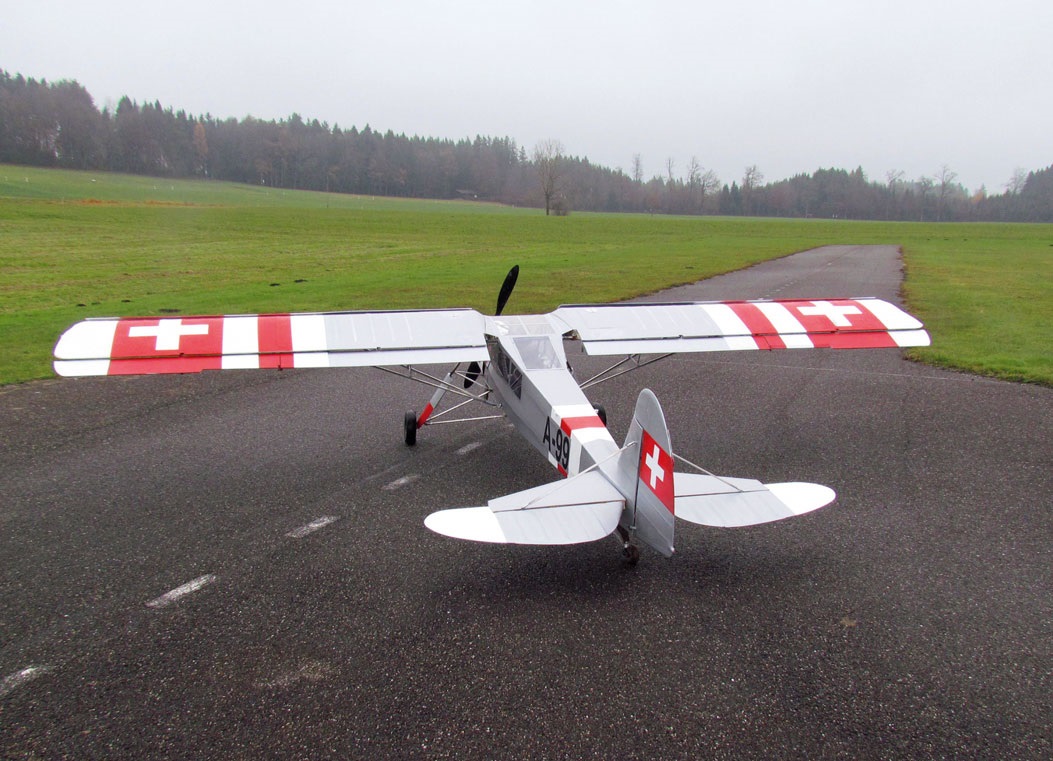
The Swiss version with its red-and-white neutrality stripes catches my eye: the A99 from 1944. The aircraft’s history is not entirely clear, as various sources contradict one another. According to one account, it is the annexed HB-ARU; according to another, it is a German aircraft that made an emergency landing. What seems clear is that it is a Fieseler F156 c3 variant. The color documentation is based on research by Steve Evans; his model is featured in Richard A. Franks’ publication *The Fieseler Storch*. He notes—probably correctly—that the “weathering” should be applied very moderately, since the aircraft was well-maintained. The red-and-white stripes were also carefully applied. This is a far cry from the hastily applied white-and-black invasion stripes of the Allied air forces. Comparisons with the research by Georg Hoch and Hans-Jürgen Fischer reveal only minor differences, thus providing a plausible picture of the paint scheme.
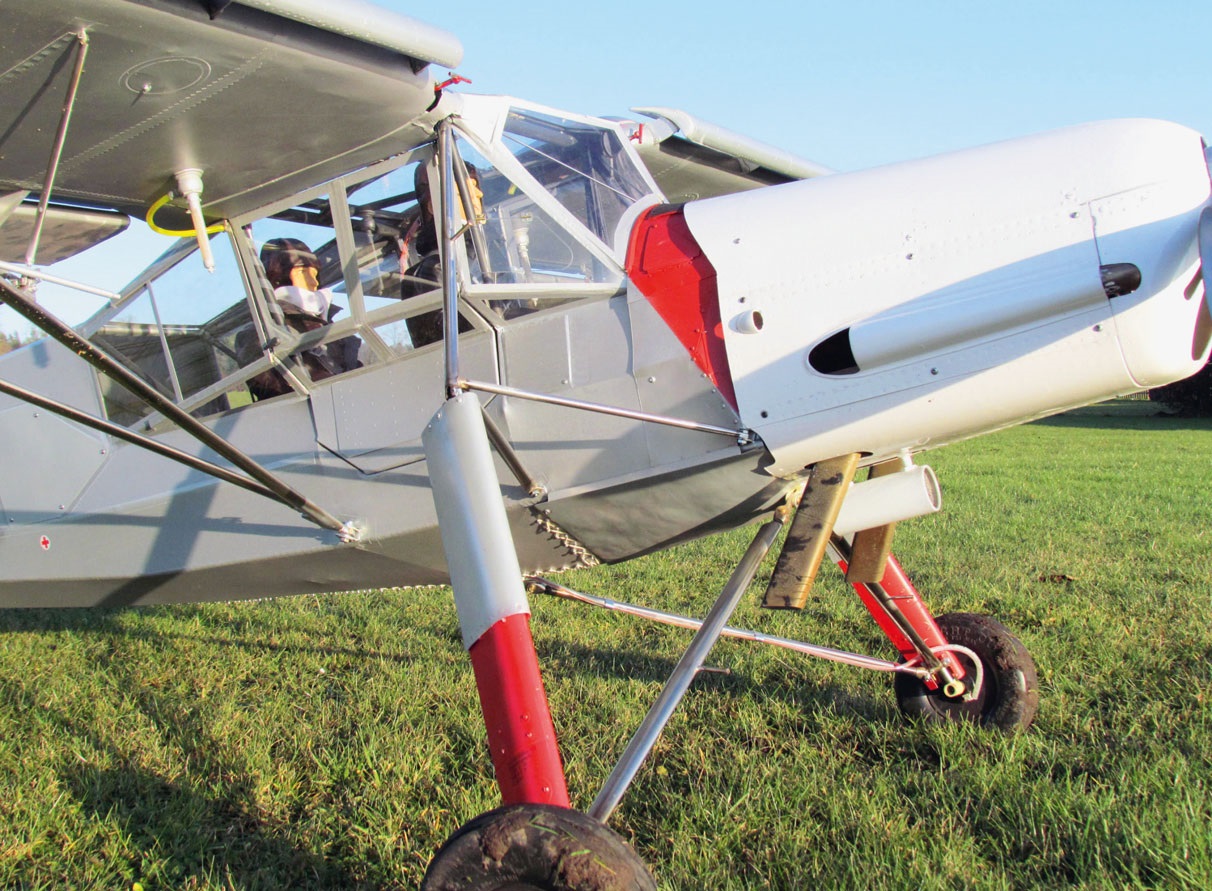
The Storchschmiede and Toni Clark’s Paulo Severin Storch are being considered as options. Even building one entirely from scratch isn’t entirely ruled out. The desired 1:4 scale is too small for the 215-Stern. This rules out the very nice Severin Storch kit. A 1:3 scale model would weigh over 25 kg. The Storchschmiede Storch in 1:3.5 scale fits the bill very well, which is why I’ve decided on it. The kit has been described and praised many times before; there’s nothing more to add. I can only echo that praise. Alfred Brenzig of Storchschmiede has also captured the stork’s contours perfectly. The only thing I can’t quite get behind is the fiberglass fuselage. I’m tempted to build a steel-tube fuselage. Unfortunately, however, I lack the appropriate drawings of the fuselage structure. While the construction method can be reconstructed fairly well from various manuals, the final confirmation is missing. Several inquiries to owners of an original Storch have gone unanswered or yielded no useful results.
So I was all the more pleased to receive a response from Tor Nørstegård (
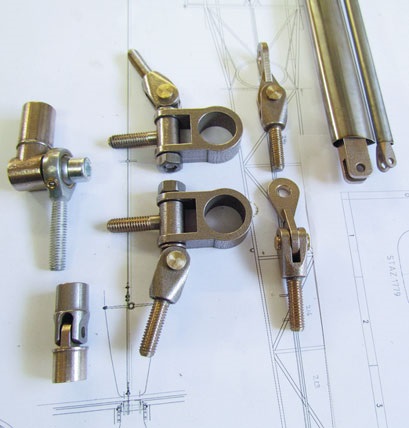
With the goal of using the same building materials as the original whenever possible, the entire fuselage is designed in CAD. Claudio Volpi’s plans serve as a reference.
The fuselage structure consists of stainless steel tubes with diameters ranging from 4 mm to 10 mm and a wall thickness of 0.25 mm. These are soldered using silver brazing. The front section is made of 0.5-mm aluminum that is bent, formed, and riveted together. Closely modeled after the original fuselage design, this results in a lightweight and stable fuselage structure that comes together relatively quickly. All connection points, such as the landing gear mounts or the wing strut attachments, are CAD-drawn and commissioned as 3D-printed steel parts. No changes need to be made to the wing and tail assembly. These come “out of the box,” which makes building them a pleasure, as the process is well thought out and all parts fit together perfectly. On my model, the wings can be folded back just like on the original. This allows me to transport the assembled plane in my delivery van. Metal ball joints are used for the articulation points.
The greenhouse-style glazing of the pilot and passenger area provides an almost unrestricted view of the cockpit. The cockpit has a relatively simple design but features a few eye-catching elements. The large, wood-framed trim wheel, the bicycle-chain-style crank for adjusting the landing flaps, and the striking pilot and passenger seats. I’ve recreated all of these with a high degree of authenticity.
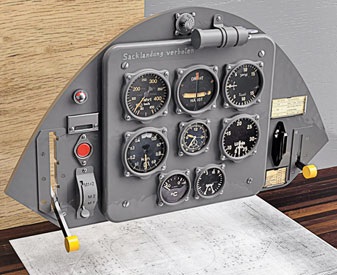
Since I couldn’t find any commercially available instruments in a 1:3.5 scale, I had to get creative here as well. I scaled down the instrument dimensions to scale in CAD, 3D-printed the frames, and etched the dials. The dials are scaled and printed using PowerPoint. The rudder pedals and instrument housings are drawn to scale in CAD and also 3D-printed. This is also how the wheel rims with integrated electric brakes are created. The tire is from a Sullivan Light wheel with a diameter of approximately 160 mm. I covered the model with Ora-Cover Silver and zigzag tape by Toni Clark. Ribbed seams are simulated using an inlay made of thread and strips of covering fabric.
With a bit of coordination, the covering work progresses quite quickly. The window panes are cut to size and glued into the frame structure using covering material. The method described here gives the model a bit more character and makes the installed windows look authentic. Viewed objectively, the fiberglass fuselage included in the kit is very close to a scale reduction, but its rigidity makes it seem somewhat lifeless. The steel tube framework in the cockpit area remains a real eye-catcher.
I'm building the Fieseler F156 "Storch" variant with an electric powertrain. A 12s battery paired with a Jeti Opto 300 and Leomotion Big Boy delivers the desired power. A removable front section allows for a quick conversion to the radial engine variant, which uses the Moki 215 and, later, a Vachach VM-R5-250 radial engine.
The electric “long-nose” Fieseler Storch has a takeoff weight of approximately 23 kg. It’s impressive—every slight movement of the throttle stick changes the RPM, and approaches become a pleasure. Thanks to the long suspension travel, landings are almost without exception smooth and have a very short rollout distance. A Storch-style approach with a short landing still takes some practice, however. The Morane radial engine version impresses with “endless power” and a pleasantly rich, deep engine sound. With the wing tanks full, the Morane version has a takeoff weight of slightly over 23 kg.
Slow flying is in line with the model’s design but takes some getting used to, as it’s possible to fly at unusually slow speeds without stalling.
Both versions offer pure flying fun; one glance into the cockpit quickly makes you forget the slightly higher construction effort.


News from HEBU

HORIZON HOBBY/LEMACO NEWS: MICRO OV-10 BRONCO 645 MM BY E-FLITE

PRIDE AND GOOD IDEAS
 Markus Nussbaumer

TEAM MANAGER "THIS" BOSSHARD
 Rodito Nussbaumer

YOU KNOW WHAT I MEAN? 125 YEARS OF THE SWISS AERO CLUB
 Emil Giezendanner

F3A EUROPEAN CHAMPIONSHIPS IN ST-MACAIRE, FRANCE
 Matthias Bosshard

ATOM, THE NEW DOUBLE-DECKER FROM CPLR
Matthias Bosshard
SUMMER FUN 2026 AT MG USTER
Martin Wunderli
TRY-OUT DAY AT MFV WETTINGEN
Urs Keller
What's New at Leomotion.com

52. 2026 ALPS CUP
Emil Giezendanner
TWIN TOWN PARTNERSHIP
Wolfgang Voeller
34th HAHNENMOOS ALPINE MODEL AIRPLANE CAMP
Res Dauwalder
CORSAIR F4U – A WARBIRD WITH A MEMORABLE LOOK
Jürgen Rosenberger, Jürgen Prinz
SMALL, MODEL-LIKE SAILBOATS
Res Dauwalder
WELCOME, NEW MEMBER!
Andrea Bolliger
FREE FLIGHT IN THE MIDDLE OF SUMMER
Urs Muntwyler
COUPE DES ALPES – OBSERVE AND LEARN
Rodito Nussbaumer
EURO CONTEST GLIDER ACRO TOUR AUSTRIA 2026

BY YOUTH, FOR YOUTH
Lorena Betschen
INSIGHTS INTO THE HISTORY OF SEAPLANES

THE PC-21 STORY
Emil Giezendanner
NEWS FROM HEBU
 Julia Bucher

FROM 0 TO 100
Markus Nussbaumer
MEMORIES
Wolfgang Völler
NOS REGION – A HUB FOR ELECTRIC AVIATION
Emil Giezendanner
DO YOU KNOW WHAT I MEAN IN THE LAND OF SMILES?
Emil Giezendanner
Have you almost forgotten about aircraft that take off and land vertically?
Emil Giezendanner