
A twin-engine aircraft from the 1970s is getting a new lease on life
The older folks among us surely still remember Dave Platt and his scale models, right? In any case, my scale modeling career began in the late 1970s with his T-28, before I went on to have success with the Bücker Jungmeister.
Dave didn't just build scale models, though; he also designed a twin-engine aerobatic plane called the Duellist 240. The "2" stands for the number of engines, and "40" for the maximum displacement. According to the internet, the model was released
in 1977. It had a wingspan of 162.5 cm and, as mentioned, was designed for engines up to about 6.5 ccm. Various magazines, such as “RC Modeller,” featured the model and mostly praised its flight characteristics. Apparently, the model flew well even with just one motor. The trick to keeping it flying was apparently to simply throttle back to half power and then figure out which motor had stopped. I liked the model even back then, but I didn’t dare try a twin-motor version. PICA also offered a kit version.
A little over two years ago, in late fall, I spent a lot of time in a
small apartment in Basel because my wife was in the hospital for an extended period. Suddenly, the Duellist came back to mind, and I scoured the internet in the hope of finding a usable blueprint. Luck was on my side, and I actually found the PICA plan as a high-resolution PDF download. I also found the original Platt plan, though it was of poor quality—but it still proved helpful later on.
By today's standards, that model would be on the small side, with a 65" wingspan. I had something
bigger in mind, so that two 5S batteries would fit in the motor nacelles. A friend who’s into model flying—and a former coworker—was able to digitize the plan in CAD and then scale it up to a 195-cm wingspan. Thanks, Oli. Before long, I found myself with two large rolls of paper. There was soon no more room on the small dining table.
First, I spent a great deal of time thinking about suitable landing gear and brakes (hard-surface runway!). But any of those options would have driven the weight up. The chosen motors and their matching Hobbywing ESCs, however, solved my braking problem instantly! They have reverse thrust, after all! The maximum achievable ground clearance is determined by the main landing gear position and limited the propeller diameter to 13". The Leo 3525-620 was a perfect fit. After a long search, I finally chose the Giezendanner landing gear with 4.5-mm wires. Mario bent them to size for me!
But what I just couldn’t wrap my head around with the PICA design were the—in my opinion—strange angles for the wings and tail. Yes, the EWD was about 0.5°, but the wing was set at a steep angle relative to the fuselage axis, and so was the tail. Conversely, the engines had a lot of negative camber—even more than the wing’s sweep. A quick check of Platt’s original plan showed me that, in his design, everything was set to zero. That suited me much better, so I opted for the classic 0.5° for the wing and 0° for the tail. The engines also have no camber. To achieve this, I had to adjust the plan, which wasn’t exactly easy with the engines, and determining the length of the nose landing gear was also a real challenge.
The design originally featured a ribbed wing. But I wanted to try my hand at a Styrofoam wing again. The cut-out sheet from back then—
I still had some left! And at RIK, I was also able to buy 0.7-mm abachi in the size I needed. Jürg Fellmann helped me with the cutting. Since I didn’t have a vacuum pump, I pressed the wings—which had been glued together with epoxy—between two thick boards that were clamped together with 10 threaded rods. But first, I installed the landing gear boards, the rear spars, and the servo mounts along with their cables. I also had to remember to include the speed controller and sensor cables. A longitudinally split rear spar was necessary because of the deep ailerons and landing flaps.
After gluing the wing halves together and applying the fiberglass reinforcement, it was time for the engine nacelles. The challenge here was transferring the wing contour to the side panels so that the cutouts matched the airfoil. I kept checking the nacelles from a distance to make sure they were both positioned identically on the wing.
The model’s shape is formed in various places using balsa blocks of varying sizes. I still had several suitable blocks left over from my previous employer, which Richi Kläger from RIK Balsa roughly sanded down for me. On a large belt sander, that’s done in a flash!
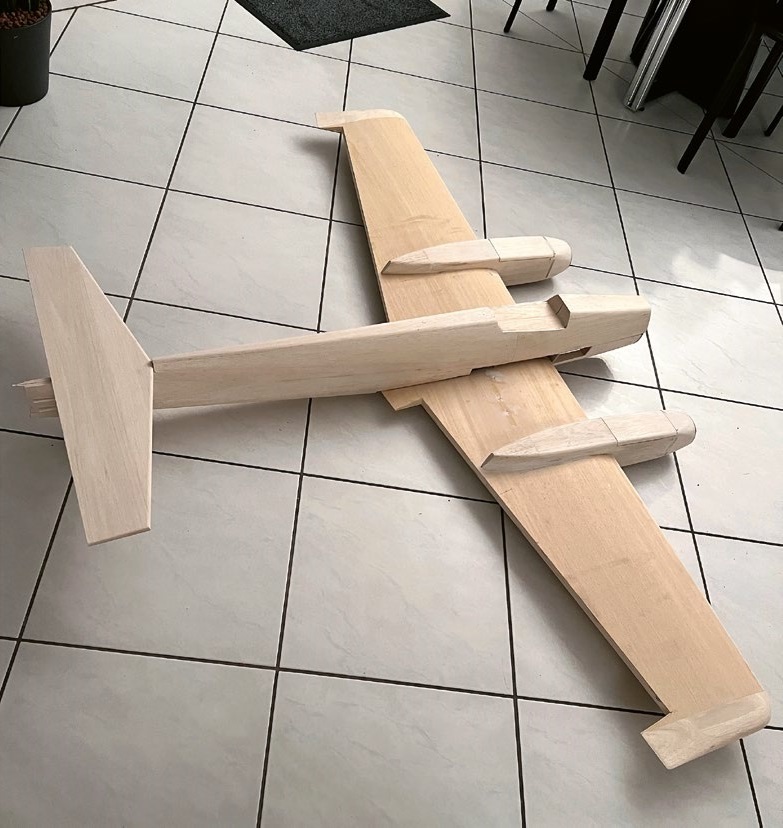
Next up was the fuselage, which I assembled upside down, contrary to the instructions. That might not have been the best idea (because
of the cockpit cutout). A keel would have helped. But at least the large nose block fit perfectly! This is what it looked like a good year ago.
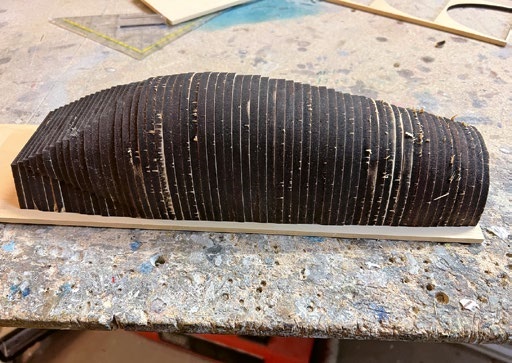
Now came the (second-to-last) hurdle for me: the canopy! I’d never shaped one myself before, and at over 30 cm, it’s also quite long. I made the master pattern from about 70 elliptical Abachi discs, which a kind colleague had laser-cut for me.
Kurt Eich recommended 0.7-mm PETG as the material, but he himself had never 3D-printed such large parts either. That’s when Jürg stepped in again—he’d already 3D-printed various car body series. He enlarged the build frame so that it would still just fit into a standard oven. The first pull was a success and now adorns the model!
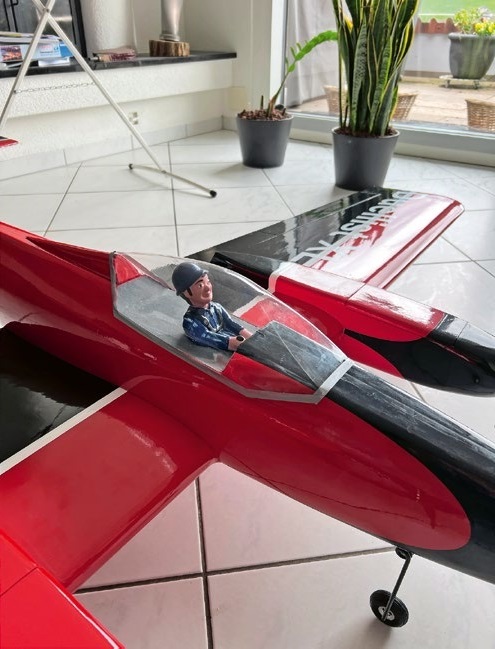
The color scheme for the wrap is a special challenge. Originally, I liked the chrome blue from Oracover. But I just couldn’t get the hang of working with this very stiff film. Apparently, I’m not the only one. There are still about 4 m available at a good price. After I was back on the field with my Miss Ultimate from Seb-Art, the idea clicked. It had to be red and black, even though it was clear that black is problematic in the sun.
And this is what my Duellist XL looks like now: I set the center of gravity to about 30% MGC, just like I always used to. The first flight
However, it turned out that 25% was better. So the lead was removed from the tail.
Even with a takeoff weight of 6.5 kg, the aircraft has more than enough power and, with the 5000-series batteries, a very long flight time. The landing gear struts turned out to be a bit too
flexible. Due to the limited ground clearance, the propellers keep getting damaged. Maybe I’ll find different struts someday.
Now I get to enjoy this unusual model every now and then.


News from HEBU

HORIZON HOBBY/LEMACO NEWS: MICRO OV-10 BRONCO 645 MM BY E-FLITE

PRIDE AND GOOD IDEAS
 Markus Nussbaumer

TEAM MANAGER "THIS" BOSSHARD
 Rodito Nussbaumer

YOU KNOW WHAT I MEAN? 125 YEARS OF THE SWISS AERO CLUB
 Emil Giezendanner

F3A EUROPEAN CHAMPIONSHIPS IN ST-MACAIRE, FRANCE
 Matthias Bosshard

ATOM, THE NEW DOUBLE-DECKER FROM CPLR
Matthias Bosshard
SUMMER FUN 2026 AT MG USTER
Martin Wunderli
What's New at Leomotion.com

52. 2026 ALPS CUP
Emil Giezendanner
TWIN TOWN PARTNERSHIP
Wolfgang Voeller
CORSAIR F4U – A WARBIRD WITH A MEMORABLE LOOK
Jürgen Rosenberger, Jürgen Prinz
SMALL, MODEL-LIKE SAILBOATS
Res Dauwalder
TRY-OUT DAY AT MFV WETTINGEN
Urs Keller
WELCOME, NEW MEMBER!
Andrea Bolliger
COUPE DES ALPES – OBSERVE AND LEARN
Rodito Nussbaumer
EURO CONTEST GLIDER ACRO TOUR AUSTRIA 2026

BY YOUTH, FOR YOUTH
Lorena Betschen
INSIGHTS INTO THE HISTORY OF SEAPLANES

34th HAHNENMOOS ALPINE MODEL AIRPLANE CAMP
Res Dauwalder
THE PC-21 STORY
Emil Giezendanner
FREE FLIGHT IN THE MIDDLE OF SUMMER
Urs Muntwyler
NEWS FROM HEBU
 Julia Bucher

FROM 0 TO 100
Markus Nussbaumer
MEMORIES
Wolfgang Völler
NOS REGION – A HUB FOR ELECTRIC AVIATION
Emil Giezendanner
DO YOU KNOW WHAT I MEAN IN THE LAND OF SMILES?
Emil Giezendanner
Have you almost forgotten about aircraft that take off and land vertically?
Emil Giezendanner