
The first dedicated combat helicopter
The Bell AH-1 Cobra was the first dedicated attack helicopter (AH stands for attack helicopter) produced by the American helicopter manufacturer Bell. In the mid-1960s, when deliveries began, it was the world’s first attack helicopter; prior to that, there had only been lightly armed transport helicopters. Only a few Bell UH-1B “Hueys” were armed for escort and protection duties and were therefore also called “Cobra.” Bell’s engineers adopted this additional designation—even though, contrary to Army regulations, it was not derived from the name of a Native American tribe. Since the Army was to be persuaded to accept, so to speak, a new version of the UH-1 rather than an entirely new model, it was originally designated the UH-1H “HueyCobra” and was renamed the AH-1G only after mass production had begun.
During the Vietnam War, the need for armed escort helicopters became apparent to the Americans for the first time. Helicopters were used extensively to transport troops and equipment, but were unable to provide much, if any, self-defense, as they were too heavy and too slow when equipped with rocket launchers and machine guns mounted on the doors. Escort by U.S. Air Force fighter jets was only a stopgap measure, as the jets, due to their higher speeds, could never really fly close to the helicopters or remain there. Bell Helicopter had already been experimenting with attack helicopters based on the Bell 47 as early as the late 1940s. In mid-1962, Bell presented the U.S. Army with a mock-up of the D-255 design, which was used in 1964 in the form of the modified D-262 for the Advanced Aerial Fire Support System (AAFSS). Bell lost that competition but nevertheless developed the Model 206, which made its maiden flight on September 7, 1965, and proved to be a stroke of luck in the context of the Vietnam War and the unavailability of the AH-56A from the AAFSS program. The first two pre-production aircraft of the model, now designated the Bell AH-1G, were ordered by the U.S. Army on April 7, 1966. The name itself reveals that Bell relied as much as possible on components from its then-current transport helicopter, the Bell 204 UH-1C “Iroquois”
had relied on, such as the rotor, gearbox, and turbines, to keep costs down. The extremely slender fuselage was an innovation that, thanks to its minimalist design, was lightweight and virtually undetectable by radar. This was a groundbreaking innovation for the combat helicopters of the future, which consequently present only a very small frontal target area to the enemy. In the Cobra, the gunner is seated in the front seat, while the pilot sits slightly higher in the rear. The gunner is primarily responsible for operating the weapons. If necessary, the crew members can each take over the other’s duties; for this purpose, both cockpits are equipped with basic flight instruments as well as control and pitch sticks.
Unlike the pre-production model, the AH-1G had a fixed skid landing gear, and the tail rotor was moved from the left to the right side during production. The lower tail fin of the tail unit was also omitted. The fully glazed, rounded-top canopy, made of non-armored safety glass, created an unpleasant greenhouse effect. As a result, fresh-air vents were retrofitted to the first AH-1Gs delivered. In the tropical regions of Southeast Asia, however, these were far from sufficient. In the workshops at the front lines in Vietnam, the helicopters were equipped with air conditioning systems, also known as “Environmental Control Units” (ECUs); later, this air conditioning system was incorporated into series production. The cockpit glazing represented the helicopter’s highest infrared signature; even the hot engine exhaust attracted heat-seeking weapons less. The AH-1G was only lightly armored. An armor plate in front of the cockpit provided protection against fire from weapons up to 7.62 mm caliber; the hydraulic and fuel delivery systems were also protected against gunfire and shrapnel. In August 1967, the first HueyCobras arrived to support U.S. troops assisting the South Vietnamese Army. During the Vietnam War, the United States Army had to write off 282 HueyCobras as total losses due to enemy action. The United States Marine Corps lost only ten HueyCobras during the same period; however, many of these were only slightly damaged, could be repaired, and subsequently returned to service. The primary mission of this combat helicopter at the time was to serve as air-mobile artillery, armed escort, and reconnaissance. It soon became apparent that the M64 turret, even when combined with two M18 pods, did not provide sufficient firepower. As for the powerful unguided air-to-ground missiles, the
| AH-1 Cobra | Prototype | Model |
| Crew | Pilot, gunner | - |
| Max. takeoff weight | 6,690 kg | 15.30 kg |
| Engine | Lycoming T53-L-13 turboshaft engine, 1,044 kW | JetCat PHT 3, 4 kW |
| Fuel capacity | 1,153 liters | 2.80 liters |
| Fuselage length | 13.97 m | 1.90 meters |
| Length overall | 17.68 m (rotor spinning) | - |
| Rotor diameter | 14.63 m | 1.81 meters |
| Height | 4.31 m | 0.60 meters |
| Max. cruising speed | 315 km/h | - |
| Range | 635 km (without reserve) | - |
| Max. rate of climb | 8.4 m/sec | - |
The problem was that, during demonstrations, the highly professional Army instructors were able to fire with pinpoint accuracy, but the untrained Army pilots could not achieve that level of precision in actual combat. At night, targets could still be engaged in conjunction with UH-1 “Hueys,” which were equipped with side-mounted searchlights. As a rule, however, the Huey Cobras remained on the ground during bad weather and at night.
In 1972, several AH-1Gs were shot down by North Vietnamese forces during the spring offensive, which led to measures to improve the combat helicopter’s infrared signature. As a countermeasure, an exhaust deflector was attached to the engine outlet; with its parabolic dish-like shape and a heat-insulating casing made of asbestosand metal layers, redirected the hot exhaust gases into the main rotor, where they were mixed with ambient air and dispersed.
Numerous further developments and modifications have ensured that the AH-1 is still in service with the U.S. Armed Forces today in several new variants and configurations.
Wieslet is the southernmost district of the municipality of Kleines Wiesental. With its Eichholz and Henschenberg farmlands, it has a predominantly rural character; however, in recent years, an increase in new construction has become noticeable in the town center. While the village of Wieslet is still part of the Black Forest’s bedrock region, the landscape in the southern part of the municipal area transitions into a wide valley with meadows and pastures.
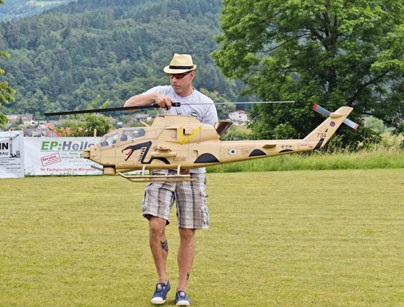
Here, in the idyllic Black Forest, Stefan Metzger calls home. Model flying was practically in his blood from birth, as his father, Bernd, is the co-founder and longtime treasurer of the Wieslet Model Flying Club (MFG Wieslet), which celebrated its 40th anniversary in 2017. He is also a member of MG SWIPAIR, a Swiss club, albeit only as a passive member.
A few years ago, while browsing the eBay platform, Stefan came across a used Vario fuselage for the Bell AH-1G. However, it was intended for a gasoline-powered engine, and the previous owner had also mounted the tail rotor on the wrong side.
Not exactly what a model builder would hope for in a model designed to take to the skies quickly, but driven by the desire to have a model in the air as soon as possible, it turned into a long-term project.
After receiving the used fuselage, however, it quickly became clear to Stefan that while moving the tail rotor to the correct side wasn’t feasible, it could be done by modifying the tail boom. To do this, the tail boom on the existing model had to be cut off and replaced with a new one. Fortunately, Vario-Helicopter supplies its customers with such replacement parts—albeit only upon request—in a timely manner. The frames also had to be removed from the fuselage, as they had been thoroughly soaked in gasoline from the model’s previous life as a gasoline-powered aircraft—a condition that was no longer acceptable for safe operation in the future.
When he purchased the fuselage, Stefan intended to build the model as an electric version. Around that time, he met the owner of another turbine-powered Cobra at an air show. From that point on, Stefan couldn’t get this type of propulsion out of his head. A JetCat PHT3 was to power his model. After all these preliminary investigations and preparatory work, construction of the new model could begin. The new set of frames from Vario was installed in the fuselage to accommodate the turbine’s mechanical components. Vario offers a fuel system with a 2.5-liter capacity that fits perfectly into the fuselage—directly below and to the side of the mechanical components, right at the center of gravity.
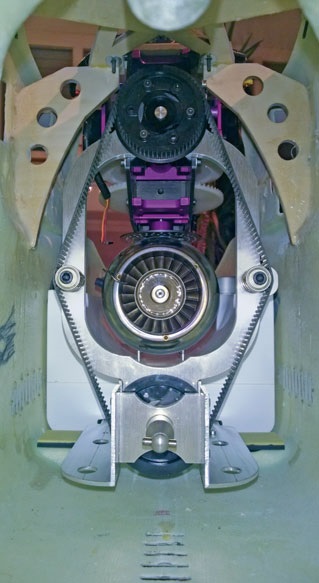
The PHT3 supplied by JetCat comes as a single unit consisting of the mechanical components and the turbine. Power is transmitted from the turbine shaft to the main gear via two intermediate stages using toothed belts. The turbine has an output of four kilowatts. To ensure that the servos of the four-point linkage are positioned exactly beneath the swashplate’s linkage points, Stefan installed the servo plate available as an option from JetCat. Another issue with this turbine-powered model is that, in the area of the tail drive, the exhaust pipe available from Vario—which is designed to fit the model—blocks the path for the tail drive. Vario also offers a lowered tail drive kit for this model to address this problem. The output speed is transmitted downward via two timing belt pulleys and a timing belt, from where the tail rotor is driven. A 6-mm flexible shaft in a silicone sheath, guided through an aluminum tube, transmits the rotational motion from the mechanical system to the M-Copter tail rotor. The tail rotor is controlled via a 3-mm fiberglass rod. The 2-blade rotor head is from SK, and the swashplate and drive shaft are from Vario. M-Blades are used for the main and tail rotor blades.
For the full-scale build, Vario Helicopter only offers the cockpit and the weapons suite. However, the AH-1G features numerous access panels and maintenance hatches, as well as various add-on parts. Stefan was determined to incorporate all of these into his model.
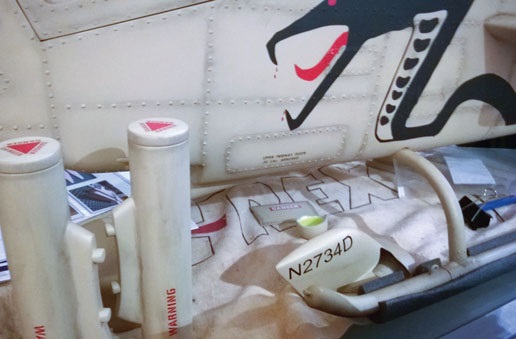
The maintenance hatches were neatly cut out using a Dremel. The sections left over from the cutting process were then reused for the hatches. To do this, they were reinforced with fiberglass or plywood. For the cutouts on the inside, CFRP strips were glued on as door rebates, creating a stop for these hatches. At the same time, this reinforces the fuselage in the area of the cutout. The edges of the open ventilation slots were also reinforced on the inside of the fuselage. Unfortunately, rivets are still missing from Vario fuselages these days. Stefan applied them using thickened white glue and a syringe. Anyone who has ever done this themselves knows how tedious and time-consuming this work is. First, mark the line where the rivets should go with a pencil, and then apply these dots of white glue at even intervals. Many other details on the fuselage, such as sheet metal joints and the cable clamps, were custom-made. On the landing gear included with the fuselage, the skid tubes were too small in diameter. The builder fabricated new, appropriately sized aluminum tubes to replace them.
The Gatling machine gun, which was already mounted at the bottom of the fuselage, was cut off by the builder in the area of the turret. With a built-in servo, the barrels can now be swiveled up and down. Some of the old plastic gun barrels on the two machine guns had broken off, so these were also custom-made from aluminum on a lathe. The two weapon mounts, which were already attached to the used fuselage, could be reused. Only the rocket launcher had some damage and was refurbished. The front and rear end caps were replaced with new ones made from aluminum.
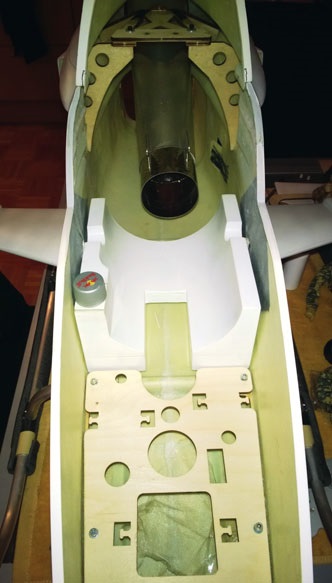
In retrospect, building the cockpit from scratch turned out to be one of the bigger challenges in the scale conversion. First, the cockpit floor was modeled using cardboard.
This template was then transferred to plywood and cut out. The cockpit pilot and the seats were then recreated using polystyrene. Stefan only purchased the control and pitch sticks separately. The instrument panel was faithfully recreated with imitation instruments and switches. These replicas are supplied in natural white and must be painted to match the original. The seats were properly upholstered with fabric and foam. Two scale-accurate pilots complete the perfect picture of the cockpit.
Stefan Metzger chose the Israeli Army’s Bell AH-1G as the model for his build. Distinctive features of this model include the snake on the side and the sand-colored paint scheme. Since the Bell AH-1G is a single color, there was no need for extensive masking; only small areas that were not supposed to be painted had to be covered. After applying and letting this sand-colored coat of paint dry, the decals could be applied. For the snake, Stefan decided to apply it using an airbrush and a stencil made specifically for this purpose. Airbrushing involves using a small spray gun no larger than a ballpoint pen. With this method, the paint can be sprayed precisely where it’s needed, eliminating the need for masking. Pastel chalk was used to age the model. Signs of wear and oil stains were applied in the appropriate colors to the relevant areas. The matte clear coat, which was applied over the entire fuselage at the end, prevents the paint from washing away from the details, decals, and weathering effects. Stefan did all the painting himself using 2K paint from a spray can.
After the painting was complete, all components could be reinstalled into the fuselage. The mechanics, tail rotor, turbine accessories, and batteries were quickly put back in place.
Futaba BLS-452 servos are mounted on the swashplate and tail rotor, connected to an R7008SB receiver. Attitude stabilization is handled by a Bavarian Demon 3X. A DPSI BICV2 dual power supply from Emcotec ensures uninterrupted power to the RC components.
As a trained electronics technician, it was only natural for Stefan to install lighting that closely resembles reality. Super-bright LEDs and emitters provide light exactly where needed, whether flashing or as a steady glow. The Aurora LCU EVO2 is used for the lighting electronics, powered by a separate lighting battery. After completing the usual finishing touches, nothing stood in the way of the maiden flight.
After about two years of construction, on a windless day, nothing stood in the way. The Jet-Cat PHR3-3 ran without any problems—even on the very first takeoff attempt. After a few minutes of idling, all critical areas were checked to ensure everything was in order. Since Stefan had already insulated the exhaust pipe where it runs inside the fuselage, no elevated temperature was detected on the fuselage. All kerosene lines were also leak-free, and after these checks, the “maiden flight” could take place.
Right from the start, the model flew beautifully and responded precisely to control commands. No adjustments were needed, either to the programming or to the mechanical settings. Precise construction and adherence to the manufacturer’s specifications were Stefan Metzger’s top priorities in bringing this Bell AH-1G project to life.
In closing, here’s a quote from the builder and owner of this fantastic model helicopter: “From the very beginning, I’ve really enjoyed this project, and it’s opened up many new perspectives for me in model building. I’d never painted a model myself before, but judging by the result, I’ll be doing it myself on my future models. The only thing is, I wouldn’t settle for a used fuselage for a project again. The money I saved had to be made up for with a lot of sweat and hard work. Today, more than four years after its maiden flight, I still enjoy the model just as much as I did at the beginning.”


News from HEBU

TEAM MANAGER "THIS" BOSSHARD
 Rodito Nussbaumer

YOU KNOW WHAT I MEAN? 125 YEARS OF THE SWISS AERO CLUB
 Emil Giezendanner

ATOM, THE NEW DOUBLE-DECKER FROM CPLR
 Matthias Bosshard

SUMMER FUN 2026 AT MG USTER
Martin Wunderli
F3A EUROPEAN CHAMPIONSHIPS IN ST-MACAIRE, FRANCE
Matthias Bosshard
52. 2026 ALPS CUP
Emil Giezendanner
PRIDE AND GOOD IDEAS
 Markus Nussbaumer

CORSAIR F4U – A WARBIRD WITH A MEMORABLE LOOK
Jürgen Rosenberger, Jürgen Prinz
TRY-OUT DAY AT MFV WETTINGEN
Urs Keller
TWIN TOWN PARTNERSHIP
Wolfgang Voeller
BY YOUTH, FOR YOUTH
Lorena Betschen
INSIGHTS INTO THE HISTORY OF SEAPLANES

SMALL, MODEL-LIKE SAILBOATS
Res Dauwalder
What's New at Leomotion.com

HORIZON HOBBY/LEMACO NEWS: MICRO OV-10 BRONCO 645 MM BY E-FLITE

COUPE DES ALPES – OBSERVE AND LEARN
Rodito Nussbaumer
EURO CONTEST GLIDER ACRO TOUR AUSTRIA 2026

34th HAHNENMOOS ALPINE MODEL AIRPLANE CAMP
Res Dauwalder
WELCOME, NEW MEMBER!
Andrea Bolliger
FREE FLIGHT IN THE MIDDLE OF SUMMER
Urs Muntwyler
THE PC-21 STORY
Emil Giezendanner
NEWS FROM HEBU
 Julia Bucher

FROM 0 TO 100
Markus Nussbaumer
MEMORIES
Wolfgang Völler
NOS REGION – A HUB FOR ELECTRIC AVIATION
Emil Giezendanner
Have you almost forgotten about aircraft that take off and land vertically?
Emil Giezendanner
DO YOU KNOW WHAT I MEAN IN THE LAND OF SMILES?
Emil Giezendanner