
CORSAIR F4U – A WARBIRD WITH A MEMORABLE LOOK
A television series about "Naval Fighter Squadron 214," consisting of cinematic depictions of the blue cantilever-wing aircraft in combat, piloted by daring and fearless pilots, leaves a lasting impression on many model aircraft enthusiasts, along with the desire to own such an aircraft.
In the early 1990s, co-author Jürgen Prinz came across an FMT construction plan for an F4U with a wingspan of 1,140 mm. Following his penchant for large-scale models, he doubled the model’s mass and chose a 10-series methanol engine as the power source. Jürgen was not entirely satisfied with the visual result, as he felt that the charm of the double-pivot wings was hardly apparent at that size. At an air show in 2004, J. P. saw a 1:4 scale Corsair with a wingspan of 3.12 m. Thrilled by the sight—“That’s the one!”—Jürgen purchased the molds for this model from Norbert Scharf, the owner. Over the course of a year and a half, he built a new model equipped with a 3-W150 Owermaster. At an airshow in 2007, both pilots demonstrated their Corsairs in formation flight. From J. P.’s perspective, the flight characteristics of his aircraft left something to be desired. The airfoil chosen by Jürgen, a NACA 2412, shows shortcomings compared to Scharf’s model with its fully symmetrical airfoil. Scharf’s Corsair exhibits better low-speed flight characteristics, while Jürgen’s plane is consistently difficult to handle, especially during approach. Master Prinz draws the necessary conclusions and plans a redesign. The new concept involves changes to the airfoil profile along the wing: NACA 2412 on the outer section and a fully symmetrical NACA 0010 on the inner section. What is easy to say in words is difficult to implement—
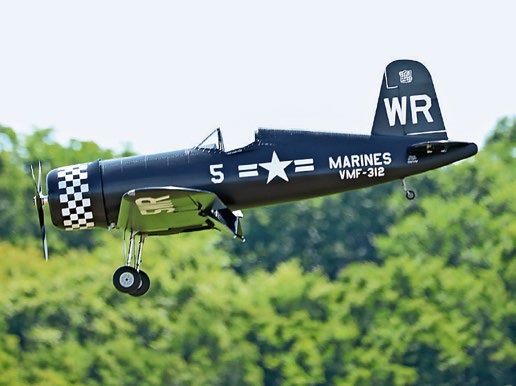
So let us now introduce: a model with a wingspan of 3.12 m, weighing 24.8 kg, powered by a DLE 170. Thirty years of model-building experience are reflected in its center-frame construction using carbon-aramid. A fuselage manufactured from hybrid fabric using vacuum infusion results in a weight reduction of 1.5 kg compared to the previous model. The tail surfaces are designed to be collapsible for easy transport. The center section of the wing is still constructed using the tried-and-true laminating technique—that is, in a form that has not yet been weight-reduced. The wing tips are made of Styrobalsa. This means there is room for further weight reduction in a future version! The fuselage, formed in two halves, consists of two joined half-shells. The cockpit canopy is formed from Vivak thermoplastic, and the cabin frame is made from thin 0.3-mm aluminum sheet. The canopy can be opened and closed by hand. The dark blue paint scheme and markings—scale accuracy is a must—correspond to those of Squadron VMF 312.
In an aircraft of the size described, high-quality servos with high actuating force are essential: 35 kg/cm for the ailerons, landing flaps, and elevator, and 70 kg/cm for the rudder. The elevator servos are installed on-site. The rudder servo, mounted at the front for weight reasons, controls the rudder and tailwheel via cables extending to the rear. For safety reasons, three receivers are used. Each aileron is operated by a single servo. The landing flaps, the heart of the Corsair, require some design effort due to the double-pivot wing: The outer flaps are articulated directly by separate servos, while the inner three are controlled by a single servo, with the outer and inner flaps driven via linkages.
When retracting, the landing gear legs must additionally rotate 90° around their axis so that the wheels disappear beneath the wing skin. For weight reasons, the cockpit interior is built to a limited scale.

| Manufacturer: | Homemade |
| Wingspan: | 3125 mm |
| Length: | 2,430 mm |
| Weight: | 24.8 kg |
| Surface load: | 150 g/dm² |
| Motor: | DLE 170 |
| Shock absorber: | MTW TD120 K |
| Speed: | 35–180 km/h |
| RC Dome servos: | Savöx |
| Lighting: | uniLight.at |
| Hacker transmitter: | Jeti DS 24 V2 |
| Power supply: | Jeti Centralbox 210 |
| Gyro: | Cortex PRO |
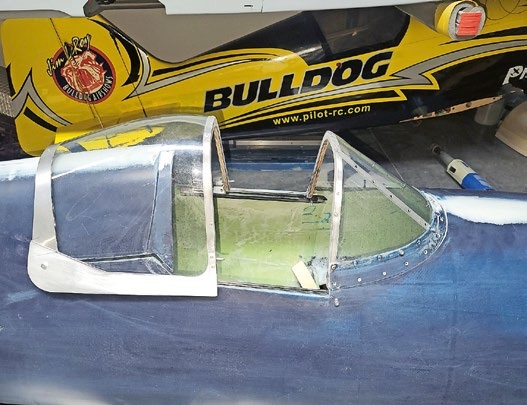
The maiden flight is scheduled for June 2025. The model can be transported in a larger station wagon, since the tail surfaces, center section, and outer wings can be stowed separately. One drawback: Final assembly requires a helper; who holds the fuselage while the center section is secured to it with two No. 5 screws. The attached outer wings are each fastened with two M-screws, and the elevator is secured to the mounting tube with an M3 screw. Now for the flight: Concerned that the aircraft might veer off to one side if too much thrust is applied, Jürgen increases the throttle cautiously during the takeoff roll, taking off at full throttle after about 30 m. During the first circuit, he checks the center of gravity; the control response at 30% Expo is moderate. A note on the double-bend wing design: The original aircraft are powered by radial engines with 4-blade propellers, which require high ground clearance. The Corsair is therefore a high-mounted low-wing aircraft that, due to its high center of gravity, is very prone to stalling when stalled. For the pilot, this means: An aircraft flying directly into the wind is easy to control and can be landed smoothly. In crosswinds, the Corsair—as demonstrated during the maiden flight—tends to yaw into the wind and stall when the flaps are extended. On subsequent flights, it proved advantageous to land the aircraft in crosswinds without landing flaps, even if this meant a longer landing roll. The primary 1-liter fuel tank is too small. During the maiden flight, we were surprised five minutes into the approach by an engine stall: Oh no, the tank is empty! Fortunately, we were able to bring our Warbird to a safe landing in a smooth glide. Subsequent flights demonstrated full aerobatic capability with acceptable low-speed flight characteristics.
In conclusion: Jürgen Prinz’s Corsair flies with surprising inherent stability for a warbird; a gyro is advisable in crosswinds, as it helps alleviate concerns about stalling in crosswinds. During takeoff, a flap setting of 25° is advantageous; this helps avoid taking off too early, which carries the risk of a stall.
Read the full article
Sign up or log in to read the full article.

News from HEBU

TEAM MANAGER "THIS" BOSSHARD
 Rodito Nussbaumer

YOU KNOW WHAT I MEAN? 125 YEARS OF THE SWISS AERO CLUB
 Emil Giezendanner

F3A EUROPEAN CHAMPIONSHIPS IN ST-MACAIRE, FRANCE
 Matthias Bosshard

SUMMER FUN 2026 AT MG USTER
Martin Wunderli
TRY-OUT DAY AT MFV WETTINGEN
Urs Keller
52. 2026 ALPS CUP
Emil Giezendanner
BY YOUTH, FOR YOUTH
Lorena Betschen
ATOM, THE NEW DOUBLE-DECKER FROM CPLR
Matthias BosshardCORSAIR F4U – A WARBIRD WITH A MEMORABLE LOOK
Jürgen Rosenberger, Jürgen Prinz
SMALL, MODEL-LIKE SAILBOATS
Res Dauwalder
What's New at Leomotion.com

HORIZON HOBBY/LEMACO NEWS: MICRO OV-10 BRONCO 645 MM BY E-FLITE

TWIN TOWN PARTNERSHIP
Wolfgang Voeller
PRIDE AND GOOD IDEAS
 Markus Nussbaumer

EURO CONTEST GLIDER ACRO TOUR AUSTRIA 2026

INSIGHTS INTO THE HISTORY OF SEAPLANES

34th HAHNENMOOS ALPINE MODEL AIRPLANE CAMP
Res Dauwalder
WELCOME, NEW MEMBER!
Andrea Bolliger
FREE FLIGHT IN THE MIDDLE OF SUMMER
Urs Muntwyler
COUPE DES ALPES – OBSERVE AND LEARN
Rodito Nussbaumer
THE PC-21 STORY
Emil Giezendanner
NEWS FROM HEBU
 Julia Bucher

FROM 0 TO 100
Markus Nussbaumer
MEMORIES
Wolfgang Völler
NOS REGION – A HUB FOR ELECTRIC AVIATION
Emil Giezendanner
Have you almost forgotten about aircraft that take off and land vertically?
Emil Giezendanner
DO YOU KNOW WHAT I MEAN IN THE LAND OF SMILES?
Emil Giezendanner