
Smoking Albatross—a remote-controlled, rocket-powered airplane
I have been building model rockets and model airplanes for years. So it was only natural that I would want to develop a rocket-powered airplane. Since I personally prefer models with delta wings, I soon began designing a prototype.
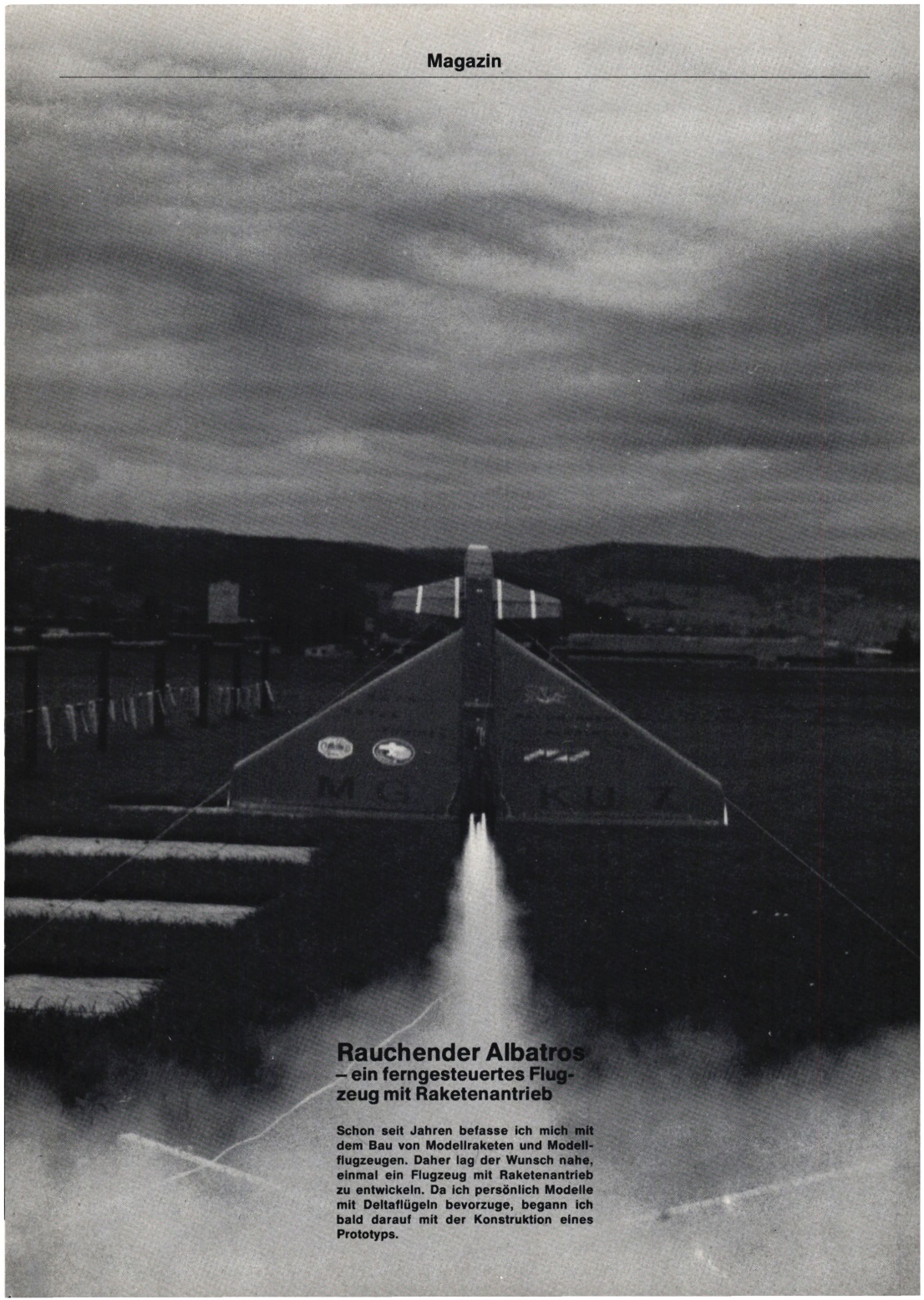
For simplicity’s sake, I chose a square fuselage cross-section with a side length of 70 mm. The model, ready for launch, has a length of 1160 mm and a wingspan of 1000 mm. Its weight, including propellant charges and the RC system, is 1,040 g. At the very rear of the fuselage, I installed a sheet-metal can that held three D12-3 (Estens) propellant charges. The technical specifications for this propellant charge are 3.95 kp, 20 N/sec, burn time 1.5 sec, maximum takeoff weight 410 g, and weight 42 g per charge. This aircraft is controlled via ailerons and an elevator on the leading edges. A third servo on the prototype allowed me to deploy an emergency parachute. Soon I was ready for the maiden flight.
My club mate Sigi towed the model behind his plane using the piggyback method to an altitude of about 100 m. After releasing the tow rope, I tried to control the model: the result was that it pitched nose-down and went into a nosedive. In desperation, I deployed the parachute. Unfortunately, it was immediately torn off—and the model crashed hard. That very evening (and into the early morning), I repaired and improved the aircraft. The elevator was enlarged, the center of gravity was shifted backward, and the angle of attack was increased. Then I got back to work. Much to the annoyance of the spectators, the model now flew flawlessly. It was wonderfully easy to control and
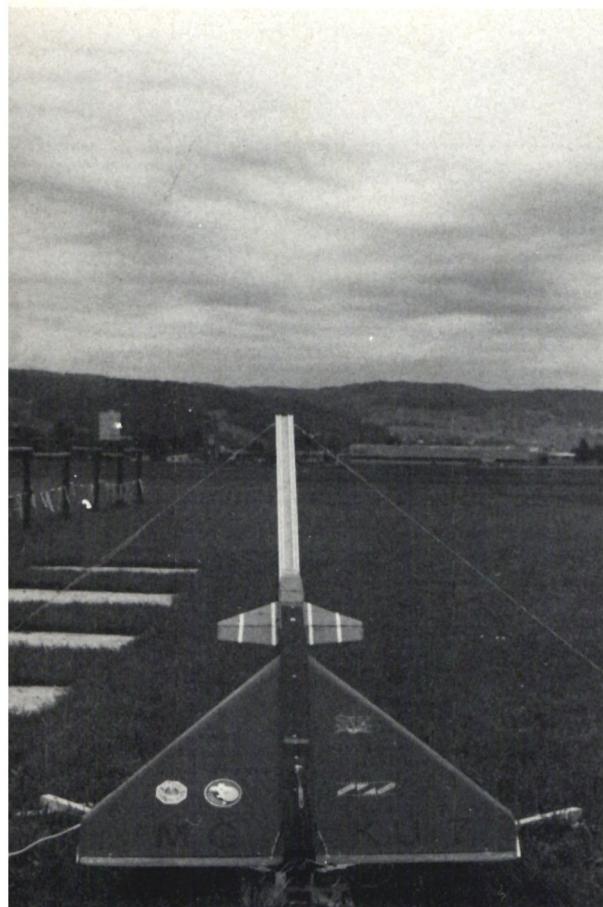
landed gently. After further test flights, I was able to safely remove the parachute. The launch was performed using a special ramp. Two parallel curtain rails serve as guides. Curtain gliders attached to the bottom of the fuselage ensure smooth and precise guidance. An amateur photographer captured the launch of the rocket glider on film using a motorized camera. Ignition occurred simultaneously.
The model launched successfully and left a trail of smoke as it climbed. After reaching its maximum altitude, I was able to control it without any problems. The flight ended, as planned, with a smooth landing. Depending on the wind, the flight lasts about 60 seconds. In subsequent flights, the rocket glider repeated its performance.
These achievements were recognized with first place at the 1979 Swiss Model Rocket Flight Day. Arthur Hunziker
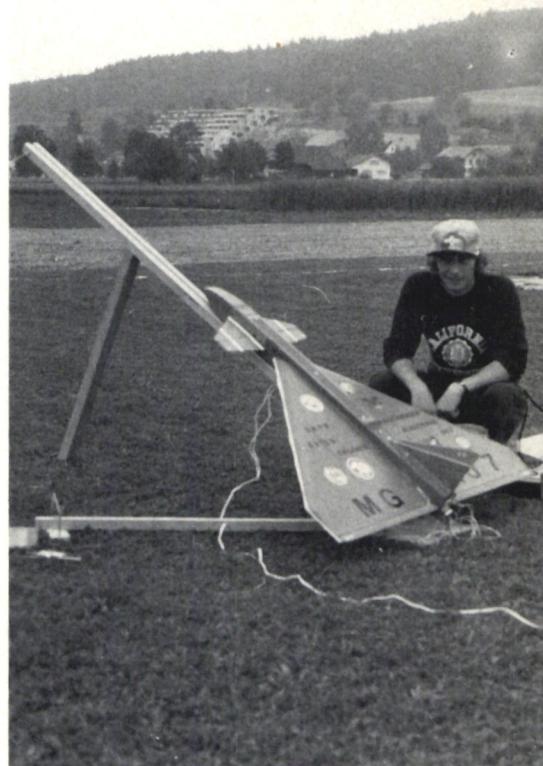
Right: The author of our RC rocket report, Arthur Hunziker of the Kulm Model Flying Club (Region 4), standing in front of his remote-controlled, rocket-powered Delta model, ready for launch ...
Launch phase (0.0 sec) during ignition. Light smoke is already visible at the rear of the rocket.
... 0.2 sec
... 0.4 sec
Above: Burned-out Estes D12-5 propellant charges.
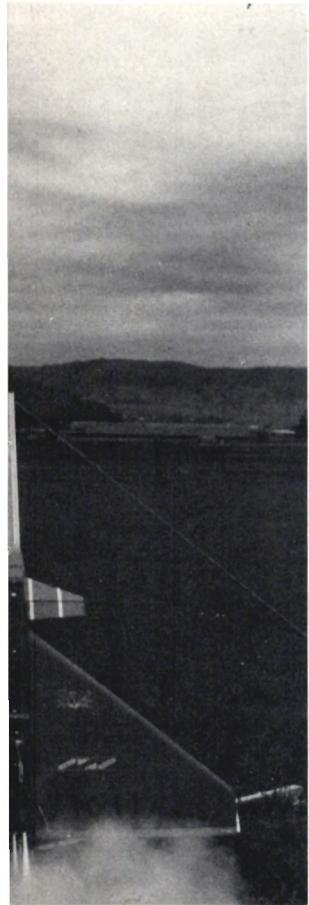
Left: Final launch preparations on the launch pad.
... 0.6 sec
and 0.8 sec

EURO CONTEST GLIDER ACRO TOUR AUSTRIA 2026

THE PC-21 STORY
 Emil Giezendanner

CORSAIR F4U – A WARBIRD WITH A MEMORABLE LOOK
 Jürgen Rosenberger, Jürgen Prinz

TWIN TOWN PARTNERSHIP
Wolfgang Voeller
SUMMER FUN 2026 AT MG USTER
Martin Wunderli
YOU KNOW WHAT I MEAN? 125 YEARS OF THE SWISS AERO CLUB
Emil Giezendanner
52. 2026 ALPS CUP
Emil Giezendanner
News from HEBU

TEAM MANAGER "THIS" BOSSHARD
Rodito Nussbaumer
ATOM, THE NEW DOUBLE-DECKER FROM CPLR
 Matthias Bosshard

F3A EUROPEAN CHAMPIONSHIPS IN ST-MACAIRE, FRANCE
Matthias Bosshard
INSIGHTS INTO THE HISTORY OF SEAPLANES

WELCOME, NEW MEMBER!
Andrea Bolliger
PRIDE AND GOOD IDEAS
 Markus Nussbaumer

What's New at Leomotion.com

FREE FLIGHT IN THE MIDDLE OF SUMMER
Urs Muntwyler
SMALL, MODEL-LIKE SAILBOATS
Res Dauwalder
BY YOUTH, FOR YOUTH
Lorena Betschen
HORIZON HOBBY/LEMACO NEWS: MICRO OV-10 BRONCO 645 MM BY E-FLITE

34th HAHNENMOOS ALPINE MODEL AIRPLANE CAMP
Res Dauwalder
COUPE DES ALPES – OBSERVE AND LEARN
Rodito Nussbaumer
TRY-OUT DAY AT MFV WETTINGEN
 Urs Keller

NEWS FROM HEBU
 Julia Bucher

NOS REGION – A HUB FOR ELECTRIC AVIATION
Emil Giezendanner
MEMORIES
 Wolfgang Völler

70 YEARS OF THE NIDWALDEN MODEL AIRPLANE CLUB
Martin Barmettler
A SPECTACULAR F3A WORLD CUP IN THE PRINCIPALITY OF LIECHTENSTEIN
Emil Giezendanner
FROM 0 TO 100
Markus Nussbaumer