
Goshawk
There’s a time for everything, as they say—even in model building, in my opinion! Indeed, after experiencing tube receivers, the advent of transistors, integrated circuits, and finally programmable transmitters, my enjoyment of flying slowly faded. This convinced me to cap off my series of numerous large-scale models with an exceptional one. At that time, CNC-Bayer—from whom I had already built four models—subtly slipped in a single announcement of a roughly 1:2 scale reproduction of the Habicht, whose maiden flight dated back to the 1936 Olympic Games, and which went into mass production in 1937—just about a year after its debut. What better way to come full circle?
The Habicht is the first glider designed for aerobatics. Developed by Hans Jacobs, its wingspan of 13.6 m was reduced to 8 m—without the gull-wing shape—and then to 6 m, to train pilots to fly the Messerschmitt Me 163 “Komet,” which landed at 200 km/h. Pilots preferred the open cockpit, as the wind in their faces gave them a sense of the aircraft’s speed. Since the percentage of pilots who could enjoy the wind in their hair multiple times in a row was rapidly declining, these tests were discontinued by the German military.
When I called, Hans Jürg Bayer told me that this all-wood model, with a wingspan of about 570 cm, was reserved for nutcases like me, which I took as a
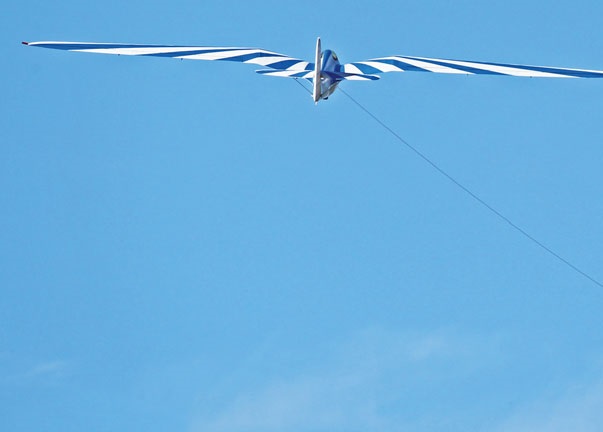
Kudos! It was never mass-produced, so it can be considered a prototype. (Since then, Bayer has shifted exclusively to producing software for CNC routers and has discontinued its production of wooden models.) But after going to great lengths
all the wood needed for the project—delivered in bulk and without a plan—my passion for building slowly became inversely proportional to the number of meters of stringers to build and the number of parts to assemble. It took me
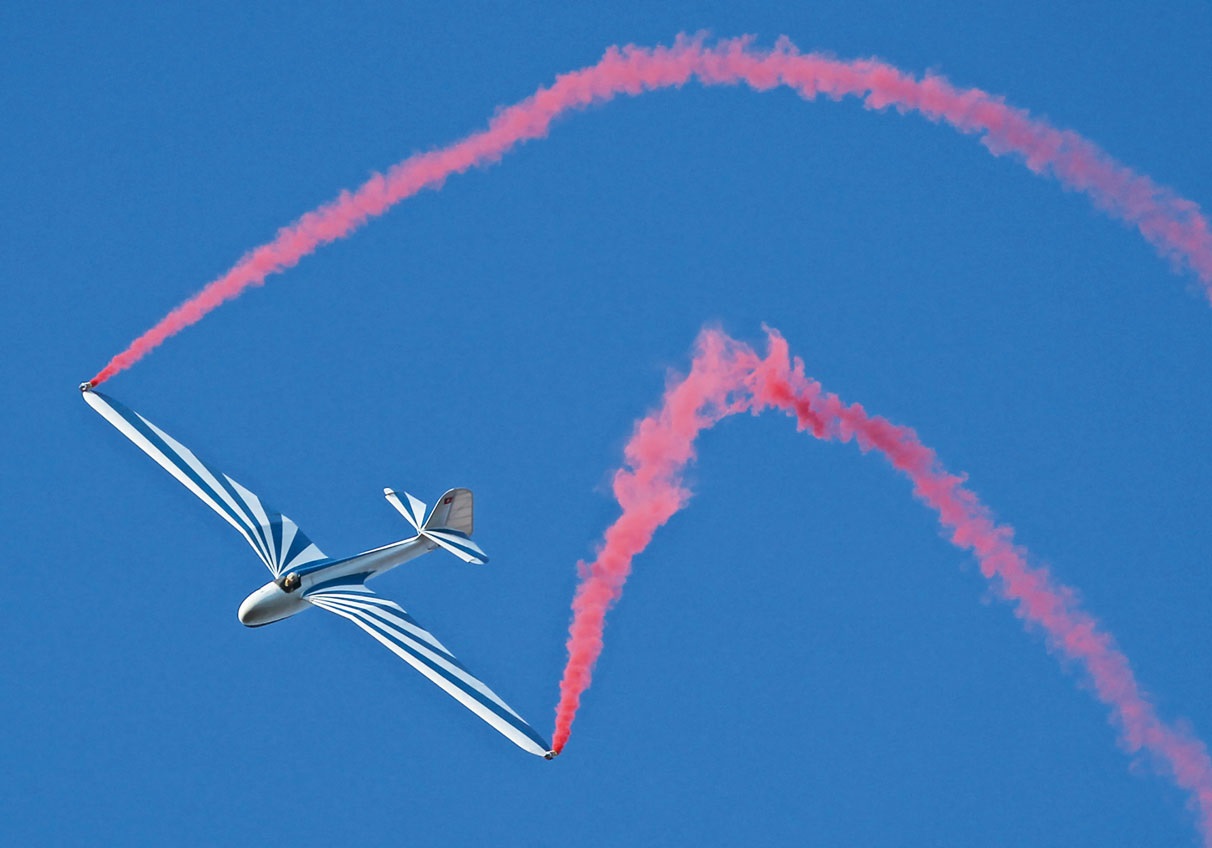
It took more than a year to complete the bulk of the assembly. It was almost finished—I had even “forgotten” about it—because sanding the 2.5 m² of wing fairings seemed so tedious to me. And once it was finished, after several years, I found myself in one of the
chronic shortages of tow pilot at the club where I was a guest. In short, the first flight couldn’t take place until 2016. But the wait was more than made up for by the sight of it in flight. Its aerobatic flight characteristics are
fabulous—which is hardly surprising, given that H. Quabek spent two full days at his computer calculating all the design parameters. My “test pilot,” Urs Marti, thoroughly enjoys himself every time he takes the model
model; he even forgets to fly my 9-meter-wingspan ASG-29, which used to be his favorite model. ■
Builder: Dominique Bear
cadobaer@gmail.com
Photos: Kusi Brönnimann
Pilot: Urs Marti


News from HEBU

TEAM MANAGER "THIS" BOSSHARD
 Rodito Nussbaumer

YOU KNOW WHAT I MEAN? 125 YEARS OF THE SWISS AERO CLUB
 Emil Giezendanner

PRIDE AND GOOD IDEAS
 Markus Nussbaumer

ATOM, THE NEW DOUBLE-DECKER FROM CPLR
 Matthias Bosshard

SUMMER FUN 2026 AT MG USTER
Martin Wunderli
F3A EUROPEAN CHAMPIONSHIPS IN ST-MACAIRE, FRANCE
Matthias Bosshard
52. 2026 ALPS CUP
Emil Giezendanner
HORIZON HOBBY/LEMACO NEWS: MICRO OV-10 BRONCO 645 MM BY E-FLITE

TWIN TOWN PARTNERSHIP
Wolfgang Voeller
CORSAIR F4U – A WARBIRD WITH A MEMORABLE LOOK
Jürgen Rosenberger, Jürgen Prinz
TRY-OUT DAY AT MFV WETTINGEN
Urs Keller
WELCOME, NEW MEMBER!
Andrea Bolliger
EURO CONTEST GLIDER ACRO TOUR AUSTRIA 2026

BY YOUTH, FOR YOUTH
Lorena Betschen
INSIGHTS INTO THE HISTORY OF SEAPLANES

SMALL, MODEL-LIKE SAILBOATS
Res Dauwalder
What's New at Leomotion.com

COUPE DES ALPES – OBSERVE AND LEARN
Rodito Nussbaumer
34th HAHNENMOOS ALPINE MODEL AIRPLANE CAMP
Res Dauwalder
FREE FLIGHT IN THE MIDDLE OF SUMMER
Urs Muntwyler
THE PC-21 STORY
Emil Giezendanner
NEWS FROM HEBU
 Julia Bucher

FROM 0 TO 100
Markus Nussbaumer
MEMORIES
Wolfgang Völler
NOS REGION – A HUB FOR ELECTRIC AVIATION
Emil Giezendanner
Have you almost forgotten about aircraft that take off and land vertically?
Emil Giezendanner
DO YOU KNOW WHAT I MEAN IN THE LAND OF SMILES?
Emil Giezendanner