
Swiss Championships for Rubber-Powered and Internal-Combustion Engine Model Aircraft in Buochs
Text: Werner Heise, Photos: Erich Rohrer
This year’s championship was organized by the MG Nidwalden under the direction of Hans Weber.
Weather conditions: A blanket of low-lying fog all day with occasional drizzle. Relatively cold, about 14°. Perfect weather for model flying!
A pleasing turnout for the rubber-powered class. 16 registered pilots—14 at the starting line—13 classified. Under the weather conditions mentioned, a high-performance model achieved exactly 180 seconds at a climb altitude of 70–80 meters. The rubber was hard due to the cold temperature and could only be stretched to 85–90% of its maximum. String breaks were common, but thanks to the durable aluminum fuselages—which virtually all participants used—this damage was quickly repaired. F1B models have been significantly simplified since the introduction of PIG control. Neither angle-difference control nor turn control is needed anymore. Thus, a standard 6-minute timer for the thermal brake is sufficient.
7 registered participants—all at the starting line—but only 4 were scored! These numbers show that the highly specialized F1C category requires a deep understanding of the laws of aerodynamics. You have to know exactly how the model will react to even a quarter-turn of a small adjustment screw. Ruedi Schenker demonstrated the most balanced and stable climbs in this category. He won convincingly with a 340" lead. Peter Maurer demonstrated just how much force a crashing model can generate. His model hurtled from a height of about 90 meters, engine still running, onto the asphalt runway, leaving a 2 cm deep hole. As impressive as the launch of an F1C model is, one must still point out the risk of accidents. Due to the increased power of the engines, run times are now down to just 7 seconds. A new category featuring only 1-cc engines should be introduced here. Years ago, an attempt was made in a similar direction (with the same engine size, the model weight was increased by 100%—from 300 g/cc to 600 g/cc), but this category never really caught on at the VM National. In Germany, there is an MS (motor glider) category for engines up to 1 cc and a 20-second engine runtime.
Who’s willing to try bringing something new to the table in this area?
Competition Schedule: Thanks to the participants’ thorough preparation—there were almost no pro-
—the time required to complete the course was reduced to half an hour. A buffet was set up for refreshments at very reasonable prices.
At 3:30 p.m., the awards ceremony took place on the field. It’s also worth noting that the Wackefield Challenge Cup (F1B), donated by the AeCS, has been in circulation since 1949. Kudos to the organizer, MG Nidwalden, for the excellent organization.
With the hope that every participant will bring a friend next year, we look forward to the next Swiss Championship.
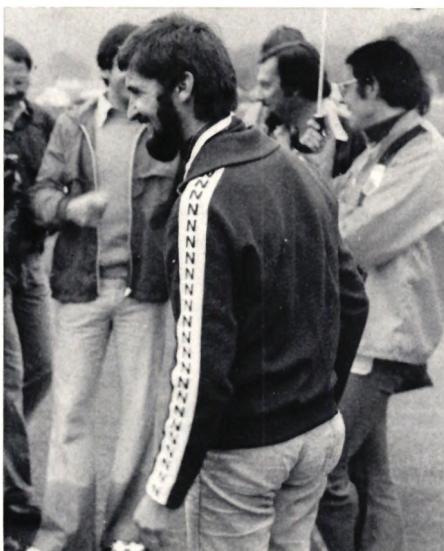
| 1. Fritz Gaensli, Dübendorf | 1255 |
| 2. Hans Reifler, Affoltern | 1251 |
| 3. Dieter Siebenmann, Affoltern | 1209 |
| 4. Erich Rohrer, Dübendorf | 1104 |
| 5. Max Suter, Dintikon | 1029 |
| 6. Walter Eggimann, Bern | 991 |
| 7. Ruedi Erismann, Olten | 903 |
| 8. Werner Heise, Furttal | 836 |
| 9. Thomas Urban, Dübendorf | 798 |
| 10. Kurt Sager, Schönenwerd | 745 |
| 11. Josef Waser, Nidwalden | 733 |
| 12. R. Sommerhalder, Männedorf | 604 |
| 13. E. Brennwald, Männedorf | 400 |
| 1. Ruedi Schenker, Schönenwerd | 1177 |
| 2. Andres Bärtschi, Bern | 837 |
| 3. Peter Maurer, Bern | 832 |
| 4. Hans Schoder, Dintikon | 643 |
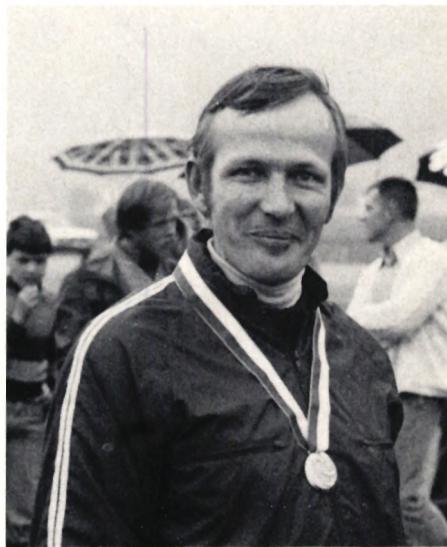
Left: All three medals in the “rubber-powered” category went to Region 5. Hans Reifler, Affoltern (center), took second place.
Below: A small “outdoor” rubber-powered model built by D. Siebenmann. U.S. kit for approx. 4 Swiss francs.


News from HEBU

TEAM MANAGER "THIS" BOSSHARD
 Rodito Nussbaumer

YOU KNOW WHAT I MEAN? 125 YEARS OF THE SWISS AERO CLUB
 Emil Giezendanner

HORIZON HOBBY/LEMACO NEWS: MICRO OV-10 BRONCO 645 MM BY E-FLITE

PRIDE AND GOOD IDEAS
 Markus Nussbaumer

34th HAHNENMOOS ALPINE MODEL AIRPLANE CAMP
Res Dauwalder
TRY-OUT DAY AT MFV WETTINGEN
Urs Keller
F3A EUROPEAN CHAMPIONSHIPS IN ST-MACAIRE, FRANCE
 Matthias Bosshard

52. 2026 ALPS CUP
Emil Giezendanner
ATOM, THE NEW DOUBLE-DECKER FROM CPLR
Matthias Bosshard
SUMMER FUN 2026 AT MG USTER
Martin Wunderli
What's New at Leomotion.com

COUPE DES ALPES – OBSERVE AND LEARN
Rodito Nussbaumer
TWIN TOWN PARTNERSHIP
Wolfgang Voeller
BY YOUTH, FOR YOUTH
Lorena Betschen
CORSAIR F4U – A WARBIRD WITH A MEMORABLE LOOK
Jürgen Rosenberger, Jürgen Prinz
SMALL, MODEL-LIKE SAILBOATS
Res Dauwalder
WELCOME, NEW MEMBER!
Andrea Bolliger
FREE FLIGHT IN THE MIDDLE OF SUMMER
Urs Muntwyler
EURO CONTEST GLIDER ACRO TOUR AUSTRIA 2026

INSIGHTS INTO THE HISTORY OF SEAPLANES

THE PC-21 STORY
Emil Giezendanner
NEWS FROM HEBU
 Julia Bucher

FROM 0 TO 100
Markus Nussbaumer
MEMORIES
Wolfgang Völler
NOS REGION – A HUB FOR ELECTRIC AVIATION
Emil Giezendanner
DO YOU KNOW WHAT I MEAN IN THE LAND OF SMILES?
Emil Giezendanner
A SPECTACULAR F3A WORLD CUP IN THE PRINCIPALITY OF LIECHTENSTEIN
Emil Giezendanner