
Safety Culture at the Club Level: The Example of MFV Kulm
The issue of safety, along with other pressing topics, is central to the SMV’s work. Even though we have been spared major incidents covered by the media in recent years, we must not slacken in our efforts to maintain—or even improve upon—this high standard.
To reacquaint our colleagues with the topic of safety, the MFS regularly publishes articles reminding readers of the most important rules of conduct. One example is the report on proper conduct during slope flying. In this report, following the motto “Do good and share it,” we want to highlight individuals or clubs that actively embrace the concept of safety in practice. When the question arose in the SMV board about which club or model aviation colleague could be interviewed on this topic, Christoph Jaber immediately came to mind. Many of you are probably familiar with Christoph, as he can often be found at air shows flying his green Fokker triplane or turbine-powered Venom, or serving as a tow pilot for the Swiss Acro Connection or IG Grosssegler. In addition to all these commitments, he runs a model aircraft school and flies the Triengen Piper Cub.
At MFV Kulm, he has held the position of Flight Director/Safety Officer for fixed-wing aircraft for a year now. I’ve often seen Christoph arrive at the model airfield and immediately notice that fellow modelers were struggling with technical problems. Selflessly, he would immediately step in to help his colleagues, which often meant that he didn’t even get around to
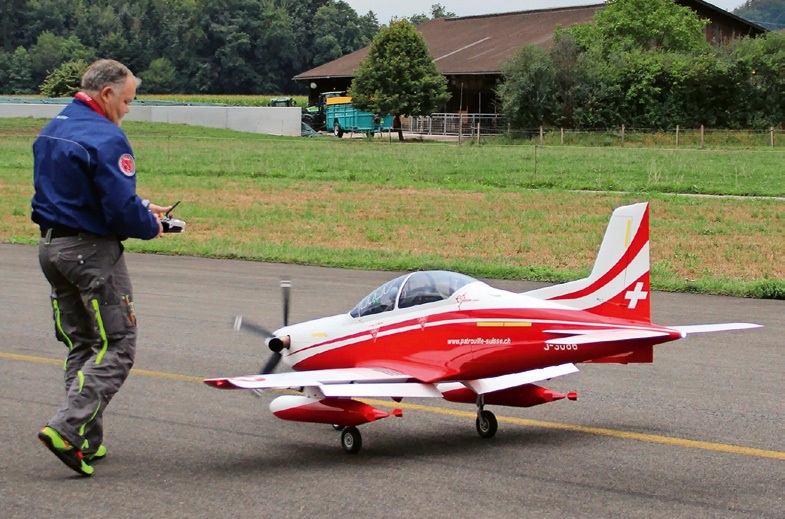
He’s the one who flies his own model airplanes. Even when problems arise in the air, Christoph is called right away—unless he’s already identified the emergency himself. His calm and competent support is highly valued by his colleagues.
At the end of a lovely early-summer flying day at our model airfield, I was able to ask Christoph a few questions about the club’s safety culture:
Absolutely, yes.
In principle, yes. In this context, people keep referring to common sense. But as we are repeatedly and soberingly reminded, this encompasses a wide range—from highly responsible
model aircraft pilots at one end of the spectrum to the casual, careless colleague whose behavior can lead to avoidable incidents.
It would be nice if this system worked, but unfortunately, it doesn't work perfectly.
All too often, interpersonal differences prevent constructive criticism from being accepted. Often, people simply watch with a smile or a shake of the head without intervening. Others, on the other hand, don’t dare to point out a safety risk to a colleague who may be much more experienced. This behavior is, of course, anything but productive and can lead to a serious incident.
There are several factors to consider. First, a wide range of experience is essential. This should include, at a minimum, all areas of activity within the club in question—whether technical or flight-related. Any additional aircraft category is, of course, a plus.
No less important—if not the most important factor—is the person themselves, how they present themselves, and their behavior toward club members, especially in crisis situations. If the interpersonal chemistry isn’t right, even the most constructive criticism won’t get through to the recipient. It is absolutely counterproductive to conduct a conversation in the style of a father-son talk; this provokes a defensive attitude in the colleague who is rightly being criticized, and the message falls flat. The conversation must be conducted on an equal footing and in a cordial
atmosphere; it must not be judgmental. The person at fault must be encouraged to reflect on their actions and their consequences. Together, ways and means to remedy the situation must be worked out. The manner in which these discussions are conducted determines success or failure; it’s a delicate balancing act. The person involved must come to realize that the goal is not to reprimand them, but to enable them to enjoy their beloved hobby without worry—with the result that others at the model airfield and in the immediate vicinity can also feel safe. And, of course, it goes without saying that support—or backing—from the board is essential.
There aren’t many options here. In this situation, too, it’s important to remain calm and appeal to the reason of those involved, true to the saying, “Constant dripping wears away the stone.” However, if all attempts at persuasion fail and safety remains at serious risk, there’s unfortunately no way around taking tougher measures. A flight ban—at least until the problem is resolved—is probably the mildest option. But the club’s well-being is the top priority here.
Such informational sessions are certainly useful, even if those
are affected tend to stay away, believing it doesn’t apply to them. But these events serve to remind participants of points that can fade from memory over time. As a sort of refresher, such events should be held regularly. Incidentally, other clubs I know of also hold such events.
A lively exchange of information and, of course, support. This includes regular exchanges of experiences and workshops. Visits to the regions, clubs, and model airfields are essential, because four eyes are always better than two.
Many thanks to Christoph Jäberg for the interview.
* * * *
And how is safety actually implemented in day-to-day flight operations at MFV Kulm?
The only financial consideration related to safety is the additional lease of another 50 meters of land to the south. Whereas in the past, during the summer, the tall cornfield extended right up to the runway threshold—primarily hindering landing tow planes or forcing glider pilots to make risky, steep approaches or “around-the-corner” approaches—this hazard has now been mitigated. Pedestrians were also obscured and would suddenly appear right next to the runway threshold. As an additional safety measure, this allows for a higher—and thus safer—flyover of the frequently traveled dirt road, especially during tow launches heading north. This costs us an extra chunk of rent each year, but it’s worth it.
Which brings us right to the topic at hand: dirt roads. On the one hand, these run directly at the northern end of the runway and, on the other, right next to the airfield, parallel to the grass runway. They are heavily used by walkers, dog walkers, cyclists, and horseback riders. The airfield regulations clearly define how to avoid dangerous situations during flight operations in these cases, especially with horses. In this context, we rely on the active attention of our non-flying colleagues, who must immediately report the appearance of these “hazards” to the pilot so that he or she can adjust the flight path. Often, when there is heavy traffic on the dirt roads, a second person stands right next to the pilot to inform him immediately and directly and to provide assistance in emergencies. During larger events, tri-planes are used to alert people to model aircraft traffic. For quite some time now, this has been
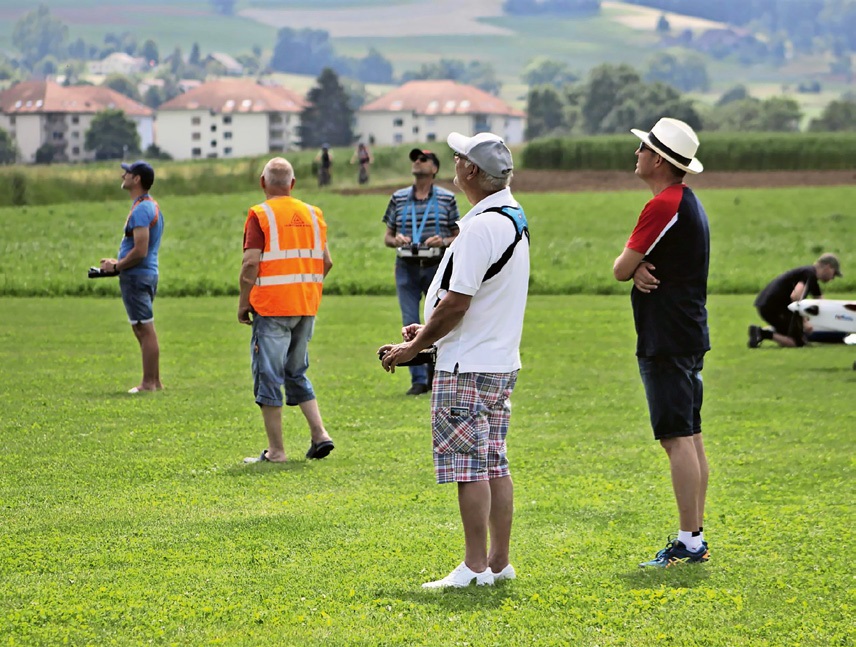
Some members also follow these rules during normal flight operations, which shows that safety awareness has increased.
Compliance with the flight operations regulations: To ensure that everyone is informed about these regulations, new and probationary members are invited to a briefing at the airfield at the start of each flying season. This ensures that new members are familiar with the regulations and that no misunderstandings arise. While enforcement of these regulations had weakened somewhat in recent years, the situation has improved lately. This is primarily due to the exemplary behavior of Christoph Jaber, who never hesitated to point out mistakes to pilots who were at fault. This, too, has had a positive influence on other members.
Fortunately, we can observe that the exemplary behavior of some club members with regard to safety culture is slowly but surely beginning to rub off on other members as well—a change is thus underway.
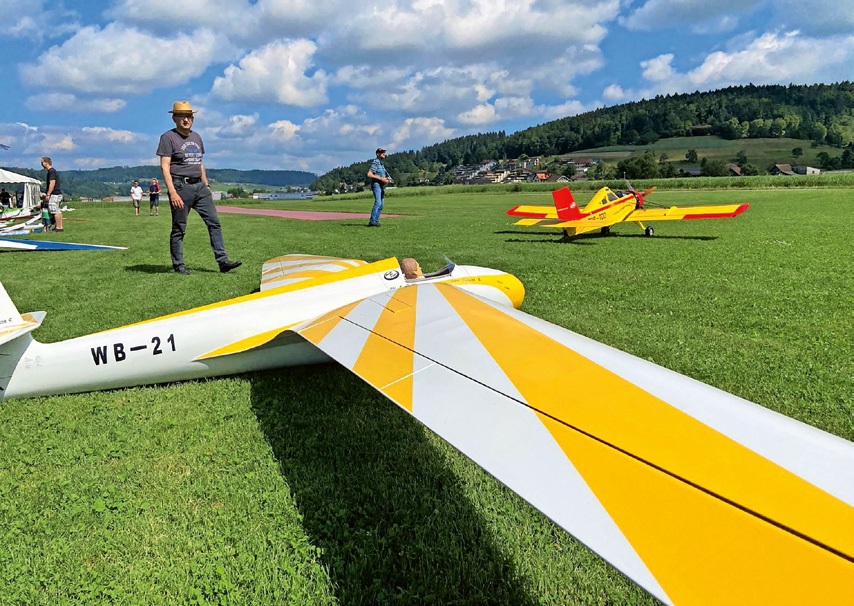
There are a few more measures in the works, but they must be implemented carefully and in a targeted manner.
Daniel Ziegenhagen


News from HEBU

EURO CONTEST GLIDER ACRO TOUR AUSTRIA 2026

TEAM MANAGER "THIS" BOSSHARD
 Rodito Nussbaumer

YOU KNOW WHAT I MEAN? 125 YEARS OF THE SWISS AERO CLUB
 Emil Giezendanner

TRY-OUT DAY AT MFV WETTINGEN
Urs Keller
F3A EUROPEAN CHAMPIONSHIPS IN ST-MACAIRE, FRANCE
 Matthias Bosshard

HORIZON HOBBY/LEMACO NEWS: MICRO OV-10 BRONCO 645 MM BY E-FLITE

PRIDE AND GOOD IDEAS
 Markus Nussbaumer

BY YOUTH, FOR YOUTH
Lorena Betschen
34th HAHNENMOOS ALPINE MODEL AIRPLANE CAMP
Res Dauwalder
52. 2026 ALPS CUP
Emil Giezendanner
THE PC-21 STORY
Emil Giezendanner
TWIN TOWN PARTNERSHIP
Wolfgang Voeller
ATOM, THE NEW DOUBLE-DECKER FROM CPLR
Matthias Bosshard
CORSAIR F4U – A WARBIRD WITH A MEMORABLE LOOK
Jürgen Rosenberger, Jürgen Prinz
SUMMER FUN 2026 AT MG USTER
Martin Wunderli
What's New at Leomotion.com

COUPE DES ALPES – OBSERVE AND LEARN
Rodito Nussbaumer
SMALL, MODEL-LIKE SAILBOATS
Res Dauwalder
WELCOME, NEW MEMBER!
Andrea Bolliger
FREE FLIGHT IN THE MIDDLE OF SUMMER
Urs Muntwyler
INSIGHTS INTO THE HISTORY OF SEAPLANES

NEWS FROM HEBU
 Julia Bucher

FROM 0 TO 100
Markus Nussbaumer
MEMORIES
Wolfgang Völler
NOS REGION – A HUB FOR ELECTRIC AVIATION
Emil Giezendanner
DO YOU KNOW WHAT I MEAN IN THE LAND OF SMILES?
Emil Giezendanner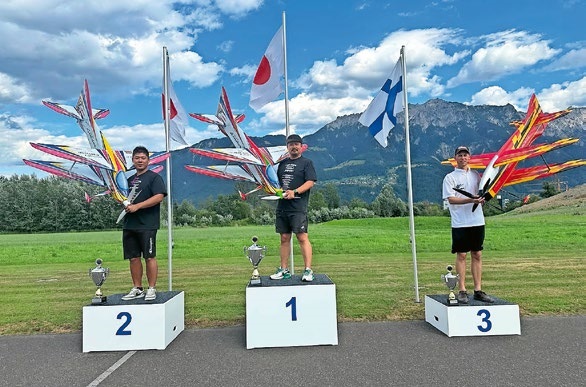
A SPECTACULAR F3A WORLD CUP IN THE PRINCIPALITY OF LIECHTENSTEIN
Emil Giezendanner