
Nick Ziroli Curtiss P-40 E, 1:4.8 scale
Since I’ve had a Ziroli Mitsubishi Zero in my hangar for several years now, I decided I wanted to build its rival from that era—a Curtiss P-40, also by Ziroli—using an all-wood construction method. I used a Curtiss P-40 M from the American Airpower Museum in Farmingdale, NY, as my model. More on that later.
Then, two years ago, I ordered both the plans and some plastic parts directly from Ziroli in the U.S. and also ordered a wooden kit from Fun-Modellbau in Germany.
Start of construction: Generally speaking, Ziroli kits are relatively easy to build, but there are a few things to keep in mind.
The plans date from the ’80s, so the wooden parts are correspondingly precise, and some of Nick Ziroli’s design ideas are simply no longer safe by today’s standards. In addition, the plan calls for a one-piece wing, and the elevators are controlled via push rods—in my opinion, appropriate servos should be mounted directly on the control surfaces. Since I’m not exactly a speed demon when it comes to building models, the project progressed slowly—but steadily. I wanted the wing in three sections so the plane could stand on its own. This meant I had to make a few adjustments, mainly because the P-40 retracts its main landing gear by rotating it 90 degrees backward (similar to the Corsair), and I still needed space for the wing joints.
Likewise, the Ziroli is designed for Robart landing gear, but I’m using an older WABO pneumatic landing gear here, which is much sturdier and has better damping properties, though it doesn’t fit into the intended mounting.
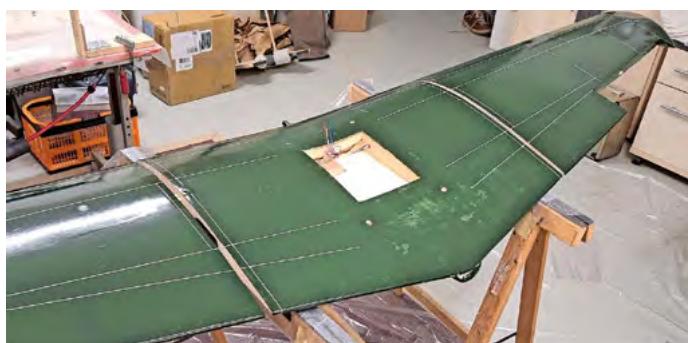
Little by little, the whole thing slowly began to look like a P-40, and I was able to cover both the wings and the fuselage with balsa wood and then cover them with 80 g fiberglass cloth. Then the whole thing looked something like this: If there’s one thing in model building that I’d really rather skip, it’s sanding and filling a fiberglass surface. But what has to be done must be done. I use Arweitex putty, which covers the fabric texture relatively well and provides an excellent base for the subsequent paint job.
I primed the entire model with synthetic resin enamel, which takes considerably longer to dry completely but forms a very durable coat of paint.
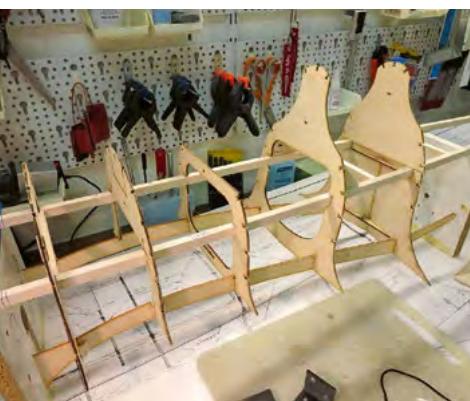
which covers the fabric texture relatively well and provides an excellent base for the subsequent paint job.
I primed the entire model with synthetic resin enamel, which takes considerably longer to dry completely but forms a very durable coat of paint.
Painting: I applied the entire coat of paint using a foam roller, which produced a result that was—at least for me—very acceptable and didn’t leave any paint mist throughout the entire hobby room. I painted and glued on the typical shark-mouth design.
I actually wanted to use a P-40 from the American Airpower Museum in New York—namely, “the Jacky C.2”—with the corresponding markings as a template. However, despite repeated attempts to contact them via email, I received no response from the Americans, so I adapted this template slightly.
The Flying Tiger and the shark mouth on the front were mandatory, as was the camouflage pattern, and instead of “Jacky C,” I used my wife’s name. As is well known, that’s supposed to bring good luck. Last but not least, I seared in a few hundred rivets with a soldering iron and applied the necessary weathering to the entire model using Vallejo water-based paint.
The P-40 is powered by a ZG 62-PCI engine, which drives a 24x10 carbon propeller.
While this isn’t scale-accurate, when paired with a stainless steel muffler from Toni Clark, it’s extremely quiet and more than sufficient in terms of in-flight performance.
Personally, I find it completely unnecessary to massively over-engineer a warbird just to race around the field at supersonic speeds with a howling propeller. In my opinion, that’s not what scale modeling is about.
Even as an “old hand” with over 30 years of model flying experience, I still felt a fair amount of nervousness during the maiden flight—though it turned out to be completely unnecessary.
With a wingspan of 238 cm and a takeoff weight of 12.5 kg, the plane flies absolutely true to the original. The key is simply to fly with a loose, spacious style and avoid frantic maneuvers.
Landing is also absolutely trouble-free, as long as you keep the throttle open all the way to the runway threshold and only then ease off the throttle.
In the end, all the work was more than worth it, and the Curtiss P-40 is a true gem in my hangar.
Finally, I’d like to thank my wife above all for her angelic patience, and Markus and Rodito Nussbaumer for the great video and photo footage.


News from HEBU

PRIDE AND GOOD IDEAS
 Markus Nussbaumer

TEAM MANAGER "THIS" BOSSHARD
 Rodito Nussbaumer

YOU KNOW WHAT I MEAN? 125 YEARS OF THE SWISS AERO CLUB
 Emil Giezendanner

F3A EUROPEAN CHAMPIONSHIPS IN ST-MACAIRE, FRANCE
 Matthias Bosshard

HORIZON HOBBY/LEMACO NEWS: MICRO OV-10 BRONCO 645 MM BY E-FLITE

ATOM, THE NEW DOUBLE-DECKER FROM CPLR
Matthias Bosshard
SUMMER FUN 2026 AT MG USTER
Martin Wunderli
52. 2026 ALPS CUP
Emil Giezendanner
TWIN TOWN PARTNERSHIP
Wolfgang Voeller
CORSAIR F4U – A WARBIRD WITH A MEMORABLE LOOK
Jürgen Rosenberger, Jürgen Prinz
SMALL, MODEL-LIKE SAILBOATS
Res Dauwalder
TRY-OUT DAY AT MFV WETTINGEN
Urs Keller
WELCOME, NEW MEMBER!
Andrea Bolliger
What's New at Leomotion.com

COUPE DES ALPES – OBSERVE AND LEARN
Rodito Nussbaumer
EURO CONTEST GLIDER ACRO TOUR AUSTRIA 2026

BY YOUTH, FOR YOUTH
Lorena Betschen
INSIGHTS INTO THE HISTORY OF SEAPLANES

34th HAHNENMOOS ALPINE MODEL AIRPLANE CAMP
Res Dauwalder
THE PC-21 STORY
Emil Giezendanner
FREE FLIGHT IN THE MIDDLE OF SUMMER
Urs Muntwyler
NEWS FROM HEBU
 Julia Bucher

FROM 0 TO 100
Markus Nussbaumer
MEMORIES
Wolfgang Völler
NOS REGION – A HUB FOR ELECTRIC AVIATION
Emil Giezendanner
DO YOU KNOW WHAT I MEAN IN THE LAND OF SMILES?
Emil Giezendanner
Have you almost forgotten about aircraft that take off and land vertically?
Emil Giezendanner