
The Jamara Pitts S-1 Special—it also comes in an electric version
With the availability of LiPo batteries, affordable brushless motors, and ESCs, electric propulsion is gradually taking over all areas of model aviation, thanks to the low weight of today's power systems and the long flight times they now make possible.
Another trend is the growing selection of ARF models, whose quality and value for money are tempting even some seasoned model builders to purchase one.
Since larger semiscale ARF models are generally designed for internal combustion engines, we wanted to know the best way to install an electric powerplant in such a model and what kind of flight performance could be achieved. Based on positive reports about the Jamara Pitts—which, with a wingspan of just under 1.4 m, is already a substantial biplane (scale approximately 1:3.5)—we decided to electrify this model.
Even unpacking the model boded well. Two sturdy corrugated cardboard boxes nested inside one another, with each model part individually wrapped in plastic film and neatly separated by corrugated cardboard dividers, showed that the model had been handled with care. When holding the individual parts in your hand, you immediately noticed how light they were.
A closer inspection confirmed the first impression. As far as could be seen, all the wood was of very good quality, precisely laser-cut, and the wood joints were neatly glued together—presumably with white glue. The same was true of the foil finish on all the decorative elements. All small parts were of good quality; only the wheels were at least three sizes too small for the included, very neatly crafted, and lightweight fiberglass wheel covers. The 4-mm aluminum landing gear is very sturdy but also quite heavy. The cleanly molded, lightweight fiberglass cowl is, unfortunately, not very scale-accurate. However, anyone unfamiliar with the Pitts in detail won’t notice this. All of this comes at the astonishing price of €199.–. I looked in vain for assembly instructions, but that didn’t worry me much, since this wasn’t the first model I’d set out to build. And since every modeler has their own preferences for certain construction techniques and detailing solutions, I wouldn’t have followed all the recommendations anyway.
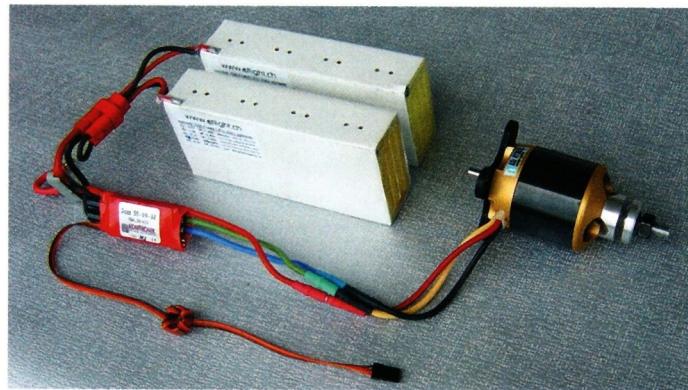
The fuselage, wings, and tail surfaces—built from wood and covered with film—weighed in at about 1.5 kg, which suggested a good model weight. With the landing gear and fiberglass parts, the weight increased to 2.2 kg. With this starting point, we turned to Urs Leodolter—a longtime electronics enthusiast and F5B world champion—to help us determine the right electric powerplant. Since Urs is among the top experts in the field of electric propulsion, we could be confident that our model would certainly not be unpowered. His suggestion was an AXI-4130/20 outrunner motor with a JAZZ-55-10-32 ESC from Kontronik and two LiPo Cool Packs 4S4P with 1200 HP cells from eflight connected in series. This results in a capacity of 4,800 mAh at approximately 30 volts. An APC 17"×8" electric propeller was to provide propulsion.
Until the propulsion components arrived, I built the model to the point where only the propulsion system needed to be installed. This involved gluing the horizontal and vertical stabilizers and the rudder hinges—made from a special film—in place using low-viscosity superglue, attaching the mounting brackets for the wing struts, which I made from 5-ply birch plywood and glued directly into the wings with epoxy, instead of using the somewhat bulky plastic fittings. I secured the canopy in three places with a bit of double-sided tape and fastened it all around with a strip of self-adhesive film.
I was able to iron out a few small wrinkles here and there on the otherwise very good film finish using an iron.
For the radio control components, I used an 8-channel receiver from Schulze, a 1100-mAh NMH battery, and five WP-150 mini servos from eflight with a torque of 2.5 kg/cm and a weight of 13.4 g. I mounted the two elevator servos and the rudder servo on a servo board offset toward the rear of the fuselage to keep the access to the tank compartment for the LiPo packs clear. The control surfaces are linked via three pushrods, which also looks quite neat. Installing visible elevator and rudder servos on the sides of the fuselage with short pushrods may be practical, but on a semiscale model, only someone with no sense of aesthetics would do it that way.
On the Jamara Pitts, the fuel compartment is made of plywood and extends through the nose bulkhead, with the motor to be mounted on the front plate. Since the AXI outrunner motor still needed to be shimmed, I built a short tube with two flanges out of 0.8-mm plywood and factored in the 2° motor rake at the same time. The 2° side rake is already determined by the model’s angled front panel, but the motor pitch is not. After aligning the propeller shaft with the center of the cutout in the cowl, I secured the motor with four through-bolts (M3) and drive-in nuts.
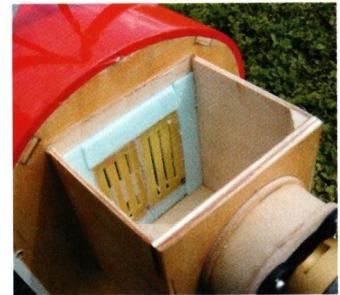
Now all that remained was to stow the two LiPo packs so that the center of gravity was correct. I found the specifications for the center of gravity in an article in the magazine “Modell.” To install the batteries, I removed the front upper cover of the fuel compartment to allow for better access. When I placed the batteries in the fuel compartment with their front edges flush with the head frame, the center of gravity was pretty much spot on. I then cut three Roofmate panels, about 15 mm thick, to line the sides and top of the fuel compartment. The batteries now fit snugly between the panels, and sliding them in required a bit of force. Next, the batteries had to be pushed all the way to the top so that another Roofmate panel could be used to wedge them in from below. This secured the two LiPo packs firmly in place. The lower Roofmate panel can be pulled out again using a sturdy adhesive tape tab to tilt the batteries downward and remove them. Since LiPo batteries should not be damaged—otherwise they could catch fire—I cut a block out of hard Styrofoam to fill the front part of the tank compartment and serve as a crumple zone. A continuous cutout allows cooling air to flow through the battery packs.
After the ESC had also been installed and the remote control programmed, we wanted to get a first impression of the powertrain. A brief jolt, and the propeller spun leisurely at minimum power. As soon as we pushed the control stick forward, the leisurely rotation turned into a wild roar accompanied by a propeller noise familiar from larger models. At the same time, thrust developed that must have exceeded the model’s own weight.
Now we wanted to know the exact figures: weight with charged batteries 4 kg, of which 1.44 kg was for the motor, batteries, and ESC, and a static thrust of 4.2 kg at 38 A. This meant high-speed model aerobatics were in order, and if flown with some restraint, flight times of up to 15 minutes should be possible with a 4.8 Ah battery capacity.
Based on these findings, it was Urs Leodolter’s turn again to make the maiden flight. After all, he is a very experienced pilot, and the short Pitts wasn’t necessarily without its quirks. The maiden flight took place on Saturday at our airfield; it was quite windy and partly cloudy.
After a dead-straight takeoff run of just under 5 m across the grass, the Pitts was airborne, climbing at a shallow angle to the end of the runway and then vertically until it couldn’t go any higher. Back at a good visual altitude, Urs trimmed the aircraft and flew it through all kinds of maneuvers with power and plenty of performance reserves; he was even able to maintain altitude in a stall. With the engine shut off and a correspondingly high rate of descent, the aircraft landed as smooth as butter. After all, the electric Pitts isn’t any heavier than one with a 15-cm³ internal combustion engine.
Urs's comment: It flies flawlessly, but you have to keep it under control at all times; a little more side drag and a wider range of movement on the ailerons wouldn't hurt, but you might want to reduce the aileron travel slightly or increase the exponential function.
Conclusion: Installing the electric powerplant in the Pitts was absolutely hassle-free. The center of gravity could be maintained without any special precautions. The weight is roughly the same as the combustion engine version. Thanks to the absence of vibrations and oil residue from the combustion engine, the model is under less strain and should last longer. The downside is that you have to dig a little deeper into your pocket, and you miss out on the beautiful four-stroke sound.
Pierre Bartholdi
MG Wehntal

EURO CONTEST GLIDER ACRO TOUR AUSTRIA 2026

THE PC-21 STORY
 Emil Giezendanner

TWIN TOWN PARTNERSHIP
 Wolfgang Voeller

SUMMER FUN 2026 AT MG USTER
Martin Wunderli
CORSAIR F4U – A WARBIRD WITH A MEMORABLE LOOK
Jürgen Rosenberger, Jürgen Prinz
52. 2026 ALPS CUP
Emil Giezendanner
YOU KNOW WHAT I MEAN? 125 YEARS OF THE SWISS AERO CLUB
Emil Giezendanner
News from HEBU

TEAM MANAGER "THIS" BOSSHARD
Rodito Nussbaumer
ATOM, THE NEW DOUBLE-DECKER FROM CPLR
 Matthias Bosshard

F3A EUROPEAN CHAMPIONSHIPS IN ST-MACAIRE, FRANCE
Matthias Bosshard
INSIGHTS INTO THE HISTORY OF SEAPLANES

WELCOME, NEW MEMBER!
Andrea Bolliger
What's New at Leomotion.com

PRIDE AND GOOD IDEAS
 Markus Nussbaumer

SMALL, MODEL-LIKE SAILBOATS
Res Dauwalder
FREE FLIGHT IN THE MIDDLE OF SUMMER
Urs Muntwyler
BY YOUTH, FOR YOUTH
Lorena Betschen
HORIZON HOBBY/LEMACO NEWS: MICRO OV-10 BRONCO 645 MM BY E-FLITE

COUPE DES ALPES – OBSERVE AND LEARN
Rodito Nussbaumer
34th HAHNENMOOS ALPINE MODEL AIRPLANE CAMP
Res Dauwalder
TRY-OUT DAY AT MFV WETTINGEN
 Urs Keller

NEWS FROM HEBU
 Julia Bucher

NOS REGION – A HUB FOR ELECTRIC AVIATION
Emil Giezendanner
MEMORIES
 Wolfgang Völler

70 YEARS OF THE NIDWALDEN MODEL AIRPLANE CLUB
Martin Barmettler
A SPECTACULAR F3A WORLD CUP IN THE PRINCIPALITY OF LIECHTENSTEIN
Emil Giezendanner
FROM 0 TO 100
Markus Nussbaumer