
Adventure World Championship
Participating in the World Model Aircraft Championships is always an adventure for teams from all countries—especially when the organizer lacks experience. Participants then face numerous surprises and problems, and how they handle these challenges can ultimately determine success or failure.
We were lucky with the hotel. Our rooms had a working shower, and we could bring our helmets into the room. However, we looked in vain for a chair. CIAM Chairman Horace Hagen had no way to bring his suitcase into Room 1. Room 2 had a shower you couldn’t stand in. Room 3, on the other hand, had a shower you could stand in, and there was room for the suitcase, too. After a visit to a hardware store, he was able to get the necessary gaskets and cable ties to get the shower working again. Once back at the hotel, unfortunately, no one had any idea where the airfield was. They didn’t speak any foreign languages either, but they were always eager to ensure the guests’ comfort. The moldy bread at breakfast, however, didn’t exactly put anyone in a good mood. The tour operator had charged for 3-star hotels but had put the guests up in 2-star hotels.
After a bit of searching, we finally found the official competition grounds via bumpy sandy trails. We were able to practice here until the official practice session began.
At the start, the two flight lines were laid out in such a way that the models’ flight paths crossed!! Only reluctantly—and after constant intervention by Horace Hagen—were the runways repositioned so that flights could take place in parallel. However, this relocation had two consequences: First, from the spectator area, flight operations could only be observed perpendicular to the flight axis—which, given the 95-euro admission fee per person, naturally dampened the mood right from the start. Even Horace Jury was unable to properly observe the flight operations. The organizing committee president, who was also a member of the jury, was likely familiar at most with the term “F3C,” but certainly not with the rules. In any case, this dual role is a poor fit. It was only thanks to Horace’s efforts that the World Championship could take place at all. He had the misfortune of being the only jury member with the necessary expertise. Due to the sandy and uneven ground, the training areas caused a rush on local carpet stores and garden centers. In most cases, an off-field landing resulted in damage to the helicopter.
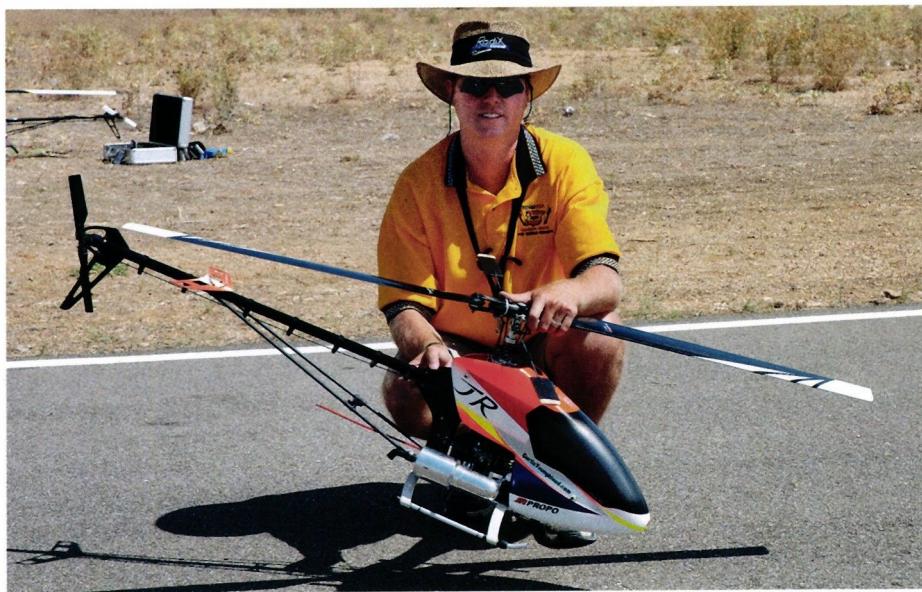
Unfortunately, the two runs couldn't be used at the same time because of the sun. One run was open from 8:00 a.m. to about 3:00 p.m., and the other from 12:00 p.m. to 8:00 p.m. Anyone who drew a bad number got at most one run without wind, and those who were lucky got three. The scoring process was very slow, and paper was in short supply. There was barely enough for one start list and one standings sheet per team. At the start, the Japanese team—featuring world champion Hashimoto, Curtis Youngblood, and Rüdiger Feil—was certainly considered the favorite. Everyone was also eagerly anticipating the performances of Scott Gray and Wayne Mann. A battle between Japan and the U.S. was expected in the team competition.
Without Johann Höhnle, the German team was hardly in a position to make it onto the podium. In the preliminary round, Scott Gray and Manabu Hashimoto each scored a 1,000-point flight. The 15-year-old Japanese pilot Hiroki Itou managed to score two 1,000-point flights. In one run, he chose the wrong flight direction and had to complete the routine with the wind blowing in the wrong direction. In addition to his strong F3C results, he had already become the Japanese 3D champion in 2002 at the age of 12! He was able to put this experience to good use in his flight maneuvers. Naturally, he received only a few points for the gliding maneuvers—as was fair—but he saw it through. Other top pilots also received zero scores for incorrectly flown maneuvers. In total, there were 16 spots in the finals. The Swiss pilots were ultimately able to secure two spots on the final day. There were many contenders for these spots. Ennio Graber and Patrick Kessler were the two lucky ones. Hans Emmenegger was the only participant flying an electric model to achieve a respectable 30th place. Due to a rainy day, the finals followed immediately after the preliminary round, leaving little time for preparation. According to the current rules, the starting order is redrawn for each final round. An early starting number always resulted in fewer points. Rüdiger Feil had the misfortune of consistently starting early. After the first heat, it became clear that the reigning world champion would likely be unable to defend his title. Ito Kobayashi and Gray appeared to be the title contenders. Hashimoto even switched the brand of his equipment during the rounds—a move that would be unthinkable for many. But that helped just as little as replacing all the bearings in the rotor head after every round. He had by far the largest support crew with him and hardly had to lift a finger himself.
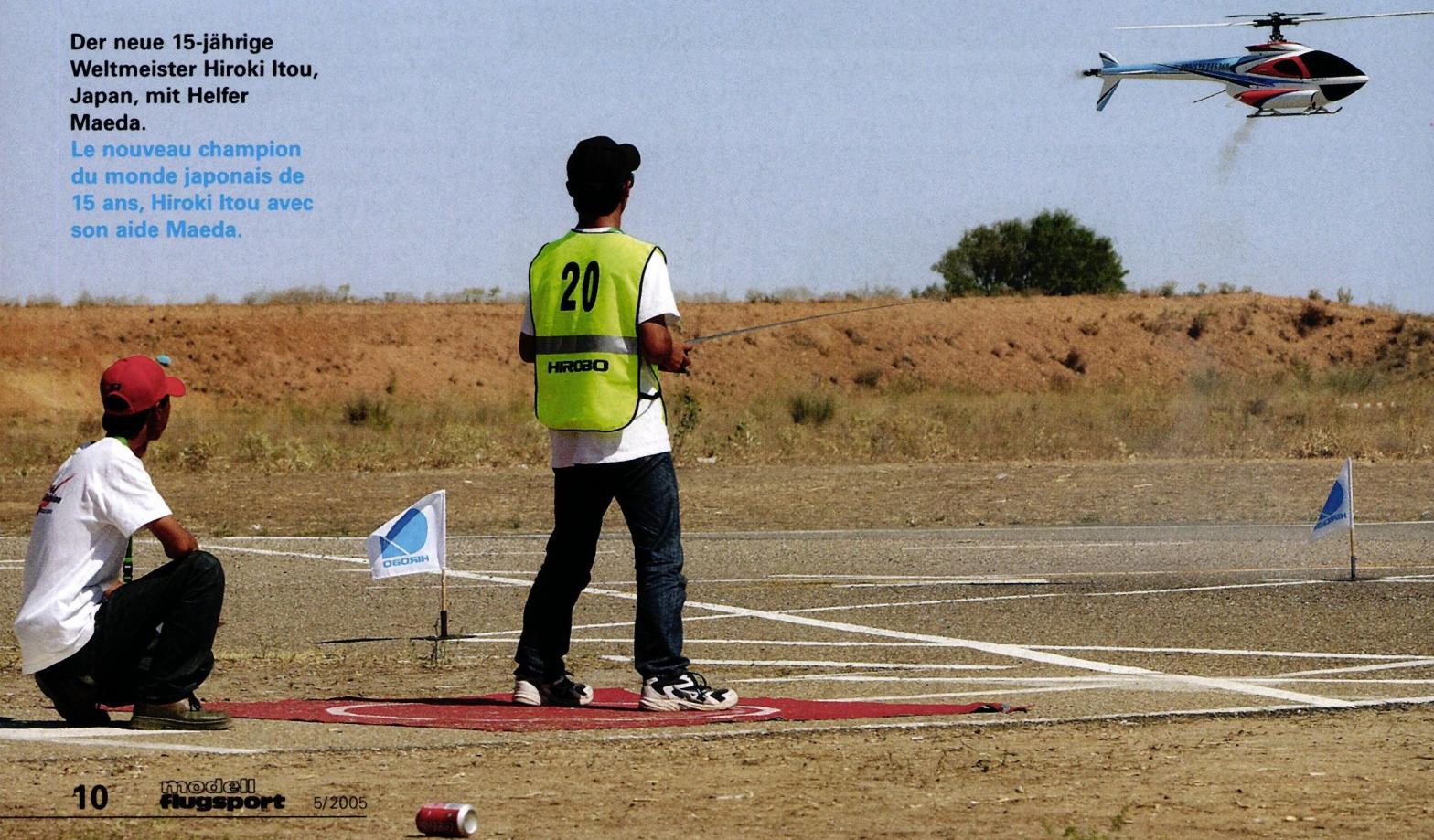
The new world champion, Hiroki Itou, had to fill up the tank, carry the car, and start it himself.
He had traveled with his mother, who was looking after him.
The top three were able to pull away from the rest of the field. Fourth and fifth place, however, were separated by just 0.3 points. Three-time world champion Hashimoto managed to beat two-time world champion Youngblood. For Japanese team manager Abe Shin, now well over 70 years old, this result was a dream come true. He had every world champion on his team. Since the new world champion was also the youngest participant, there was no need for a youth category. Our hobby is certainly one of the few with a age range spanning from 15 to 65 at a World Championship. Ennio Graber and Patrick Kessler were once again able to move up in the final. Ennio finished 10th and Patrick moved up to 13th place. They have thus joined the world’s elite.
On the technical side, there wasn’t much new to report. Only Hans used an electric model. Interest in electric powertrains was still limited. This was likely due to the new, quiet, and smooth-running OS-91 SZ engines. OS has created a more than competitive powertrain here. Final tests and modifications are underway, and the engine is scheduled to hit the market in December. The world champion even demonstrated that it works with 15% nitro. In Japan, the oil content is limited to 18% and the nitro content to 15%, and that works splendidly. Unfortunately, the CIAM has not yet been able to agree on such a rule. Full-fuselage models are in demand. Youngblood struggled with his more compact trainer flying style. Among the top 10, only Youngblood (5) and Graber (10) flew a trainer model. The smooth overall impression and quiet sound of the full-fuselage models are in demand. Canadian Scott Gray had also successfully switched to the Japanese style. However, his flying wasn’t quite as smooth yet. The Japanese still use very slightly semi-symmetrical blades weighing about 200 g. Hashimoto and Feil even use 240 g blades. They fly at head speeds well over 2,000. To everyone’s surprise, most of the top pilots used Zimmerman dampers. In Japan, it’s called the Tornado. Curtis Youngblood has developed new symmetrical blades for 3D and FAI. It will certainly be interesting to compare these with the Japanese products. SAB even gave each of the 78 pilots a set of the latest FAI blades as a gift! For more information, visit: www.wc2005-f3c.helcom.es/
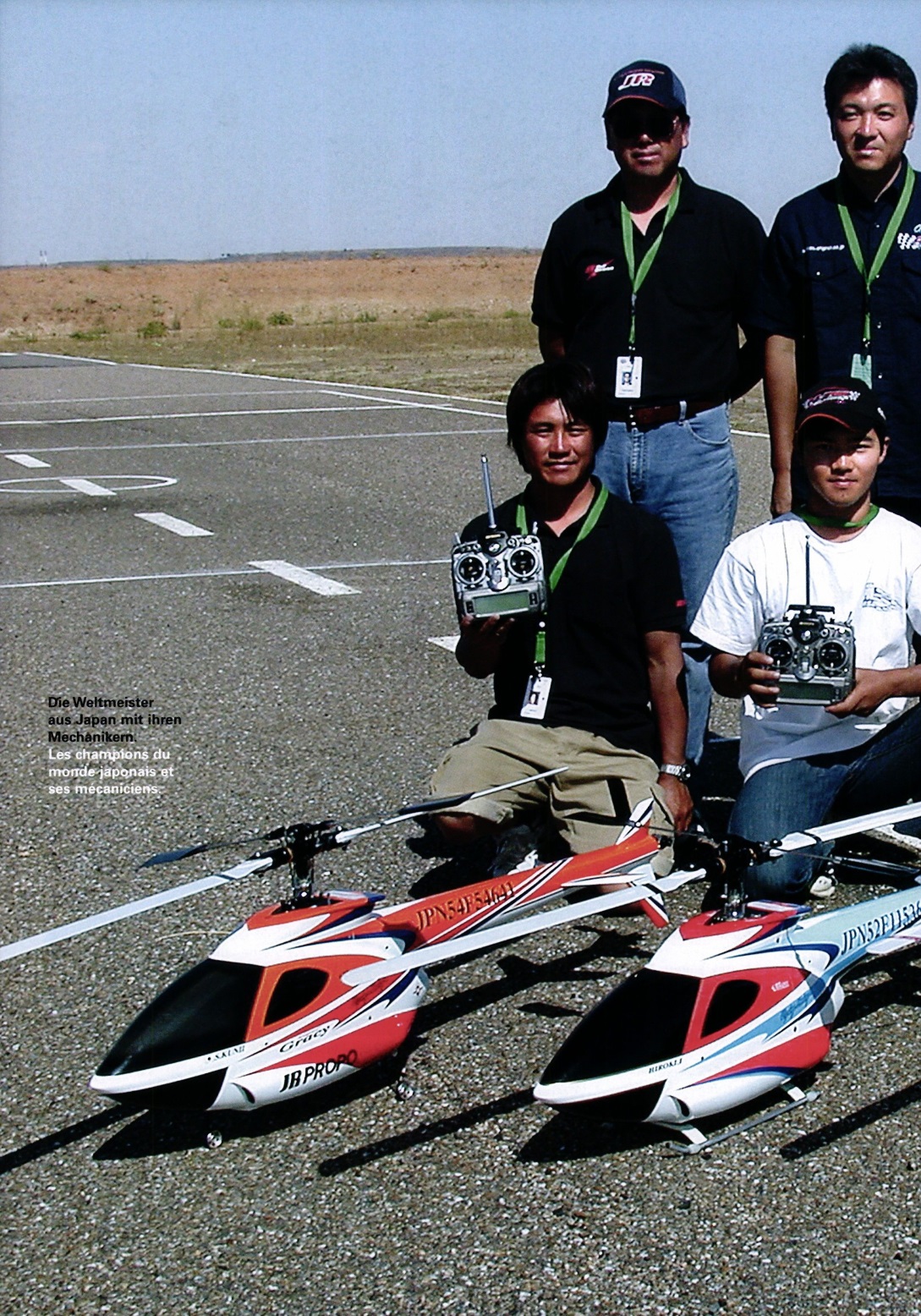
| 1. Japan (Itou, Kobayashi, and Kunii) |
| 2. United States (Youngblood, Mann, Sabato) |
| 3. Italy (Livi, Livi, and Lucchi) |
| 6. Switzerland (Graber, Kessler, and Emmenegger) |
| 1. Hiroki Itou | JP | JR Sylphide 90 | OS 91SZ | JR PCM 10X |
| 2. Scott Gray | CN | JR Sylphide 90 | OS 91SZ | JR PCM 10X |
| 3. Minoru Kobayashi | JP | JR Sylphide 90 | OS 91SZ | JR PCM 10X |
| 4. Manabu Hashimoto | JP | Hirobo Eagle WC | YS91ST4 | Futaba T14MZ / Sanwa |
| 5. Curtis Youngblood | USA | JR Vibe 90 | OS 91 PS | JR PCM 10X |
| 6. Shinya Kunii | JP | JR Sylphide 90 | OS 91SZ | JR PCM 10X |
| 10. Ennio Graber | SUI | Hirobo Eagle WC | YS91 | Futaba 9Z WC II |
| 13. Patrick Kessler | SUI | JR Sylphide 90 | YS91 | Futaba T14MZ |
| 30. Hans Emmenegger | SUI | Bucher Spirit | Actro 32 | Robbe FC 28 V3 |
*Photos: Urs Herzog*

EURO CONTEST GLIDER ACRO TOUR AUSTRIA 2026

THE PC-21 STORY
 Emil Giezendanner

TWIN TOWN PARTNERSHIP
 Wolfgang Voeller

SUMMER FUN 2026 AT MG USTER
Martin Wunderli
CORSAIR F4U – A WARBIRD WITH A MEMORABLE LOOK
Jürgen Rosenberger, Jürgen Prinz
52. 2026 ALPS CUP
Emil Giezendanner
YOU KNOW WHAT I MEAN? 125 YEARS OF THE SWISS AERO CLUB
Emil Giezendanner
News from HEBU

TEAM MANAGER "THIS" BOSSHARD
Rodito Nussbaumer
ATOM, THE NEW DOUBLE-DECKER FROM CPLR
 Matthias Bosshard

F3A EUROPEAN CHAMPIONSHIPS IN ST-MACAIRE, FRANCE
Matthias Bosshard
INSIGHTS INTO THE HISTORY OF SEAPLANES

WELCOME, NEW MEMBER!
Andrea Bolliger
What's New at Leomotion.com

PRIDE AND GOOD IDEAS
 Markus Nussbaumer

SMALL, MODEL-LIKE SAILBOATS
Res Dauwalder
FREE FLIGHT IN THE MIDDLE OF SUMMER
Urs Muntwyler
BY YOUTH, FOR YOUTH
Lorena Betschen
34th HAHNENMOOS ALPINE MODEL AIRPLANE CAMP
Res Dauwalder
HORIZON HOBBY/LEMACO NEWS: MICRO OV-10 BRONCO 645 MM BY E-FLITE

COUPE DES ALPES – OBSERVE AND LEARN
Rodito Nussbaumer
TRY-OUT DAY AT MFV WETTINGEN
 Urs Keller

NEWS FROM HEBU
 Julia Bucher

NOS REGION – A HUB FOR ELECTRIC AVIATION
Emil Giezendanner
MEMORIES
 Wolfgang Völler

70 YEARS OF THE NIDWALDEN MODEL AIRPLANE CLUB
Martin Barmettler
A SPECTACULAR F3A WORLD CUP IN THE PRINCIPALITY OF LIECHTENSTEIN
Emil Giezendanner
FROM 0 TO 100
Markus Nussbaumer