
Variometers Are Becoming Increasingly Popular as Thermal Detectors
This article is intended neither as a disguised advertisement for specific products nor as a detailed review. The four systems presented here were developed either in Switzerland or in neighboring southern Germany and are primarily sold directly through online stores from those locations. The author regularly uses two of the four products himself and is therefore familiar with how they work.
In the 1920s, the existence of thermals as a source of lift in manned gliding was discovered in Germany. At the same time, researchers succeeded in developing an instrument to measure the rate of descent or climb. In 1928, at the Wasserkuppe, gliding was completely revolutionized thanks to these new findings, and the previous altitude record was more than doubled. This was soon followed by cross-country flights over very long distances. The reason for this was the availability of the new instrument, the variometer, which reliably indicated areas with updrafts or thermals to the pilot, thereby making it possible to locate updraft zones with confidence.
In model aviation, the variometer didn’t become widespread until about 20 years ago, when electronics were miniaturized. Energy-efficient microcontrollers, high-precision pressure sensors, and very small transmitter modules made it possible to transmit the variometer signal—an additional requirement—to the pilot controlling the model.
The integration of telemetry into RC systems led to an even wider adoption of variometers. This was because a complete two-way radio link with data transmission at the transmitter was suddenly available, requiring only a suitable sensor in the model aircraft. Alongside these high-performance products, numerous low-cost solutions also emerged. With their limited functionality, these are mainly suitable for determining flight altitude and provide only rough readings, which make it nearly impossible to precisely center oneself within a thermal.
The following information applies exclusively to modern systems that represent the current state of the art.
Actually, the pressure sensor only measures the barometric change in air pressure inside or on the aircraft. This is used to determine the rate of climb or descent, as well as the altitude above ground. It doesn’t matter at all whether the lift is generated on a slope or in a thermal. The resolution of the measurements is in the range of a few centimeters, making them extremely precise. At takeoff, the altitude is typically “reset to zero,” and the altitude reading is relative to the takeoff location. In the event of significant changes in air pressure during a longer flight (e.g., in the run-up to a thunderstorm), the altitude reading may be slightly distorted as a result. Thus, a reported landing altitude of –4 m is by no means a total loss—it simply requires a bit of mental calculation on the pilot’s part. High-end vario instruments even feature two pressure sensors. The sensor connected to the measuring probe measures the rate of climb or descent, while the second sensor is used exclusively to determine flight altitude. This makes the altitude measurement less dependent on airspeed (which is advantageous when using a TEK probe).
A great rate of climb can also be caused by what is known as a “stick thermal.” The aircraft has “stored up” a lot of potential energy through a rapid descent and is now put into a steep climb by pulling back on the elevator stick. In this case, the climb rate now being recorded is not caused by an updraft, which the pressure sensor cannot detect and therefore only indicates the physical climb rate. Total energy compensation (TEC) is used to counteract this effect, so that only the rate caused by the updraft or downdraft is transmitted to the pilot. Specially designed TEC probes are used for this purpose; due to their size and weight, they are primarily installed on larger gliders.
Some autonomous systems transmit the Varioton via radio on the 70-cm band to a simple radio receiver and from there to the pilot’s “earpiece.” This maintains visual contact with the model, and at higher altitudes, it prevents loss of sight caused by checking readings on the transmitter’s display. Modern systems provide additional voice prompts. These can be activated selectively using an additional switch on the transmitter. Additional alarm thresholds immediately signal dangerous conditions in the model aircraft, such as the receiver voltage falling below a certain level. Other data, such as remaining battery power, flight time, total altitude climbed, and much more, can also be transmitted.
Using a GPS sensor, the aircraft’s coordinates can be continuously determined and recorded in three-dimensional space. This data can also be used to trigger alerts if altitude or distance limits are exceeded. In the event of an unplanned off-airport landing, the last transmitted coordinates of the aircraft’s location are very useful. This is especially true when this information is also stored in the transmitter (which is typically the case with variometers integrated into the telemetry system). The data can then be entered into an existing portable vehicle navigation system, enabling a targeted search for the missing model.
As with piloted flight, the model’s flight data is very useful for determining the cause of a landing involving structural damage. Modern telemetry systems or variometers record these values at short intervals onto a small memory card (micro-SD format), from which they can later be conveniently transferred to a PC for analysis. The capacity of such a card is several gigabytes, so it can often store well over a thousand flight hours.
*Hermann Mettler*
At the NOS Symposium on December 14, 2013, at Technorama Winterthur, the topic of variometers will be explored in depth in a presentation.
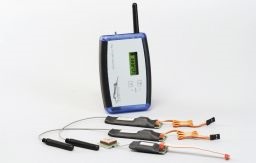
Ground-based base station (rear), flight modules, and optional GPS module with GPS sensor (front). Brief description: Autonomous digital 2.4 GHz system; options: GPS module, Bluetooth module in the ground station for data transmission to Sky-navigator and to a wireless earpiece.
Note: Swiss product, suitable for narrow fuselages, modularly expandable.
Sold through our own online store: www.flightgadgets.ch
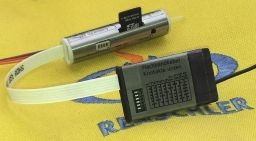
Small, rugged housing with an inserted SD card and an external 433-MHz transmitter module. Brief description:
Small, rugged, and space-saving system; can be operated autonomously (with a 433 MHz module) or as part of a larger system (currently with Robbe/Futaba); SD card; options: two pressure sensors, TEK probe. Note: Configuration via USB connection to a PC is possible; lightweight and very rugged; developed and serviced by Renschler Instruments Stuttgart.
Available through our own online store: www.thommys.com
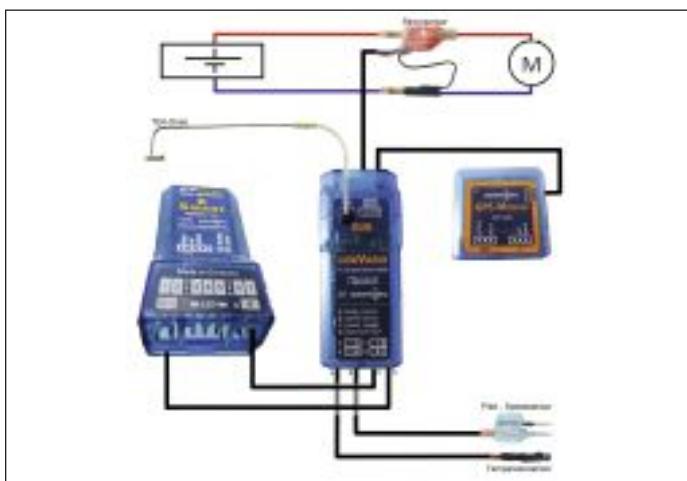
LinkVario with receiver, GPS sensor, Pitot speed sensor, and temperature sensor, plus current and voltage sensors and a TEK nozzle. Brief description:
Integrated into the Weatronic RC system; space-saving, lightweight, and low power consumption. Options: Two pressure sensors, TEK probe, GPS module, external current and voltage sensors, Pitot speed sensor, and temperature sensor; Bluetooth interface to Sky-navigator and wireless earpiece
Note: Priced toward the higher end, uncompromising integration with telemetry, very long return channel range, very comprehensive data logging on the transmitter’s SD card, requires the Weatronic system, variometer developed by WSTech.
Available through the company’s own online store and specialty retailers: www.weatronic.com.
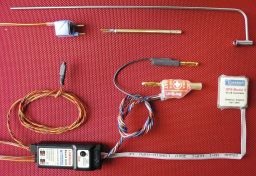
LinkVario by WSTech with a GPS sensor, Pitot speed sensor, and temperature sensor, plus a current and voltage sensor and a TEK nozzle. Brief description:
CS DataVario with autonomous 433 MHz radio transmission; LinkVario with integration into Jeti; Graupner HOTT and Multiplex; M-Link for Multiplex and ACT; Options: Two pressure sensors, TEK probe, GPS module; external current and voltage sensors, Pitot speed sensor, temperature sensor
Note: Currently a technological leader, good value for money, development, sales, and support all under one roof; LinkVario units can be converted to other systems for a fee; wide range of functions; CS DataVario with very clear audio for purists; complete documentation and, for those interested in details, very extensive additional information on the website.
Sold through the company’s own online store: http://www.wstech.de
Photos: Manufacturer of the respective product


News from HEBU

HORIZON HOBBY/LEMACO NEWS: MICRO OV-10 BRONCO 645 MM BY E-FLITE

PRIDE AND GOOD IDEAS
 Markus Nussbaumer

TEAM MANAGER "THIS" BOSSHARD
 Rodito Nussbaumer

YOU KNOW WHAT I MEAN? 125 YEARS OF THE SWISS AERO CLUB
 Emil Giezendanner

F3A EUROPEAN CHAMPIONSHIPS IN ST-MACAIRE, FRANCE
 Matthias Bosshard

ATOM, THE NEW DOUBLE-DECKER FROM CPLR
Matthias Bosshard
SUMMER FUN 2026 AT MG USTER
Martin Wunderli
What's New at Leomotion.com

52. 2026 ALPS CUP
Emil Giezendanner
TWIN TOWN PARTNERSHIP
Wolfgang Voeller
CORSAIR F4U – A WARBIRD WITH A MEMORABLE LOOK
Jürgen Rosenberger, Jürgen Prinz
SMALL, MODEL-LIKE SAILBOATS
Res Dauwalder
TRY-OUT DAY AT MFV WETTINGEN
Urs Keller
WELCOME, NEW MEMBER!
Andrea Bolliger
COUPE DES ALPES – OBSERVE AND LEARN
Rodito Nussbaumer
EURO CONTEST GLIDER ACRO TOUR AUSTRIA 2026

BY YOUTH, FOR YOUTH
Lorena Betschen
INSIGHTS INTO THE HISTORY OF SEAPLANES

34th HAHNENMOOS ALPINE MODEL AIRPLANE CAMP
Res Dauwalder
THE PC-21 STORY
Emil Giezendanner
FREE FLIGHT IN THE MIDDLE OF SUMMER
Urs Muntwyler
NEWS FROM HEBU
 Julia Bucher

FROM 0 TO 100
Markus Nussbaumer
MEMORIES
Wolfgang Völler
NOS REGION – A HUB FOR ELECTRIC AVIATION
Emil Giezendanner
DO YOU KNOW WHAT I MEAN IN THE LAND OF SMILES?
Emil Giezendanner
Have you almost forgotten about aircraft that take off and land vertically?
Emil Giezendanner