
Bumpy Flight
The tooth-shaped fins of whales could inspire a new design for airplane wings.
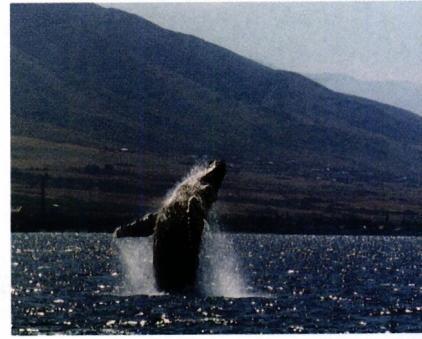
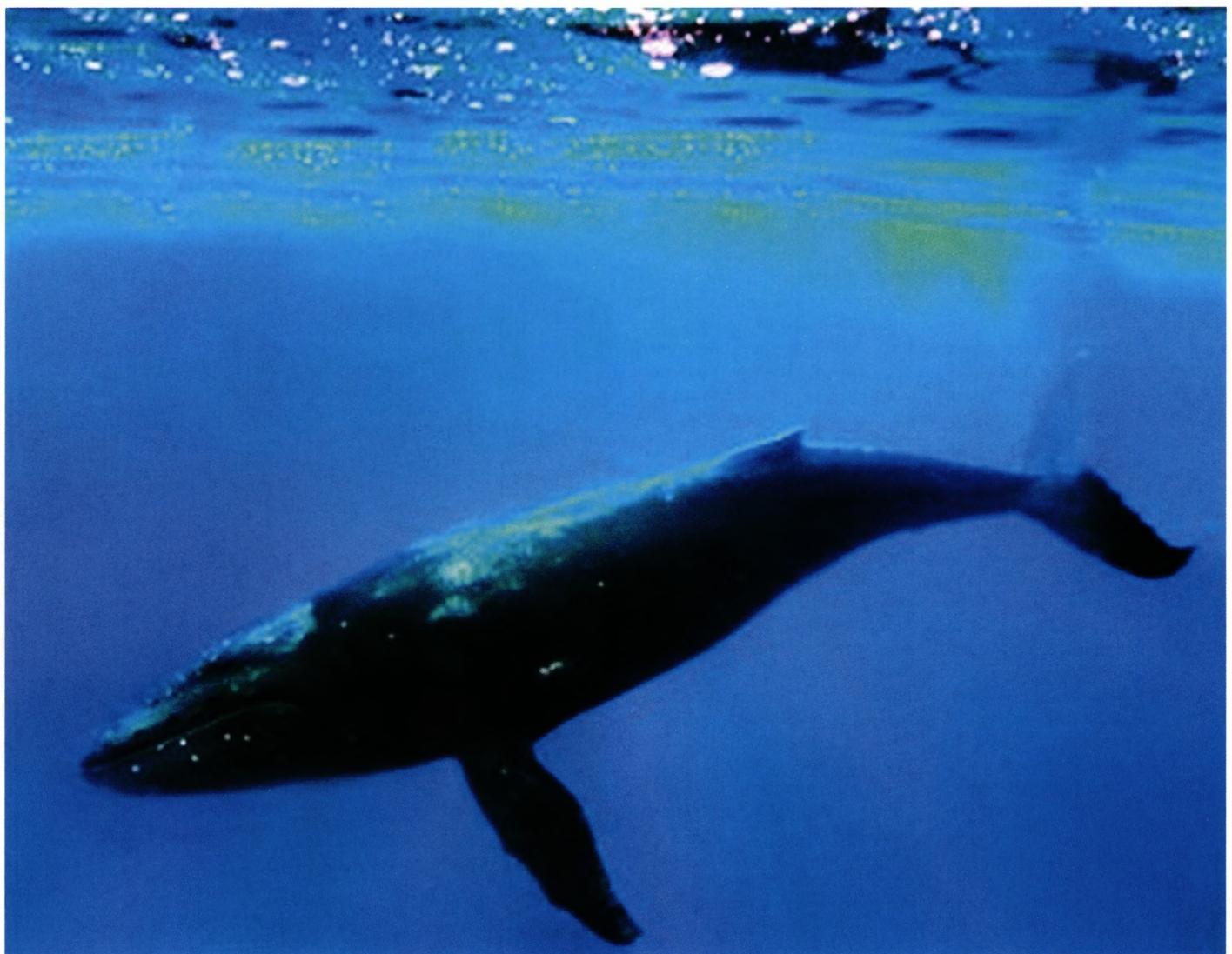
One day in the early 1980s, Frank E. Fish noticed a small sculpture of a humpback whale in a sculpture gallery in Boston. Upon closer inspection, he noticed that the animal’s large, wing-like pectoral fins were studded with bumps at regular intervals along their leading edges. Fish was completely astonished. As an expert in the hydrodynamics of swimming vertebrates, he knew of no whale fins, fish fins, or bird wings that looked so strange—all of these have smooth leading edges. He mentioned this to his wife and suspected that the artist must have made a mistake. The gallery owner, who had overheard Fish’s comments and knew of the sculptor’s meticulous attention to detail, quickly produced a photograph that clearly showed the humped fins of the humpback whale. Fish made a note of these unusual humps for future research. After repeatedly interrupted investigations over the next two decades—one such instance involved sawing off three-meter-long fins from a decaying, beached humpback whale —the biology professor at West Chester University of Pennsylvania and several colleagues recently demonstrated that the whale’s humped lateral appendages, in a sense, surpass the more conventionally smooth versions found in both humans and nature.
In collaboration with Laurens E. Howle, a fluid mechanics engineer at Duke University, David S. Miklosovic and Mark M. Murray of the U.S. Naval Academy, Fish constructed two 56-centimeter-long plastic replicas of humpback whale pectoral fins—one with the characteristic bumps, one without. In tests conducted in the Naval Academy’s wind tunnel, the model of the smooth fin behaved similarly to a standard airplane wing. The replica of the humped fin, on the other hand, demonstrated significantly better aerodynamic performance. As the researchers reported in the May issue of *Physics in Fluids*, whale fins with humped leading edges generate 8 percent more lift and up to 32 percent less drag than comparably designed smooth fins. Furthermore,
Nodular leading edges increase the hydrodynamic efficiency of humpback whales' pectoral fins, allowing the whale to move nimbly while pursuing prey.
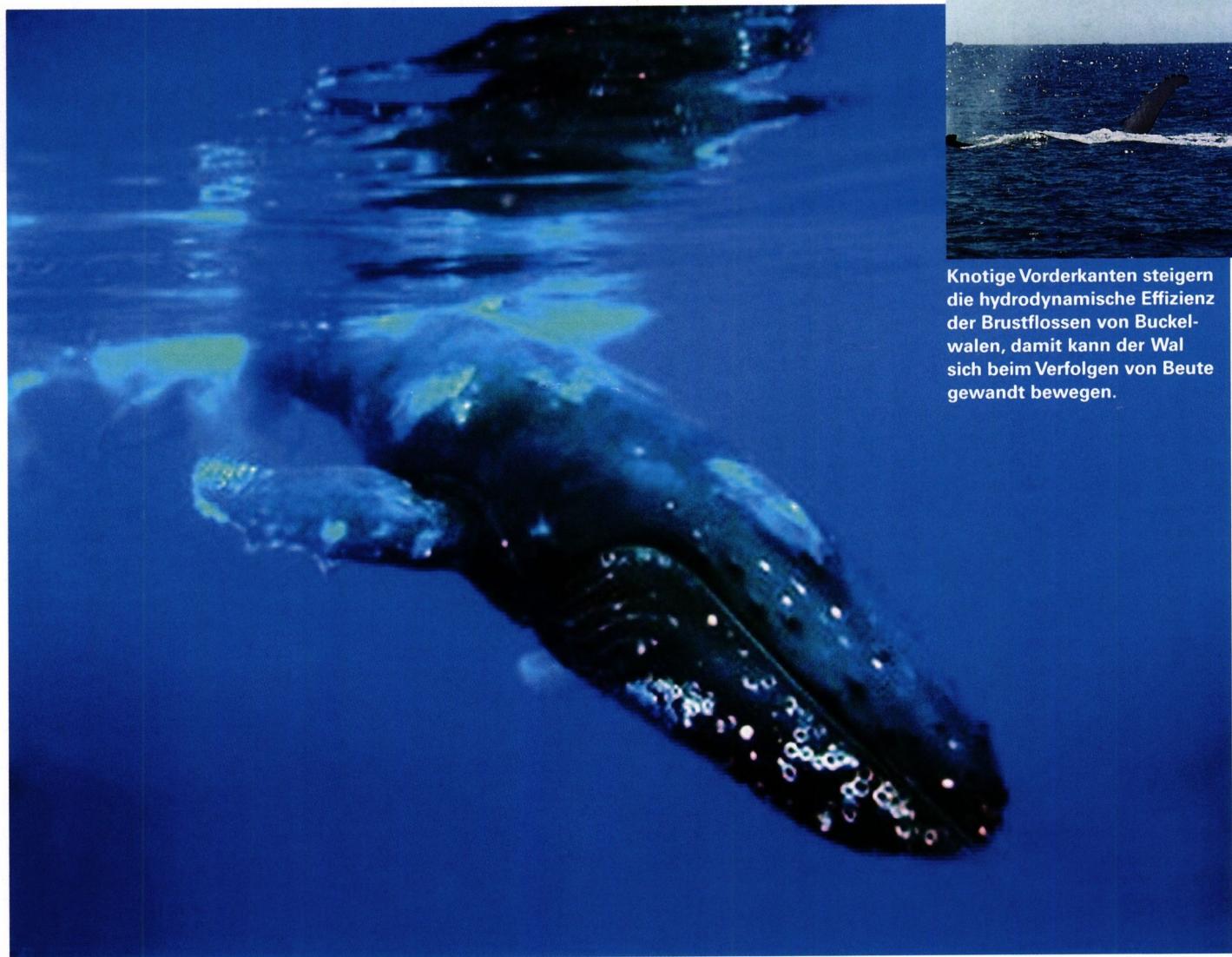
The humpback whale’s large, serrated pectoral fins prevent stall at angles of attack 40 percent steeper than those of their seemingly more streamlined counterparts. “These structures contradict our understanding of fluid dynamics so much that no one has studied them until now,” says Fish.
The main reason for the improved performance is the pairs of counter-rotating vortices generated on both sides of the leading edge of the hump, known as tubercles or knots. “The tubercles act as vortex generators,” explains Howle. “The vortices inject momentum into the fluid flow, causing the flow to be drawn over the top surface rather than separating, as would otherwise be the case. This effect delays stall at higher angles of attack.” As a result, the Leviathan can swim tighter turns and move more nimbly—a useful ability when hunting fast-moving schools of herring or sardines.
Fish, who has patented the concept of tuberculate wings, says that tests with a more accurate fin model and functional optimization of the tubercule geometry are in the works, which could lead to better man-made wings. Improved resistance to stall could increase flight safety and make aircraft more maneuverable. “This discovery opens up potential applications not only for aircraft wings but also for aircraft propellers, helicopter rotors, and ship rudders,” notes Howle. He speculates that the next America’s Cup winner could turn even more sharply with a tuberculate rudder.
*From Scientific American*
Laurens E. Howle,
Duke University
Translation: E. Wagner
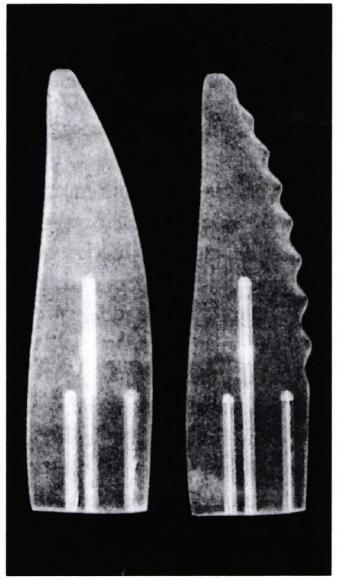
Replicas of pectoral fins, with and without bumps, which were tested side by side in a wind tunnel.

EURO CONTEST GLIDER ACRO TOUR AUSTRIA 2026

THE PC-21 STORY
 Emil Giezendanner

TWIN TOWN PARTNERSHIP
 Wolfgang Voeller

SUMMER FUN 2026 AT MG USTER
Martin Wunderli
CORSAIR F4U – A WARBIRD WITH A MEMORABLE LOOK
Jürgen Rosenberger, Jürgen Prinz
52. 2026 ALPS CUP
Emil Giezendanner
YOU KNOW WHAT I MEAN? 125 YEARS OF THE SWISS AERO CLUB
Emil Giezendanner
News from HEBU

TEAM MANAGER "THIS" BOSSHARD
Rodito Nussbaumer
ATOM, THE NEW DOUBLE-DECKER FROM CPLR
 Matthias Bosshard

F3A EUROPEAN CHAMPIONSHIPS IN ST-MACAIRE, FRANCE
Matthias Bosshard
INSIGHTS INTO THE HISTORY OF SEAPLANES

WELCOME, NEW MEMBER!
Andrea Bolliger
What's New at Leomotion.com

PRIDE AND GOOD IDEAS
 Markus Nussbaumer

SMALL, MODEL-LIKE SAILBOATS
Res Dauwalder
FREE FLIGHT IN THE MIDDLE OF SUMMER
Urs Muntwyler
BY YOUTH, FOR YOUTH
Lorena Betschen
34th HAHNENMOOS ALPINE MODEL AIRPLANE CAMP
Res Dauwalder
HORIZON HOBBY/LEMACO NEWS: MICRO OV-10 BRONCO 645 MM BY E-FLITE

COUPE DES ALPES – OBSERVE AND LEARN
Rodito Nussbaumer
TRY-OUT DAY AT MFV WETTINGEN
 Urs Keller

NEWS FROM HEBU
 Julia Bucher

NOS REGION – A HUB FOR ELECTRIC AVIATION
Emil Giezendanner
MEMORIES
 Wolfgang Völler

70 YEARS OF THE NIDWALDEN MODEL AIRPLANE CLUB
Martin Barmettler
A SPECTACULAR F3A WORLD CUP IN THE PRINCIPALITY OF LIECHTENSTEIN
Emil Giezendanner
FROM 0 TO 100
Markus Nussbaumer