
PILOTS HAVE A FUTURE
The Swiss Air Force, the aviation magazine COCKPIT (published since 1959), the Pro Aero Foundation (founded in 1938), and the Aero-Club of Switzerland (AeCS) are jointly launching a campaign
to support young people interested in aviation. A large-scale competition is designed to draw young people’s attention to the exciting career opportunities in aviation.
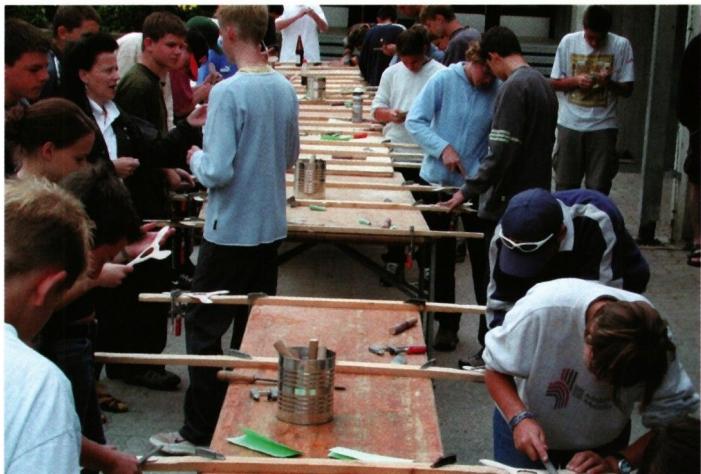
At Pro Aero’s annual youth camp in S-chanf, 14- to 16-year-olds are introduced to the basics of aerodynamics. (Fredy Frutig)
By Hansjörg Bürgi
Take off—fly—let your gaze wander into the distance, view the Earth from above. Operate tomorrow’s technology today. Take on responsibility, work as part of a team, make decisions—all of this is part of a pilot’s daily routine. The chances of securing a seat in the cockpit, both now and in the future, are good.
So how does one make the career move into the cockpit? Anyone expecting a standard formula is in for a disappointment. Even today, the job of a pilot is almost exclusively a second career, pursued after completing a primary education or gaining professional experience. It doesn’t require supermen or power women. A future pilot doesn’t need a
high school diploma, nor do they need to see or hear better than the rest of the world. In principle, it’s possible to enter the piloting profession over a period of more than 15 years—starting as early as age 15 in gliding, at age 17 in powered flight alongside initial vocational training, and even after the age of 30 following the completion of a degree or professional experience.
The easiest way to access basic training is through the federal government’s Aviation Pre-Training Program (FVS). Anyone who meets the basic requirements should definitely not miss this opportunity to obtain a private pilot license—which would otherwise cost around 15,000 Swiss francs—at no cost, and should register for the aptitude assessments at the Aero-Club of Switzerland, Lidostrasse 5, 6006 Lucerne (phone 041 370 21 21); information is also available at www.fvs.ch
In Switzerland, young aviation enthusiasts have various paths available to them for entering the cockpits of commercial and military aircraft. Crossair and Swissair offer integrated “ab initio” courses in which students learn to fly from scratch. The costs, ranging from 100,000 to 150,000 francs, must be covered by the student.
However, a career as a pilot can also begin at a small airfield near one’s home. This is usually the most affordable option. It is important, however, that the flight school provides training in accordance with the guidelines of the European Joint Aviation Requirements (JAR), because with a JAR license, pilots can fly in about two dozen European countries. Many of the flight schools based at smaller airfields also offer FVS courses on behalf of the federal government and, thanks to their JAR certification, meet the same standards as the schools operated by Swissair or Crossair. The AeCS also offers a program called Young Eagles of Switzerland (YES) to all young people between the ages of 8 and 17. YES aims to spark young people’s interest in the world of aviation.
The Swiss Air Force will also train its pilots in accordance with civilian European JAR regulations in the future. For this reason, it intends to obtain the status of a Flying Training Organization (FTO) and enable military pilots to transition seamlessly to an airline after eight years. In this way, the federal government also indirectly promotes civilian pilot training, as the Air Force offers its training free of charge.
Contest Rules:
All young people born between 1985 and 1989 who are residents of Switzerland are eligible to participate. A parent or legal guardian must give consent for participation and thereby confirm the age provided.
Please use the enclosed reply card.
Entry deadline: November 15, 2001 (postmark).
Winners will be notified personally.
Employees of Ziegler Druck- und Verlags-AG and the AeCS are not eligible to participate. No correspondence will be entered into.
The decision is final and not subject to legal recourse.
| Rank | Price | Donor |
|---|---|---|
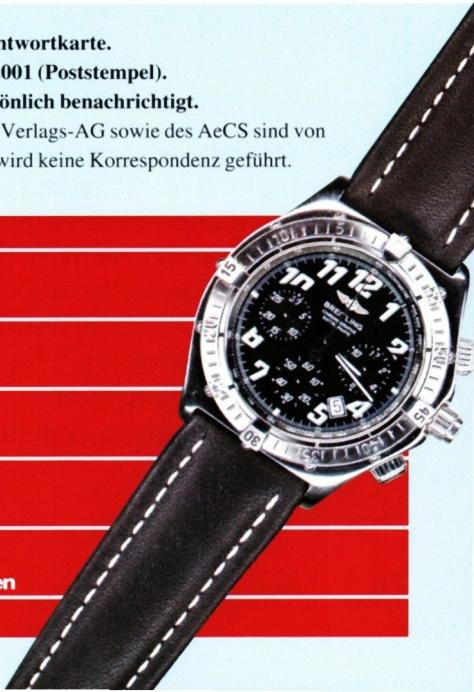
| 1 | Chronograph (Chronoracer Rattrapante) valued at 4,520 Swiss francs | Breitling SA, Grenchen |
| 2 through 21 | Axalp with Super Puma, air show (includes one guest) | Swiss Air Force, Bern |
| 22 to 33 | Patrouille Suisse training (includes one guest) | Air Force, Bern |
| 34 | Simulator flight (F100, A320) , including supervision by SR pilots | Swissair Training Center, Zurich Airport |
| 35 | One-hour sightseeing flight on a Tante-JU | RUAG, Swiss, Aircraft and Systems, Emmen |
| 36 to 261 | Other attractive prizes such as hot-air balloon rides, sightseeing flights, and introductory flights, etc. |

EURO CONTEST GLIDER ACRO TOUR AUSTRIA 2026

THE PC-21 STORY
 Emil Giezendanner

TWIN TOWN PARTNERSHIP
 Wolfgang Voeller

SUMMER FUN 2026 AT MG USTER
Martin Wunderli
CORSAIR F4U – A WARBIRD WITH A MEMORABLE LOOK
Jürgen Rosenberger, Jürgen Prinz
52. 2026 ALPS CUP
Emil Giezendanner
YOU KNOW WHAT I MEAN? 125 YEARS OF THE SWISS AERO CLUB
Emil Giezendanner
News from HEBU

TEAM MANAGER "THIS" BOSSHARD
Rodito Nussbaumer
ATOM, THE NEW DOUBLE-DECKER FROM CPLR
 Matthias Bosshard

F3A EUROPEAN CHAMPIONSHIPS IN ST-MACAIRE, FRANCE
Matthias Bosshard
INSIGHTS INTO THE HISTORY OF SEAPLANES

WELCOME, NEW MEMBER!
Andrea Bolliger
What's New at Leomotion.com

PRIDE AND GOOD IDEAS
 Markus Nussbaumer

SMALL, MODEL-LIKE SAILBOATS
Res Dauwalder
FREE FLIGHT IN THE MIDDLE OF SUMMER
Urs Muntwyler
BY YOUTH, FOR YOUTH
Lorena Betschen
HORIZON HOBBY/LEMACO NEWS: MICRO OV-10 BRONCO 645 MM BY E-FLITE

COUPE DES ALPES – OBSERVE AND LEARN
Rodito Nussbaumer
34th HAHNENMOOS ALPINE MODEL AIRPLANE CAMP
Res Dauwalder
TRY-OUT DAY AT MFV WETTINGEN
 Urs Keller

NEWS FROM HEBU
 Julia Bucher

NOS REGION – A HUB FOR ELECTRIC AVIATION
Emil Giezendanner
MEMORIES
 Wolfgang Völler

70 YEARS OF THE NIDWALDEN MODEL AIRPLANE CLUB
Martin Barmettler
A SPECTACULAR F3A WORLD CUP IN THE PRINCIPALITY OF LIECHTENSTEIN
Emil Giezendanner
FROM 0 TO 100
Markus Nussbaumer