
Highlight Acro (Altus XL)
The striking design of this small glider, manufactured in Poland, immediately catches the eye: a long fuselage with a translucent Kevlar finish, ribbed wings with elliptical leading edges in a D-box configuration, V- or cross-shaped tail units, and decidedly modern, pointed wingtips. Fuselages for V-tail or cross-tail configurations are available. White and silver are available for the molded parts of the wings, and many other colors are available for the transparent parts covering the ribs.
The components weigh 50 g for the fuselage, 190 g for the 1.80 m wings (a 1.50 m wing is also available), and 10 g for the foam tail surfaces covered with fiberglass. The wing is a rigid molded carbon fiber frame with balsa ribs. The servo mounts and the grommets that route the servo wires to the fuselage are already installed. This magnificent wing is practically finished. All that remains is to install the ailerons using self-adhesive tape, 11-mm servos, control horns, control rods, servo covers, and servo extension wires—none of which are included in the kit. I quickly realized that one aileron was twisted. It’s possible to heat it with a hair dryer to straighten it out. However, this will leave an unsightly orange peel texture on the foam aileron covered with fiberglass.
The mounting hardware for the fuselage, as well as instructions on how to mount the servos, are also missing. I logically placed a small 250 mAh battery in the front, then the two aileron and elevator servos in a row on a CTP board, and the receiver under the wing. The PBT wing mount, threaded into the wood (!), is installed. All that’s left is to find a way to attach the carbon canopy and permanently secure the supplied rods. Looking more closely at the fuselage, you’ll notice that the joint between the hulls isn’t made of Kevlar (wet-on-wet) but of fiberglass, and that it isn’t arranged diagonally, which could have reinforced it against torsion: too bad!
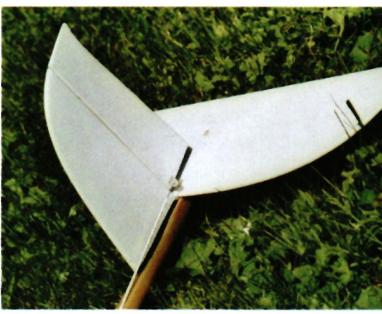
The stabilizers are designed to be glued to the fuselage. The brief instructions suggest cutting a groove in the Kevlar fuselage to insert the vertical stabilizer... What a nightmare! I glued it to the fuselage and reinforced its base with carbon fiber. Given the apparent fragility of the fiber-reinforced foam stabilizer, I preferred to secure it with two M2 screws. I sacrificed a few grams in the process, but this ensures the stabilizer is interchangeable. Be careful not to mark your stabilizer, as I did, during the alignment process.
The servos used are C2081s, and the receiver must be a micro model: Yellow 7, Webra nano, or equivalent. The battery is a 250 mAh NiCd, which provides only one hour of flight time (with 4 servos), but should ideally be replaced with a higher-capacity battery that has been tested beforehand in the narrow fuselage.
After balancing the glider with 50 g of lead, here we are at the top of the slope. I haven’t tested the model on flat ground, since hand-launching isn’t really my thing. In flight, with the control travel recommended in the manual, the controls feel very smooth but never too sensitive. The Highlight is a great thermal climber that often feels like it’s drifting like a dead leaf in the thermals. There’s really no need to adjust the flaps to increase the already more-than-sufficient lift. Spirals are easy with minimal yaw. An average pilot will quickly feel at ease with this glider, which leads me to say that this model lends itself well to 3-axis flight training. You won’t, however, be particularly impressed by its acceleration or the speed of its rolls. Inverted flight is stable with no major issues, requiring little elevator correction. Inversion is very difficult to achieve due to the rudder’s lack of effectiveness. Faceted rolls are performed without much difficulty, since there’s hardly any lateral fuselage surface to speak of! It needs a few grams of lead for sharper speed builds, but there’s not enough room in this narrow fuselage. Eventually, the time comes to land this ultra-light glider that never wants to leave the air. Raising the flaps to 45° or more will be necessary to bring the model down gently. No elevator correction is necessary. Tests with the flaps down were not conclusive for landing. The model is so light that it can handle “leeks”—a maneuver I don’t voluntarily test.
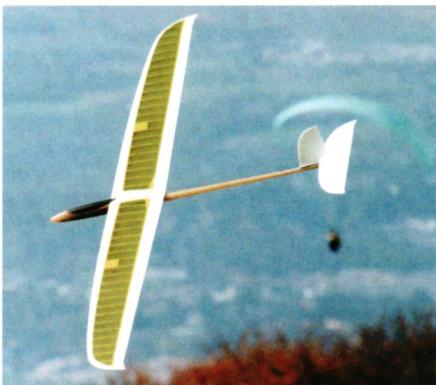
This glider belongs in a category reserved for versatile recreational and fun gliders. It offers far more possibilities than a simple hand-launched glider. Its in-flight aesthetics are superb. Its light weight and sturdiness make it a great choice for calm weather, with a few acrobatic maneuvers to keep things interesting. The downsides include the tail surfaces, which often get dented or broken during transport (!), the lack of accessories—which must be purchased separately—and the instruction manual, which is truly minimalist. For a purchase price of 300.–, there’s nothing to fault in the overall quality, which remains superb, even with room for improvement.
This Highlight Acro will easily provide you with the enjoyment you need to leave your daily worries behind. Isn’t that what matters most?
T. Ruef
| Wingspan | 1.80 m |
| Profile | S-4083 mod. 8% |
| Weight | 480 g |
| Wing area | 25.4 dm² |
| Wing loading | 18 g/dm² |

EURO CONTEST GLIDER ACRO TOUR AUSTRIA 2026

THE PC-21 STORY
 Emil Giezendanner

TWIN TOWN PARTNERSHIP
 Wolfgang Voeller

SUMMER FUN 2026 AT MG USTER
Martin Wunderli
CORSAIR F4U – A WARBIRD WITH A MEMORABLE LOOK
Jürgen Rosenberger, Jürgen Prinz
52. 2026 ALPS CUP
Emil Giezendanner
YOU KNOW WHAT I MEAN? 125 YEARS OF THE SWISS AERO CLUB
Emil Giezendanner
News from HEBU

TEAM MANAGER "THIS" BOSSHARD
Rodito Nussbaumer
ATOM, THE NEW DOUBLE-DECKER FROM CPLR
 Matthias Bosshard

F3A EUROPEAN CHAMPIONSHIPS IN ST-MACAIRE, FRANCE
Matthias Bosshard
INSIGHTS INTO THE HISTORY OF SEAPLANES

WELCOME, NEW MEMBER!
Andrea Bolliger
What's New at Leomotion.com

PRIDE AND GOOD IDEAS
 Markus Nussbaumer

SMALL, MODEL-LIKE SAILBOATS
Res Dauwalder
FREE FLIGHT IN THE MIDDLE OF SUMMER
Urs Muntwyler
BY YOUTH, FOR YOUTH
Lorena Betschen
HORIZON HOBBY/LEMACO NEWS: MICRO OV-10 BRONCO 645 MM BY E-FLITE

34th HAHNENMOOS ALPINE MODEL AIRPLANE CAMP
Res Dauwalder
COUPE DES ALPES – OBSERVE AND LEARN
Rodito Nussbaumer
TRY-OUT DAY AT MFV WETTINGEN
 Urs Keller

NEWS FROM HEBU
 Julia Bucher

NOS REGION – A HUB FOR ELECTRIC AVIATION
Emil Giezendanner
MEMORIES
 Wolfgang Völler

70 YEARS OF THE NIDWALDEN MODEL AIRPLANE CLUB
Martin Barmettler
A SPECTACULAR F3A WORLD CUP IN THE PRINCIPALITY OF LIECHTENSTEIN
Emil Giezendanner
FROM 0 TO 100
Markus Nussbaumer