
A Vision of the Future from Ancient Switzerland
The widespread belief in our circles that everything good must come from abroad often leads us to overlook outstanding developments in our own country. Sepp Bucher and Hans Emmenegger’s Elektro-Spirit has set new standards in the electronic music scene both at home and abroad.
While Sepp Bucher from Kerns in the canton of Obwalden has been deeply involved with model helicopters for more than 30 years, Hans Emmenegger—with just over a dozen years of helicopter experience—is, by comparison, a “greenhorn.” Nevertheless, from the very beginning, Emmenegger has given the established competitors a run for their money in competitions and, above all, has drawn attention early on with interesting contributions to technical improvements and flight-related specialties—particularly regarding control programming. In addition, Hans is already a multiple Swiss champion and Militky Cup winner in the electric helicopter category. Much as has repeatedly proven successful in other model aviation categories, both men combine forward-thinking with the expertise to bring their designs to life, coupled with above-average flying skills. Both also bring a wealth of experience from fixed-wing aviation. Hans was a long-time member of the national team in RC aerobatics (F3A). As is well known, fixed-wing flying also offers ample opportunities to train in control system installation and handling, engine management, and—last but not least—precision and safety awareness.
After many years of experience with helicopters, Sepp Bucher began designing and manufacturing helicopter fuselages for internal combustion engines around 1985. While models resembling the originals were in demand at first, the 1990s marked the beginning of the era of purely functional models, which are better suited for the F3C aerobatics program. In close collaboration with Daniele Graber, the Swiss and European champion, the Futura fuselage was developed, which immediately generated great interest in the helicopter community. The German company Robbe acquired the copyright and sold it worldwide with great success. Shortly thereafter, the Zenit—another development from Bucher—was also released for sale by Robbe.
Sepp competed in the Swiss Helicopter Championships himself until 1988. Over time, however, he felt an increasing desire to tackle something completely new. After attending the Militky Cup in 1990, he reportedly saw that electric fixed-wing aircraft flew “damn well.” “That must be possible with helicopters too,” he told himself. This marked the beginning of a highly creative period of “electric tinkering.” The results included a Futura fuselage with an electrified homemade mechanical system, a Zenit electric model with its own mechanical system, and an Esprit with a belt drive.
In the winter of 1996–1997, he built the K-Max Elektro twin-rotor helicopter, which promptly earned him the Design Trophy at the 1997 Militky Cup. In 1998, he began a close collaboration with Hans Emmenegger. This led to the development of the Spirit fuselage for internal combustion engines. When the helicopter program—featuring hover and flight maneuvers—was introduced at the Militky Cup in the late 1990s, the idea arose to install an electromechanical system in the Spirit fuselage. This idea was supported from the very beginning by Hans Emmenegger from Zufikon AG, who was already a successful F3C competition pilot at the time. The two set to work with enthusiasm, aiming to develop a competition-ready electric helicopter. While Hans evaluated the optimal space and weight distribution in the plywood models, Sepp began designing the chassis, which is made entirely of carbon fiber-reinforced plastic (CFRP). This chassis, the centerpiece of the Spirit electric helicopter, is manufactured as a single, seamless piece and therefore does not need to be bolted together.

The housing is made entirely of carbon fiber and Kevlar. Sepp highlights the anti-static design: Designing the entire structure to minimize static charge buildup is a very challenging task and requires secure connections between the individual components—such as those between the main rotor and tail rotor, which are ensured by the toothed belt running over carbon fiber gears. The rotor head used is the X-Cell version, milled entirely from aluminum (120-degree Tri-link linkage). This rotor head is very lightweight, and it’s not worth “reinventing” it. However, other heads can also be used, such as the Heim model. The tail rotor is also from X-Cell.
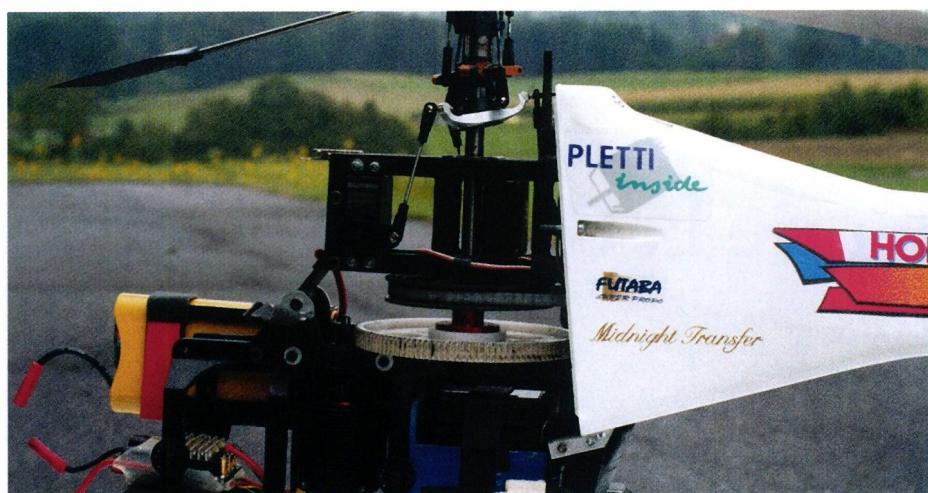
Important: We recommend rotor blades specially manufactured for the Spirit, which have a semi-symmetrical profile. The blade length is 66 cm. This results in a rotor diameter of 150 cm. The power source is a Plettenberg 300/30/A4 electric motor, which is geared down at a ratio of 9.23:1. The tail rotor’s reduction ratio is 4.5:1. The individual Spirit components produced by Sepp Bucher, as well as the materials purchased from X-Cell, are pre-assembled by Hans Emmenegger. Hans explains that there are various suppliers of electric motors with similar specifications, but they currently have no experience with them. An older Schulze speed controller is used for this purpose, since the brushless motor is still a first-generation model and operates with sensors. Only digital servos are used, along with the Futaba G401 gyro. Incidentally, the Spirit is produced only to order. Sales are handled by Hope Modellbau in Schöftland, which also maintains a spare parts inventory.
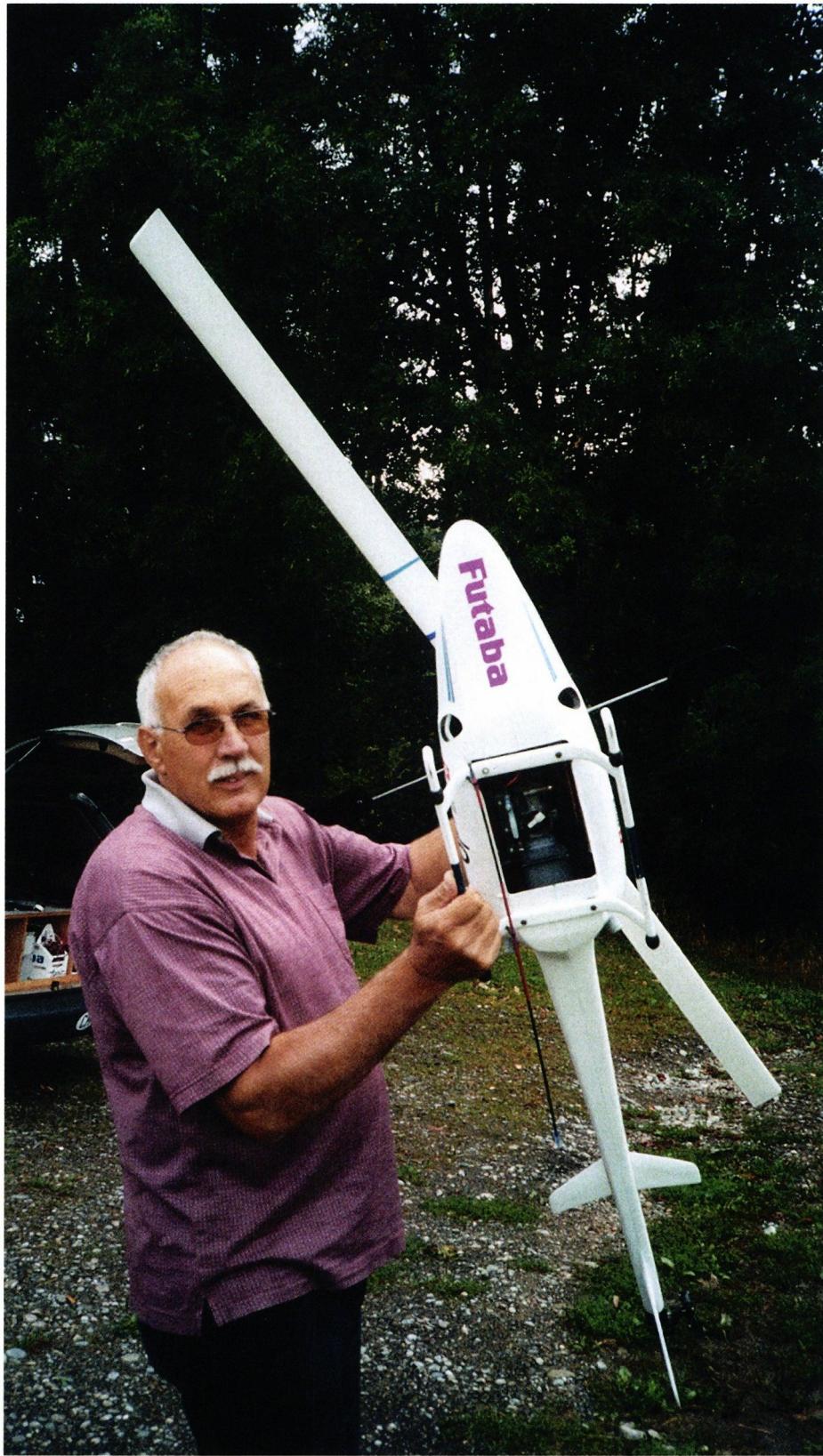
Both enthusiasts highlight the low maintenance requirements resulting from the low-vibration drive as arguably the most important advantages. Aside from a few drops of oil on the swashplate and tail rotor shaft, there’s nothing else to do. Hans estimates the ratio of maintenance effort between electric and internal-combustion-engine helicopters at 1:10. With turbine helicopters, which are also low-vibration, maintaining the turbine is somewhat more time-consuming. Hans mentions that he has completed between 500 and 1,000 flights with each of his two Spirit electric helicopters without having to replace a single part. However, this is also due to the fact that many parts serve multiple functions, meaning the entire helicopter consists of very few parts. Furthermore, both highlight the lower noise levels and completely emission-free flight. This makes it much easier to find a flying site. Sepp emphasizes that his spirit of experimentation keeps coming to the fore. He therefore welcomes the development of the electric helicopter.
The disadvantages were quickly listed: First, it’s quite clear that the electric helicopter’s power is limited (approx. 750 watts with 30 cells). One can assume that it offers about one-third of the power of a helicopter with an internal combustion engine. However, due to the high torque of the electric motor, this has a far less drastic effect in flight than one might fear. In certain flight situations, you can apply an extremely high amount of pitch, which would cause an internal combustion engine to stall. Second, operating an electric helicopter is not as flexible as operating one with an internal combustion engine: electric powertrains require a certain amount of planning. Charging 30 cells—possibly two to three sets—takes about two hours and is certainly more complicated than refueling with gasoline. On the other hand, hoses, filters, pendulums, and tanks aren’t exactly indestructible, not to mention mufflers and their installations. Finally, the high acquisition costs are cited as a third disadvantage (corresponding figures in the technical literature are—depending on what was being proven—useless).
Hans and Sepp emphasize that the electric helicopter has a different flight style. Less power, but better torque characteristics, would automatically result in longer flight times. Hans has set three RPM settings that he can select on the transmitter as needed:
| Hover: | 1,450 rpm |
| Flight: | 1,650 rpm |
| Rolling: | 1,700 RPM |
Both helicopter enthusiasts and novices are consistently amazed by the high speed and exceptionally smooth operation of the Elektro-Spirit: a feast for the eyes and ears for many! Unfortunately, F5C competitions in Europe have not developed as one might expect given the great interest in and popularity of these beautiful aircraft. While official SMV championships were held in Switzerland early on as part of the AeCS/SMV, the German Aero-Club, for example, has taken no action in this regard. This has led to a business-driven proliferation of brand-specific events and, consequently, to a detrimental fragmentation of the scene, which in turn hinders progress. The Militky Cup remains one of the very few electric helicopter competitions listed on the FAI’s International Sports Calendar.
Looking to the future, Hans says with a smile that the new generations of batteries—lithium-polymer cells in the near future—will soon give “methanol vaporizers” a run for their money. Both predict a bright future for electric helicopters based on the following developments: outrunner motors, increased maximum voltage, and new batteries. The reporter would not like to conclude this report without pointing out that, as exemplified by Spirit in Switzerland, there are still pioneers at work whose developments and achievements are making a name for themselves far beyond the country’s borders and are making a valuable contribution to the recognition of our Swiss model aviation scene. For this, I would like to thank them.
Emil Ch. Giezendanner

EURO CONTEST GLIDER ACRO TOUR AUSTRIA 2026

THE PC-21 STORY
 Emil Giezendanner

TWIN TOWN PARTNERSHIP
 Wolfgang Voeller

SUMMER FUN 2026 AT MG USTER
Martin Wunderli
CORSAIR F4U – A WARBIRD WITH A MEMORABLE LOOK
Jürgen Rosenberger, Jürgen Prinz
52. 2026 ALPS CUP
Emil Giezendanner
YOU KNOW WHAT I MEAN? 125 YEARS OF THE SWISS AERO CLUB
Emil Giezendanner
News from HEBU

TEAM MANAGER "THIS" BOSSHARD
Rodito Nussbaumer
ATOM, THE NEW DOUBLE-DECKER FROM CPLR
 Matthias Bosshard

F3A EUROPEAN CHAMPIONSHIPS IN ST-MACAIRE, FRANCE
Matthias Bosshard
INSIGHTS INTO THE HISTORY OF SEAPLANES

WELCOME, NEW MEMBER!
Andrea Bolliger
What's New at Leomotion.com

PRIDE AND GOOD IDEAS
 Markus Nussbaumer

SMALL, MODEL-LIKE SAILBOATS
Res Dauwalder
FREE FLIGHT IN THE MIDDLE OF SUMMER
Urs Muntwyler
BY YOUTH, FOR YOUTH
Lorena Betschen
HORIZON HOBBY/LEMACO NEWS: MICRO OV-10 BRONCO 645 MM BY E-FLITE

COUPE DES ALPES – OBSERVE AND LEARN
Rodito Nussbaumer
34th HAHNENMOOS ALPINE MODEL AIRPLANE CAMP
Res Dauwalder
TRY-OUT DAY AT MFV WETTINGEN
 Urs Keller

NEWS FROM HEBU
 Julia Bucher

NOS REGION – A HUB FOR ELECTRIC AVIATION
Emil Giezendanner
MEMORIES
 Wolfgang Völler

70 YEARS OF THE NIDWALDEN MODEL AIRPLANE CLUB
Martin Barmettler
A SPECTACULAR F3A WORLD CUP IN THE PRINCIPALITY OF LIECHTENSTEIN
Emil Giezendanner
FROM 0 TO 100
Markus Nussbaumer