
Timber construction
The spar is the central component of a wing, designed to absorb all the forces generated during flight. There are various ways to build a spar. Here, I’d like to present a method that has worked best for me in practice.
You can buy CFRP prepreg sheets for this purpose; they are very expensive, but they offer tremendous strength. I decided to build my own GRP spars. This makes the spars slightly heavier, but they withstand the loads well. In flight, this slight increase in weight of a few grams is not noticeable. So I highly recommend this construction method, as it allows you to save quite a bit of money without making major compromises in terms of strength.
First, you need to cut the fiberglass-reinforced plastic (FRP) strips. I use 163 g/m² FRP fabric. You could also use carbon-fiber-reinforced plastic (CFRP) fabric. The width of the strips depends on the spar height for two spars, plus about 10 mm allowance for the cutting width.
Rule of thumb: 10 strips result in a strut thickness of approximately 1 mm. If, as in our example, you want to make a tapered spar that tapers from 2 mm to 1 mm, you can achieve this by cutting 9 of the 20 strips to lengths that are evenly spaced—just to be safe.
For this, you’ll need two flat, smooth boards that are sturdy enough. Coated 20-mm particleboard is sufficient. Attach two sheets of plastic film (construction plastic) to these boards, allowing for a little extra length so that the laminate doesn’t stick to the boards.
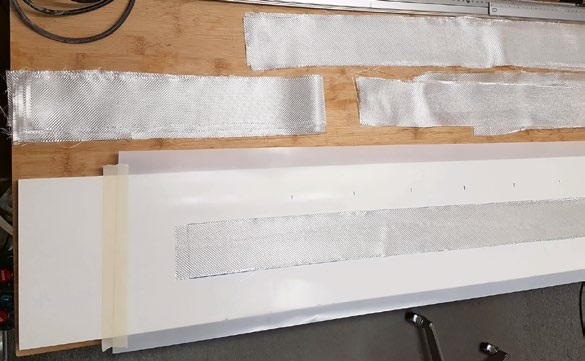
To avoid making the spar unnecessarily heavy, you should only saturate every other layer with resin. You can gently adjust the unsaturated strips by hand (be sure to wear gloves).
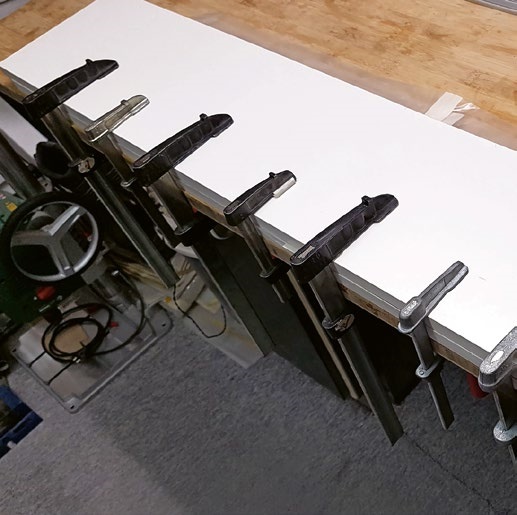
The finished laminate must now be pressed to achieve high strength. I do this by clamping the entire package directly to a flat tabletop using screw clamps.
After curing (approx. 24 hours), remove the blank. Then cut the spars to the desired dimensions. This works best with a jigsaw.
In the area where the spars will be joined, taper the spar height by about 1 mm (0.5 mm at the top and 0.5 mm at the bottom), because the spar will later be wrapped with a CFRP strip in this area.
Now glue a 2-mm fiberglass strip to both sides (a 2-mm plywood strip can also be used). Make sure to bevel one end and cut the other to a different length. This is to prevent an unintended break.
I glue 2-mm balsa wood strips to the remaining length of the spar. Together, this results in a spar thickness of 5–6 mm. This makes it easier to cut out the section in the polystyrene core and remove it. With a spar that’s only 1–2 mm wide, this is practically impossible.
Now the spar must be sanded down to the correct height.
Next, cut out the opening for the insertion tube. This is best done with a jigsaw. This cut also defines the desired V-shape of the wing. The insertion tube should protrude by about 5 mm, because two 2 mm-thick plywood ribs will be glued on later.
Now, apply resin to secure the insertion tube into the cutout. Make sure the tube is precisely aligned along the length of the spar (at a 90° angle to the fuselage’s connecting rib)!
Next, close the remaining opening on the rear side of the insertion tube with a piece of balsa wood and sand it to a tapered shape.
Then fill the gap between the spar and the insertion tube with lightweight filler and let it dry.
Once the filler has dried, sand the four edges smooth so that the CFRP filaments don’t break during the wrapping process.
Now, wrap the prepared wing spar with a CFRP roving under tension. This ensures high strength. It’s easier if you first coat the surface to be wrapped with resin.
It’s best to secure the ends to the spar with adhesive tape. The CFRP roving must now be coated with or saturated with resin. Don’t be too sparing with the resin here.
Let the resin cure for about 24 hours, then trim off any excess roving. You can then install the spar into the cutout in the wing.
I use a little lightweight filler to secure the spar to the wing core to prevent the spar from twisting during rough landings.
Instructions for building a sandwich wing will follow in a separate post.


News from HEBU

TEAM MANAGER "THIS" BOSSHARD
 Rodito Nussbaumer

YOU KNOW WHAT I MEAN? 125 YEARS OF THE SWISS AERO CLUB
 Emil Giezendanner

PRIDE AND GOOD IDEAS
 Markus Nussbaumer

ATOM, THE NEW DOUBLE-DECKER FROM CPLR
 Matthias Bosshard

SUMMER FUN 2026 AT MG USTER
Martin Wunderli
F3A EUROPEAN CHAMPIONSHIPS IN ST-MACAIRE, FRANCE
Matthias Bosshard
52. 2026 ALPS CUP
Emil Giezendanner
HORIZON HOBBY/LEMACO NEWS: MICRO OV-10 BRONCO 645 MM BY E-FLITE

TWIN TOWN PARTNERSHIP
Wolfgang Voeller
CORSAIR F4U – A WARBIRD WITH A MEMORABLE LOOK
Jürgen Rosenberger, Jürgen Prinz
TRY-OUT DAY AT MFV WETTINGEN
Urs Keller
WELCOME, NEW MEMBER!
Andrea Bolliger
EURO CONTEST GLIDER ACRO TOUR AUSTRIA 2026

BY YOUTH, FOR YOUTH
Lorena Betschen
INSIGHTS INTO THE HISTORY OF SEAPLANES

SMALL, MODEL-LIKE SAILBOATS
Res Dauwalder
What's New at Leomotion.com

COUPE DES ALPES – OBSERVE AND LEARN
Rodito Nussbaumer
34th HAHNENMOOS ALPINE MODEL AIRPLANE CAMP
Res Dauwalder
FREE FLIGHT IN THE MIDDLE OF SUMMER
Urs Muntwyler
THE PC-21 STORY
Emil Giezendanner
NEWS FROM HEBU
 Julia Bucher

FROM 0 TO 100
Markus Nussbaumer
MEMORIES
Wolfgang Völler
NOS REGION – A HUB FOR ELECTRIC AVIATION
Emil Giezendanner
Have you almost forgotten about aircraft that take off and land vertically?
Emil Giezendanner
DO YOU KNOW WHAT I MEAN IN THE LAND OF SMILES?
Emil Giezendanner