
75 Years of the Zurich Model Aircraft Club, 1926–2001
If we look back 75 years to November 9, 2001, that marks the day of the Zurich Model Flying Club’s inception and its founding date. Although model aircraft building was already widely practiced abroad, it had barely gained a foothold in Switzerland. There were indeed a few small groups in Bern and Basel that were involved in model flying, but there was no significant activity on a larger scale. Anyone interested in aviation became equally captivated by model building and model flying, but did so alone and in the quiet confines of their own home (people built their model airplanes in the kitchen or living room). Model airplane enthusiasts were satisfied if the model they built stayed airborne for a few minutes. Only those who wanted to compete with other model airplane enthusiasts would make a point of participating as contestants at Gottschalkenberg.
More and more often, a group of like-minded people would meet in Zurich to fly model airplanes together. And so it came to pass that Werner Schramme, together with Walter Burger and Fritz Fellmann, founded the “Model Aircraft Construction Association” (FMBV) on November 9, 1926. At the time, these young men set as their goal “the collective and individual construction of model airplanes, the organization of theoretical and practical courses, the hosting of competitions and field trips, and participation in air shows, gliding camps, etc.” In its founding year, 20 members were registered, and a lively model-aircraft scene developed among secondary school students. With the advent of gliders at that time, model aircraft flying lost its appeal. It was only thanks to a few “die-hard enthusiasts” that model aircraft flying was not completely abandoned. The FMBV had then worked to popularize model aircraft building and promoted it in daily newspapers and at air shows. There were even plans to organize building courses for teachers with the aim of later introducing model building into handicrafts classes. Unfortunately, the commission of handicrafts teachers was not receptive to this idea. In the meantime, many of the Zurich model aviators took up gliding and joined the Zurich Gliding Club. Some, however, remembered the good old days of model flying and did not want to let Zurich’s model flying scene fade away. And so it came to pass that a small remnant of the FMBV joined forces with the glider pilots. The Zurich model aviators were then assigned a modest space in the Zurich Gliding Club’s Letten workshop to build their model airplanes alongside other members. Under the direction of Werner Schramme, the first model airplane building courses were then held at the Letten workshop.
From June 28 to July 11, 1933, the then-Zurich Section of the Aero-Club of Switzerland (today the Aero-Club Zurich, a regional association of the Aero-Club of Switzerland) held the first exhibition covering all aviation disciplines, in collaboration with other groups, societies, and government agencies, throughout the entire Zurich Tonhalle. The exhibition was titled “Der Flug” (The Flight). Werner Schramme presented the first public model-building workshop at this exhibition. This exhibition became a milestone for the model aviation movement in Switzerland. In this way, the model-building group was “taken in” by—or rather, accepted into—the former Zurich Section of the AeCS. The Zurich model aviators then formed a subgroup of the Zurich Gliding Club. Following this exhibition, the FMBV was given the name “Modellfluggruppe Zürich,” or MGZ for short. Dr. Tilgenkamp wrote at the time: “Thus, in seven years, from humble beginnings and thanks to the initiative of a few individuals, the Zurich Model Aircraft Group developed—a group destined to play a leading and pioneering role in the movement and to provide it with decisive impetus.” In 1934, the MGZ had 24 members. In 1936, together with the Zurich Gliding Club, it set up an exhibition booth at the Zurich Sports and Weekend Exhibition—once again at the Zurich Tonhalle—and thus launched a public outreach campaign.
In February 1936, Dr. Walter Dollfuss took over as head of the Zurich Model Aircraft Club. “From that day on, the chronicler can note an uninterrupted upswing in Zurich’s model aviation, which led all the way to groundbreaking achievements,” as stated in Tilgenkamp’s book. It was Dr. W. Dollfuss who ensured that the model aviation movement of that time experienced a remarkable upswing. The FAI, the “world parliament of aviation sports,” also addressed model aviation that year. Standards and regulations were established. With these regulations in place, model aviation had become “socially acceptable” and was recognized as an international air sport. National competitions and the Swiss model aviation camp were already being held at Gottschalkenberg. Arnold Degen set an endurance record at this event. Under the leadership of Arnold Degen, the Zurich Model Aviation Group organized model aviation camps, model aviation conferences, competitions, and exhibitions. The biggest event of the year was the radio-controlled model building course. Over the course of five lessons, Arnold Degen introduced listeners to the secrets of model aircraft construction via the microphone at Radio Studio Zurich. No fewer than 1,700 model kits were sold at that time. This initiative proved to be a great success for model aviation. Now, model airplanes could also be built in handicrafts classes at secondary schools. The “Shell I” model airplane construction plan published by A. Degen was printed in a run of 10,000 copies and distributed free of charge to young people.
This was followed by various national events held in accordance with FAI standards, at which the Zurich Model Aircraft Club excelled with record-breaking flights. The Zurich Gliding Club’s workshop became too small for model aircraft construction. So the club split—
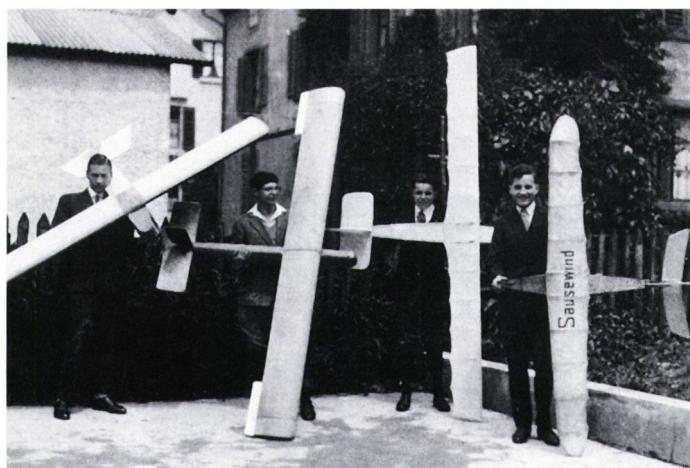
The model airplane enthusiasts separated from the glider pilots and moved into their own workshop in Zurich. The workshop became a gathering place for Zurich’s youth interested in aviation and flying. In this way, the Zurich Model Flying Group had promoted the spirit of flight on a broad basis and brought it to many segments of the population.
The Allmend in Zurich became the flying field for the Zurich Model Flying Group.
In 1939, the city of Zurich showed keen interest in model aircraft. Thanks to an initiative by the board of the Cantonal Zurich Association for Boys’ Activities and School Reform and the efforts of the City Council, the City of Zurich approved a grant of 3,300 Swiss francs for a pilot program and the optional implementation of a summer course on model aircraft construction in schools. This finally achieved the goal, set some 13 years earlier, of promoting model aircraft building in schools. It is worth noting that, despite the war years, more and more new model aircraft clubs were formed.
In earlier years, and especially in 1948, it became apparent—as was also the case in other sports, incidentally—that enthusiasm was very high at the beginning. However, when the first difficulties arose, the necessary perseverance was lacking, and enthusiasm quickly waned. The Zurich Model Aircraft Club switched to a one-year provisional membership period. During this trial period, the club could observe how a prospective member’s technical skills and personal qualities developed. Only then would the applicant be definitively admitted to the club. The Zurich Model Aircraft Club no longer sought to have as many members as possible; instead, it aimed to maintain a high-quality membership consisting solely of individuals genuinely interested in model aircraft. It became increasingly clear that many young people were using model aircraft merely as a stepping stone to full-scale aviation. If they failed to make that leap, they were deeply disappointed and left the group. On the other hand, it became apparent that the older—and thus more mature—generation was increasingly becoming the true driving force behind the model aviation movement. It was this generation, in fact, that ensured the continuity of the group’s work and kept the Zurich Model Flying Group viable. The Allmend in Zurich increasingly became a site for everyone. Thus, in
acquired a small plot of land from a private owner in the Niederhasli gravel pit in 1967 and, on a trial basis, built a paved runway to offer powered model pilots the opportunity to conduct training flights, as more and more members were building powered model aircraft. Membership rose to 115 members. The model flying club had to deal with off-the-shelf model engines and address noise issues that residents were no longer willing to tolerate without question. According to one resident, the noise was “harmful to health.” The Zurich Model Aviation Group was then forced to give up the site in Niederhasli.
After the airfield in Niederhasli was abandoned, a new site was found in Eglisau in 1972. The board established strict regulations and required effective mufflers on all internal combustion engines. At the same time, new regulations were introduced by the AeCS, and structural changes were required for the entire model aviation community. The Zurich Model Aviation Group became a separate legal entity in accordance with Art. 60 et seq. (Swiss Civil Code) with the purpose of “bringing together individuals interested in the field of model aviation, promoting and imparting technical knowledge, acquiring and maintaining model flying sites, organizing lectures, building courses, air shows, and competitions, as well as fostering friendly relations with other organizations.” It therefore decided to implement rigorous measures and drew up corresponding bylaws and strict implementing regulations. Not all members were willing to adhere to the new regulations. As a result, membership declined from 115 to 88 members.
Model airplane construction no longer took place in kitchens and living rooms but shifted to the group’s own hobby and workshop rooms. As a result, construction activity at the group’s own workshop was greatly reduced, so that the group eventually gave up the workshop it had been renting
. Thanks to functional model building and modern radio control systems, model pilots now have the opportunity to study the behavior of the model aircraft in flight even more precisely, to observe its aerodynamic characteristics in practice with even greater focus, and to maintain even better control over the model aircraft than was previously possible. Functional model building with multi-channel-controlled model airplanes has not only set new standards in terms of versatility but has also opened up new dimensions that belong in the realm of large-scale models or small unmanned aircraft. As a result, people who fly models purely for pleasure—some of whom previously had no connection to aviation—have taken up the hobby. This led to new insights for the Zurich Model Flying Club, but also to new challenges. In 1988, the Zurich Model Flying Club hosted its first major international exhibition of large-scale model aircraft at the Allmend in Zurich, featuring the then-world champion Hanno Prettnner. The Zurich City Council and the City of Zurich’s Sports Office secured the necessary permits and facilities. They recognized model aviation achievements as a sporting endeavor.
The members of the Zurich Model Aircraft Club have recognized that the pilot and the model aircraft form an almost inseparable unit—they belong together, and from this relationship new forms of awareness and identity emerge, such as responsibility, individuality, creativity, and self-initiative. But a sense of accomplishment and other such experiences are also part of it, although the aerodynamic as well as the physical, technical, and craftsmanship aspects of model flying continue to play an essential role.
The targeted dissemination of information in the fields of psychology and education, as well as politics and ideology, plays a significant role in the Zurich Model Aircraft Club today. This includes keeping a watchful eye and maintaining good relations with our neighboring groups, as examples have shown how quickly—virtually overnight—problems can arise that could jeopardize our meaningful leisure activities and, consequently, model aviation. Opponents of aviation have recognized that there are sectors within aviation that are particularly vulnerable. It is therefore part of the Zurich Model Flying Group’s mission for model flyers to collaborate with other sectors of light and recreational aviation and to demonstrate that they are prepared, on the one hand, to do everything in their power to make life with aviation as bearable as possible for opponents, and, on the other hand, to help preserve model flying and the sport of model flying (airspace, model airfields, model aircraft, facilities, etc.). This approach has proven successful, and as a result, the Zurich Model Flying Group will soon be able to celebrate its 30th anniversary at its model flying field in Eglisau.
Much has changed over the past 75 years, but one thing has remained the same: the model flying of yesterday is the model flying of today and will also be the model flying of tomorrow. For this, we are grateful to our founders and honor their pioneering achievements.
I conclude with the hope that the Zurich Model Aircraft Club will continue to flourish and thrive in the future, true to its mission, and that it will maintain the prominent position in model aviation that it has held thus far thanks to its rich tradition.
René A. Schnorf
, Honorary President of
the Zurich Model Flying Club

EURO CONTEST GLIDER ACRO TOUR AUSTRIA 2026

THE PC-21 STORY
 Emil Giezendanner

TWIN TOWN PARTNERSHIP
 Wolfgang Voeller

SUMMER FUN 2026 AT MG USTER
Martin Wunderli
CORSAIR F4U – A WARBIRD WITH A MEMORABLE LOOK
Jürgen Rosenberger, Jürgen Prinz
52. 2026 ALPS CUP
Emil Giezendanner
YOU KNOW WHAT I MEAN? 125 YEARS OF THE SWISS AERO CLUB
Emil Giezendanner
News from HEBU

TEAM MANAGER "THIS" BOSSHARD
Rodito Nussbaumer
ATOM, THE NEW DOUBLE-DECKER FROM CPLR
 Matthias Bosshard

F3A EUROPEAN CHAMPIONSHIPS IN ST-MACAIRE, FRANCE
Matthias Bosshard
INSIGHTS INTO THE HISTORY OF SEAPLANES

WELCOME, NEW MEMBER!
Andrea Bolliger
What's New at Leomotion.com

PRIDE AND GOOD IDEAS
 Markus Nussbaumer

SMALL, MODEL-LIKE SAILBOATS
Res Dauwalder
FREE FLIGHT IN THE MIDDLE OF SUMMER
Urs Muntwyler
BY YOUTH, FOR YOUTH
Lorena Betschen
HORIZON HOBBY/LEMACO NEWS: MICRO OV-10 BRONCO 645 MM BY E-FLITE

34th HAHNENMOOS ALPINE MODEL AIRPLANE CAMP
Res Dauwalder
COUPE DES ALPES – OBSERVE AND LEARN
Rodito Nussbaumer
TRY-OUT DAY AT MFV WETTINGEN
 Urs Keller

NEWS FROM HEBU
 Julia Bucher

NOS REGION – A HUB FOR ELECTRIC AVIATION
Emil Giezendanner
MEMORIES
 Wolfgang Völler

70 YEARS OF THE NIDWALDEN MODEL AIRPLANE CLUB
Martin Barmettler
A SPECTACULAR F3A WORLD CUP IN THE PRINCIPALITY OF LIECHTENSTEIN
Emil Giezendanner
FROM 0 TO 100
Markus Nussbaumer