
Crystal by Yoshioka – when you want something really light
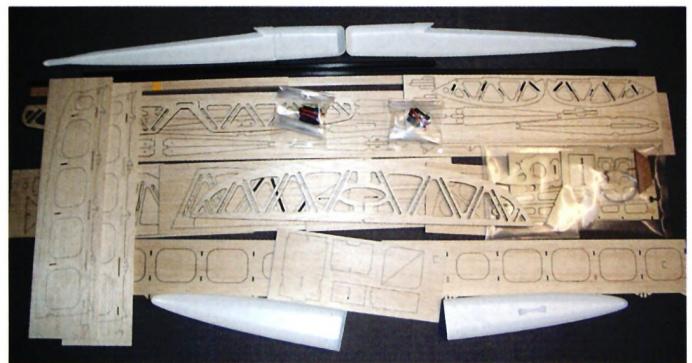
The manufacturer specifies a takeoff weight of between 150 g and 160 g, with a wingspan of 1250 mm—but is that even possible? Inside the small cardboard box, you’ll find a neatly organized, extensively illustrated assembly manual in English, several laser-cut balsa wood pieces, four plastic fuselage parts, two carbon tubes, and various accessories.
I’ll start by assembling the main wing; all the balsa parts fit together perfectly, though the carbon tube needs to be trimmed slightly at the ends. Once everything is correctly assembled and secured in the necessary places with small pins, it all needs to be glued together with liquid instant adhesive. The elevator and rudder consist of a single piece of balsa, from which the cutouts must be carefully removed.
Once the elevator and rudder are glued together, they and the main wing can be covered with Oralight; a little experience is helpful here, as this is a very delicate process. All the parts needed for the fuselage are made of thin, sanded plywood; these, too, can be glued precisely into one side of the fuselage. The finished tail assembly is then glued onto the pre-milled recesses in the carbon tube, aligned with the fuselage, and glued in place as well. The control surfaces are controlled using the included Silch transmitter. Finally, the two fuselage halves are glued together. To keep the aircraft’s weight low, a similarly small receiver with a lightweight battery should be used. I’m using a Quadro 4-channel transmitter from eflight and a 100-mA battery from Graupner. If the battery is pushed all the way to the front, the center of gravity is already set correctly. Once everything is installed, it’s time to weigh the model. The manufacturer’s specifications don’t seem to be just empty promises—the model weighs in at just under 151 g. Now I’m curious to see how this thing flies! Yoshioka offers matching micro servos (4 g) as an option, but they’re relatively expensive here.
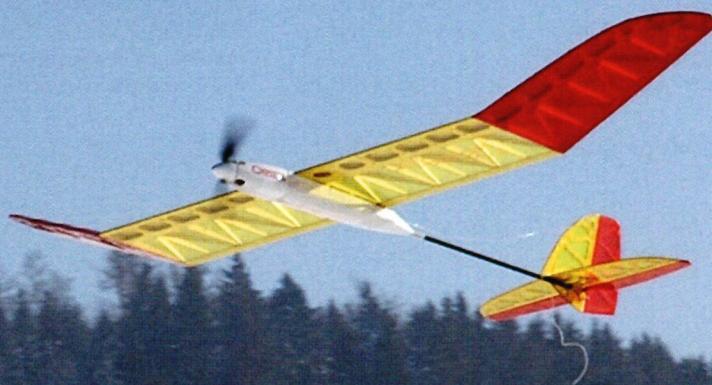
Although there wasn’t even the slightest breeze during the maiden flight, the model’s lightness was immediately striking. A week later, under conditions where a 300-g HLG couldn’t catch any of the extremely light thermals, the little Crystal showed its true strength. It reacts to even the slightest breeze like a feather, immediately gaining altitude, and its maneuverability using the rudder is exceptionally good. With the included launch rubber band, altitudes of around 30 meters can be reached. Thanks to its lightweight yet quite sturdy construction, the model can handle even rough landings without any problems.
Building this model is pure enjoyment—it’s simple, everything fits together perfectly, and it’s surprisingly efficient; the little guy should be ready to take off in just a few hours. It’s a plane suitable for beginners that will fascinate advanced modelers as well, since it can still fly even in extremely light conditions. I highly recommend this model.
Domi Wettstein

EURO CONTEST GLIDER ACRO TOUR AUSTRIA 2026

THE PC-21 STORY
 Emil Giezendanner

TWIN TOWN PARTNERSHIP
 Wolfgang Voeller

SUMMER FUN 2026 AT MG USTER
Martin Wunderli
CORSAIR F4U – A WARBIRD WITH A MEMORABLE LOOK
Jürgen Rosenberger, Jürgen Prinz
52. 2026 ALPS CUP
Emil Giezendanner
YOU KNOW WHAT I MEAN? 125 YEARS OF THE SWISS AERO CLUB
Emil Giezendanner
News from HEBU

TEAM MANAGER "THIS" BOSSHARD
Rodito Nussbaumer
ATOM, THE NEW DOUBLE-DECKER FROM CPLR
 Matthias Bosshard

F3A EUROPEAN CHAMPIONSHIPS IN ST-MACAIRE, FRANCE
Matthias Bosshard
INSIGHTS INTO THE HISTORY OF SEAPLANES

WELCOME, NEW MEMBER!
Andrea Bolliger
What's New at Leomotion.com

PRIDE AND GOOD IDEAS
 Markus Nussbaumer

SMALL, MODEL-LIKE SAILBOATS
Res Dauwalder
FREE FLIGHT IN THE MIDDLE OF SUMMER
Urs Muntwyler
BY YOUTH, FOR YOUTH
Lorena Betschen
HORIZON HOBBY/LEMACO NEWS: MICRO OV-10 BRONCO 645 MM BY E-FLITE

COUPE DES ALPES – OBSERVE AND LEARN
Rodito Nussbaumer
34th HAHNENMOOS ALPINE MODEL AIRPLANE CAMP
Res Dauwalder
TRY-OUT DAY AT MFV WETTINGEN
 Urs Keller

NEWS FROM HEBU
 Julia Bucher

NOS REGION – A HUB FOR ELECTRIC AVIATION
Emil Giezendanner
MEMORIES
 Wolfgang Völler

70 YEARS OF THE NIDWALDEN MODEL AIRPLANE CLUB
Martin Barmettler
A SPECTACULAR F3A WORLD CUP IN THE PRINCIPALITY OF LIECHTENSTEIN
Emil Giezendanner
FROM 0 TO 100
Markus Nussbaumer