
The 2022 Model Helicopter Season Has Begun
Every Easter Saturday—this year on April 17—the Spring Helicopter Meet took place at the Loorholz Air Show grounds in Leuggern, AG. This time-honored event has been organized for years by Toni Laube, together with his family and MG SWIPAIR.
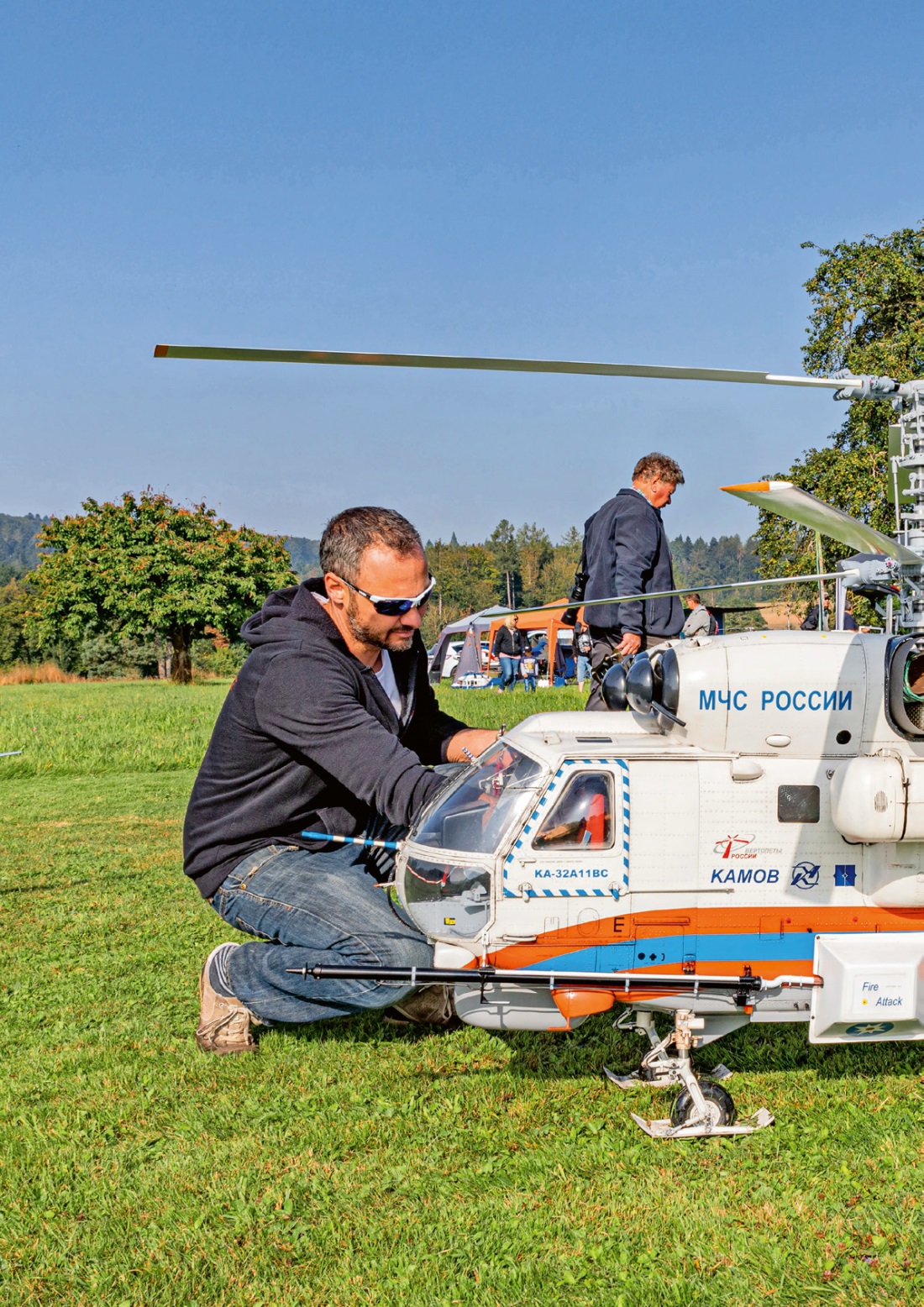
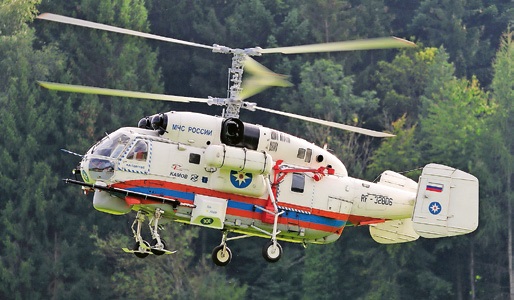
With the KAMOV KA-32A, Marco has created a model that is truly one of a kind. With its impressive flight profile and from a sufficient distance, it is virtually indistinguishable from the real thing when in the air.
It’s one of the first gatherings of the year where a large number of scale helicopters and 3D pilots are present—a true gathering of model helicopter pilots to kick off the new season. In addition to Swiss pilots, there were also Germans, French, and Austrians in attendance, some of whom had traveled over 800 kilometers to be there. Just over 70 pilots from all disciplines of RC helicopter flying made their way to the lower Aare Valley on this beautiful, warm early summer day. The fact that the events in Loorholz have firmly established themselves among model aviation enthusiasts was evident from the fact that there were about three times as many spectators as pilots on site. The 3D flying group was particularly well represented. A separate flying field had been set up for them, though it was less than 100 meters away from the main venue. The fact that the event is also of great importance to manufacturers is evident from the participation of factory pilots from Heli-Professional, MIKADO, Miniature Aircraft, SAB Goblin, and Tron Helicopters—some of whom brought their entire teams. Many of these companies also set up booths
where they showcased their latest products to attendees. This achievement is particularly remarkable given that Toni Laube, with his small scale model company swiss-scale-helikopter.ch, is more at home in the scale model scene. This gathering has now become one of the largest 3D events in Switzerland. The main airfield was very well attended by the large scale model community.
Once again, there were a few models on display that were being shown to the public for the first time. However, due to the two years of the COVID-19 pandemic, there weren’t numerous newly built models on display at this first post-pandemic event. Because of the pandemic, the models simply couldn’t be used much, and so almost no new ones were built. Further
Information and photos at www.loorholz-flugtage.ch.
But before I write here about the sausages—which were curved to the right this time—the beer, which was sufficiently chilled, and the bread, which was fresh, I’d rather introduce you to an absolutely fantastic scale model that was beautifully displayed at the event and admired by the spectators.
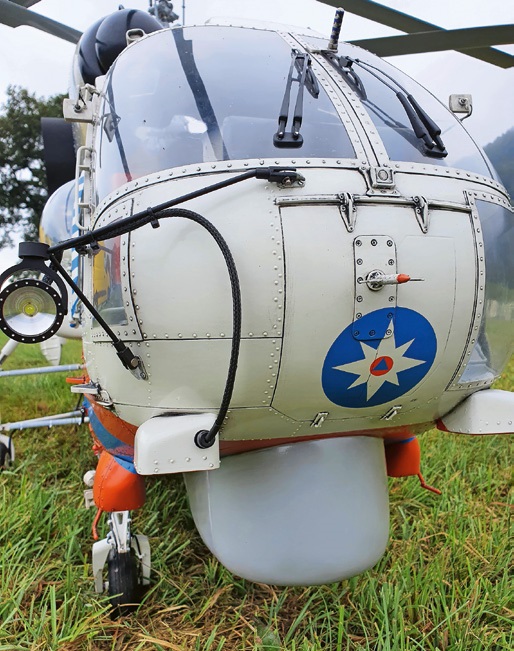
Back in the fall of 2021, at the Scale Helicopter Meet in Loorholz, Marco Brem from Bilten, GL, presented his KAMOV KA-32A, modeled after the “RUSSIA FIRE FIGHTER.” What makes this model exceptional are the typical features of Kamov helicopters: a compact, sturdy fuselage and the coaxial, counter-rotating twin rotors.
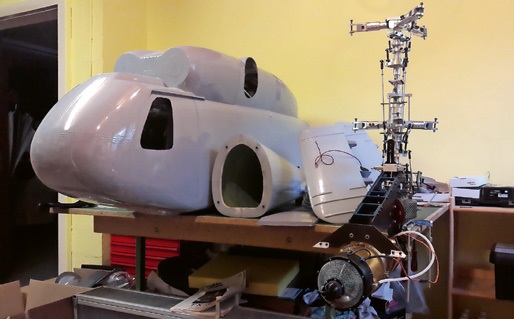
Marco purchased the 2019 model from the prestigious Heliclassics workshop run by Matthias Strupf in Sondershausen, Germany. The package included the complete fiberglass fuselage, including the 4-leg landing gear, the mechanical components with rotor head, the Pahl Taurus 12 two-shaft turbine, and various small parts.
After completing the usual initial work—such as cutting out all openings, gluing in the frames, performing an initial “test fit” of the mechanical components, and adjusting the exhaust system and all covers—the countless scale-accurate parts, such as footwells, antennas, and handholds, could be installed. However, since the fuselage is already delivered from the factory with all rivets, sheet metal joints, beading, reinforcements, and other details, this work was kept to a minimum.
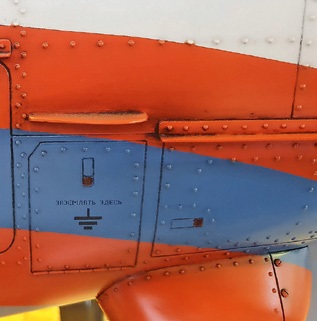
Within reason. Drilling out the blind rivets on the attachment parts took a little work.
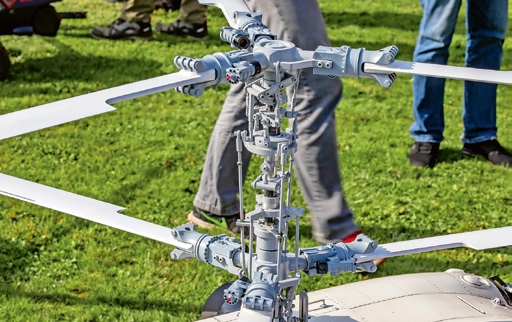
The special coaxial mechanism, developed and manufactured by Helicclassics itself, is delivered partially assembled. The work is limited to mounting the three Futaba BLS 172 SV servos, adjusting the linkages, and fine-tuning all the controls for the two rotor heads. To ensure the model looks right later on, the head was painted in a matching shade of gray after the usual masking work was completed.
A quick note on this special mechanism: In geometry, “coaxial” refers to the alignment of the rotational axes of three-dimensional elements.
The lower rotor circle is driven by a hollow shaft through which the second drive shaft passes to the upper, counter-rotating rotor circle. The lower and upper rotor planes are controlled via control rods connected to the respective three blade holders to adjust the pitch of the rotor blades during rotation. However, the control rods for the upper rotor must be deflected by a second
swashplate between the rotor planes—which is actuated by the main swashplate via separate linkages—in order to account for the opposite direction of rotation. In flight, pitch and roll are controlled via cyclic blade pitch (swashplate), just as in single-rotor helicopters. Rotation about the vertical axis, however, is achieved through opposite collective pitch adjustments between the rotors, so that one rotor generates more lift due to a higher angle of attack, which results in greater drag, thereby transmitting more (counter) torque to the fuselage and thus producing the desired yaw. Since the other rotor, with a proportionally smaller angle of attack, generates less counter-torque, less drag, and also less lift, the total lift is not altered by this method of yaw control, and the helicopter largely maintains its altitude. This is a difficult and highly complex process, but thanks to the extensive experience of Helicclassics’ Matthias Strupf as a supporter, it worked right away. This complex technical description is based in part on textbook material.
| Scale: | 1:4.9 |
| Rotor diameter: | 2×2.50 meters |
| Length: | 2.30 meters |
| Height: | 1.25 meters |
| Takeoff weight: | 38 kilograms |
| Equipment: | Servos: 3× Futaba BLS 172SV; Flybarless system: Bavarian Demon 3X; PowerBox BaseLog with 2× PowerPak 2.5X2 PRO; Receiver: Futaba R7014; Futaba GY701 turbine speed controller, Pahl Taurus 12 turbine, UniLight lighting, Sitar rotor blades |
From the very beginning, Marco Brem was determined that the model should be 99% identical to the real thing. This, of course, includes the appropriate weathering on the model. Unfortunately, most of our “Super Scale” models are painted as if they had just rolled off the manufacturer’s production line and were waiting for their maiden flight. This was definitely not to be the case with the KAMOV KA-32A.
After the usual time-consuming sanding and priming work—with the sanding taking up the bulk of the time—the model was painted with a two-component paint in the colors of the real aircraft. All decals and lettering were also applied.
The next step—the weathering process—required a bit of courage, however, and it took a long time to see the results. All areas that had a
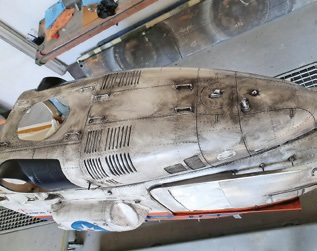
Areas intended to show signs of wear, such as oil stains or traces of use, were generously coated with black oil paint. This paint then had to be wiped away with turpentine until the desired effect was achieved—a task that sometimes seemed never-ending. It is important with this “wiping technique” that the direction of the streak
is carefully studied. A mark that doesn’t fit and points in the wrong direction would later ruin all the painstaking work and the helicopter’s overall appearance. Once the desired effect was achieved, the model was sealed with a clear coat, as usual.
It’s also important to note here that the primer, all the paints, turpentine, and clear coat must be compatible with one another to prevent unsightly color reactions.
After the painting work was completed, the entire interior could be reassembled. Following the adjustments and a test run, the model—which now weighs an impressive 38 kilograms—was submitted to the FOCA for certification. Certification took place in June 2020, and the agency
granted approval for the flight program and the necessary flights without an audience, which were then completed by October 2020.
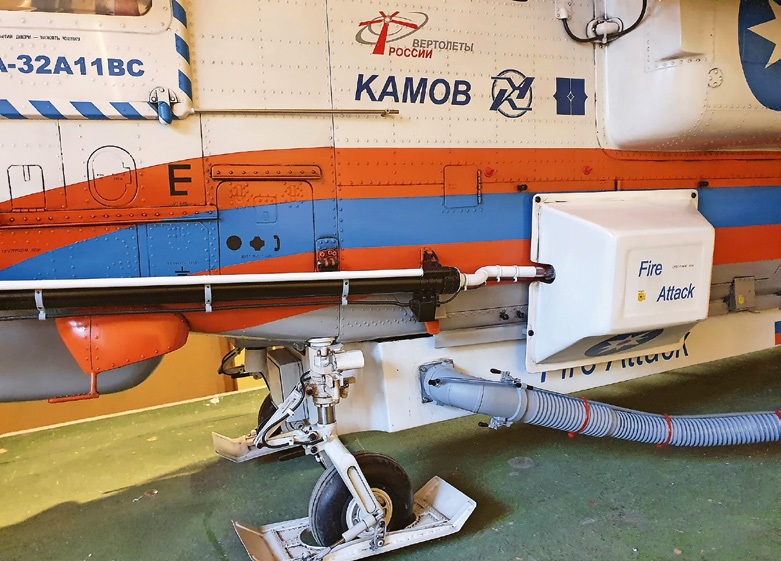
Next came the interior outfitting, including the cockpit and seating in the passenger cabin. A winch and the fire suppression system were custom-built.


News from HEBU

TEAM MANAGER "THIS" BOSSHARD
 Rodito Nussbaumer

YOU KNOW WHAT I MEAN? 125 YEARS OF THE SWISS AERO CLUB
 Emil Giezendanner

F3A EUROPEAN CHAMPIONSHIPS IN ST-MACAIRE, FRANCE
 Matthias Bosshard

HORIZON HOBBY/LEMACO NEWS: MICRO OV-10 BRONCO 645 MM BY E-FLITE

PRIDE AND GOOD IDEAS
 Markus Nussbaumer

34th HAHNENMOOS ALPINE MODEL AIRPLANE CAMP
Res Dauwalder
TRY-OUT DAY AT MFV WETTINGEN
Urs Keller
52. 2026 ALPS CUP
Emil Giezendanner
EURO CONTEST GLIDER ACRO TOUR AUSTRIA 2026

ATOM, THE NEW DOUBLE-DECKER FROM CPLR
Matthias Bosshard
CORSAIR F4U – A WARBIRD WITH A MEMORABLE LOOK
Jürgen Rosenberger, Jürgen Prinz
SUMMER FUN 2026 AT MG USTER
Martin Wunderli
What's New at Leomotion.com

THE PC-21 STORY
Emil Giezendanner
COUPE DES ALPES – OBSERVE AND LEARN
Rodito Nussbaumer
TWIN TOWN PARTNERSHIP
Wolfgang Voeller
BY YOUTH, FOR YOUTH
Lorena Betschen
SMALL, MODEL-LIKE SAILBOATS
Res Dauwalder
WELCOME, NEW MEMBER!
Andrea Bolliger
FREE FLIGHT IN THE MIDDLE OF SUMMER
Urs Muntwyler
INSIGHTS INTO THE HISTORY OF SEAPLANES

NEWS FROM HEBU
 Julia Bucher

FROM 0 TO 100
Markus Nussbaumer
MEMORIES
Wolfgang Völler
NOS REGION – A HUB FOR ELECTRIC AVIATION
Emil Giezendanner
DO YOU KNOW WHAT I MEAN IN THE LAND OF SMILES?
Emil Giezendanner
A SPECTACULAR F3A WORLD CUP IN THE PRINCIPALITY OF LIECHTENSTEIN
Emil Giezendanner